Overview
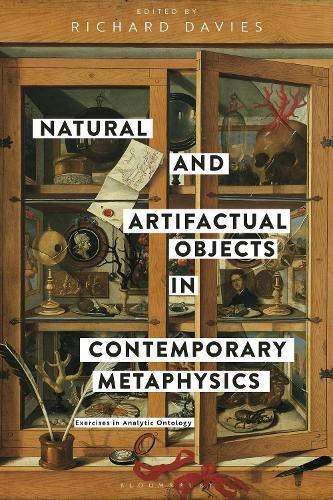
What is an object? How do we look at them? Why do they matter? This collection presents a lively, timely discussion of natural and artifactual objects, considering the relationship between them from a range of philosophical perspectives, including the philosophy of biology, the metaphysics of space and the philosophy of perception. Beginning from the starting point that natural objects are bona fide, endowed with some natural border between themselves and everything else, while artifactual objects depend on the observation of tacit conventions and may include the ordinary objects of everyday life, this volume explores, contextualises and interrogates objects. Contributors discuss a variety of objects including physical, scientific and mental ones, as well as things that appear to question the limits of object-hood, including holes, Quinean ‘posits’ and language. The very first collection to address this growing topic within analytic philosophy, Natural and Artifactual Objects in Contemporary Metaphysics represents a highly original work, showcasing some of the most important and influential philosophers working in Europe today.
Full Product Details
Author: Professor Richard Davies (University of Bergamo, Italy)
Publisher: Bloomsbury Publishing PLC
Imprint: Bloomsbury Academic
Weight: 0.349kg
ISBN: 9781350175433
ISBN 10: 1350175439
Pages: 248
Publication Date: 23 July 2020
Audience:
College/higher education
,
Tertiary & Higher Education
Format: Paperback
Publisher's Status: Active
Availability: Manufactured on demand 
We will order this item for you from a manufactured on demand supplier.
Table of Contents
Introduction: Carving Nature at the Joints, Richard Davies (University of Bergamo, Italy) Part I: Does Nature Carve Itself? 1. Mental acts, externalism and fiat objects: an Ockhamist solution, Riccardo Fedriga (University of Bologna, Italy) 2. Is the World really a World of Objects? A Note on Quinean Ontology, Antonio Rainone ( L'Orientale University of Naples, Italy) 3. Spatial Fictionalism. A Solution of the Grounding Problem, Nicola Piras (University of Sassari, Italy) 4. Talking about Properties: A Couple of Doubts about Hofweber's Internalist View, Elisa Paganini (State University of Milan, Italy) Part II: Where Do Limits Lie? 5. The Eye of the Needle: Seeing Holes, Clotilde Calabi (State University of Milan, Italy) 6. Bona Fideness of Material Entities and their Boundaries, Lars Vogt (University of Bonn, Germany) 7. A Conceptualist View in the Metaphysics of Species, Ciro De Florio and Aldo Frigerio (both Catholic University of Milan, Italy) Part III: Where Do Tools Come From? 8. Artifacts and fiat objects: two families apart?, Massimiliano Carrara and Marzia Soavi (both University of Padua, Italy) 9. The Semantics of Artifactual Words, Marco Santambrogio (University of Parma, Italy) 10. Are linguistic objects fiat or bona fide? An ancient proposal, Maddalena Bonelli (University of Bergamo, Italy) Part IV: What Does Mind-Dependency Depend On? 11. Leibniz's principle and psycho-neural identity, Andrea Bottani and Alfredo Paternoster (both University of Bergamo, Italy) 12. Do we exist? Mereological nihilism, collective thinking and dualism, Alfredo Tomasetta (University School for Advanced Studies IUSS, Pavia) Abstracts Index of Names Index of Principal Subjects
Reviews
The 13 essays Davies (Univ. of Bergamo, Italy) has gathered discuss problems arising from the distinction between natural and nonnatural objects and between language-the supreme human artifact-and language-indifferent nature ... Summing Up: Recommended. Researchers and faculty. * CHOICE * When philosophers deal with ontology, they still turn their attentions primarily to ideal worlds constructed out of sets, or bare particulars, or atomless gunk. Outside philosophy, in contrast, ontology is being vigorously applied to real-world problems in areas such as genomics, engineering design, materials science or geopolitics. This groundbreaking volume is the first major study of the philosophical issues brought to light by this new applied ontology. It will be an indispensable resource for the work that is to come. * Barry Smith, Director of National Center for Ontological Research, State University of New York at Buffalo, USA * Everybody agrees: there is a big difference between the natural and the artifactual, between the mind-independent features of reality and the products of our worldmaking practices. The challenge, as the essays in this book admirably show, is where to draw the line, and how to do so without begging the question. A rich, engaging, highly original contribution to the classical debate between metaphysical realism and constructivism. * Achille C. Varzi, Professor of Philosophy, Columbia University, USA *
The 13 essays Davies (Univ. of Bergamo, Italy) has gathered discuss problems arising from the distinction between natural and nonnatural objects and between language—the supreme human artifact—and language-indifferent nature … Summing Up: Recommended. Researchers and faculty. * CHOICE * When philosophers deal with ontology, they still turn their attentions primarily to ideal worlds constructed out of sets, or bare particulars, or atomless gunk. Outside philosophy, in contrast, ontology is being vigorously applied to real-world problems in areas such as genomics, engineering design, materials science or geopolitics. This groundbreaking volume is the first major study of the philosophical issues brought to light by this new applied ontology. It will be an indispensable resource for the work that is to come. * Barry Smith, Director of National Center for Ontological Research, State University of New York at Buffalo, USA * Everybody agrees: there is a big difference between the natural and the artifactual, between the mind-independent features of reality and the products of our worldmaking practices. The challenge, as the essays in this book admirably show, is where to draw the line, and how to do so without begging the question. A rich, engaging, highly original contribution to the classical debate between metaphysical realism and constructivism. * Achille C. Varzi, Professor of Philosophy, Columbia University, USA *
Author Information
Richard Davies is a Professor of Philosophy at University of Bergamo, Italy.
Tab Content 6
Author Website:
Countries Available
All regions
|