Overview
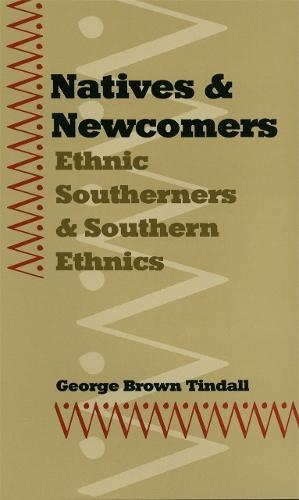
In Natives and Newcomers, George Brown Tindall surveys the changes in the South's cultural and racial makeup over the past two centuries. Tindall discusses southern ethnicity in light of immigration laws and trends, attitudes toward immigrants, and economic and political forces that have changed the region's ethnic makeup from within (such as the Civil War) or without (such as Castro's rise to power in Cuba). Tindall shows that the colonial South developed the most polyglot population in the English colonies, encompassing Indian tribes, Western Europeans, and West Africans. The southern and western rims of the South, moreover, were adjoined by Spanish and French colonies into the nineteenth century. After the American Revolution, fewer immigrants came south, Indians were largely expelled, the slave trade subsided—and southerners of whatever color came to be almost wholly native-born. A single group of ethnic southerners with white and black subgroups emerged—subgroups that had more in common, Tindall observes, than they cared always to admit. After World War II a trend toward greater diversity reemerged when newcomers from abroad (primarily Hispanic, Caribbean, and Asian people) and from other regions in the United States began entering the South in greater proportions than at any other time since the colonial period. Immigrants living in the South now account for 23.2 percent of the total United States immigrant population, Tindall points out. ""Now, just over two hundred years after the birth of the Cotton Belt and one hundred years after the birth of the New South,"" he concludes, ""the conviction grows that the region is at a new conjuncture in its history. One thing seems already clear about the post-New South. The shades of the Sunbelt will no longer be a simple matter of black and white. They will span a much broader spectrum of color.""
Full Product Details
Author: George Brown Tindall
Publisher: University of Georgia Press
Imprint: University of Georgia Press
Volume: No. 3
Dimensions:
Width: 12.70cm
, Height: 1.50cm
, Length: 20.30cm
Weight: 0.272kg
ISBN: 9780820316550
ISBN 10: 0820316555
Pages: 96
Publication Date: 01 January 1995
Audience:
College/higher education
,
Undergraduate
,
Postgraduate, Research & Scholarly
Format: Hardback
Publisher's Status: Active
Availability: Out of stock

The supplier is temporarily out of stock of this item. It will be ordered for you on backorder and shipped when it becomes available.
Language: English
Reviews
A compelling argument that over its history the South changed from a polyglot society into two homogeneous ones divided by race, but that in recent decades the region has been rapidly acquiring a new ethnic diversity. . . . Tindall eruditely shatters stereotypes about the South, drawing a picture of a region that is at once distinctive and much like the rest of the U.S. in its diversity. --Kirkus Reviews
A compelling argument that over its history the South changed from a polyglot society into two homogeneous ones divided by race, but that in recent decades the region has been rapidly acquiring a new ethnic diversity. . . . Tindall eruditely shatters stereotypes about the South, drawing a picture of a region that is at once distinctive and much like the rest of the U.S. in its diversity.
A compelling argument that over its history the South changed from a polyglot society into two homogeneous ones divided by race, but that in recent decades the region has been rapidly acquiring a new ethnic diversity. Tindall (History/Univ. of North Carolina; America, 1984) develops this thesis in three short pieces drawn from his 1992 Averitt lectures at Georgia Southern University. In the first, Natives and Newcomers, Tindall gives an overview of the surprisingly diverse social composition of the South from the time of the first European settlers through modern times. The pervasive presence of African-Americans and Indians, Scotch-Irish settlers, English colonists, Louisiana Cajuns, and German Protestants seeking religious freedom gave the 18th-century South, in Tindall's view, the most polyglot population in the English colonies. After the Revolution, Indians were expelled from the Southeastern states and far fewer new immigrants settled in the South than in the North. In Ethnic Southerners, Tindall traces the growth of a distinctive southern ethnicity from the colonial period to the 20th century. The regional identity of southern people, he asserts, grew both out of the ethnic traditions they brought with them and out of perceived contrasts with other regions of the country in lifestyle, custom, and outlook. In Southern Ethnics, Tindall looks at the modern phenomenon of foreign immigration to the South. He points out that, in recent decades, more people have moved into the region than have moved out: from Southeast Asia, Latin America, and the northern states. Tindall anticipates that the nativism, xenophobia, and political tension that met earlier waves of immigration to the US may occur in the modern South, but that the diverse cultures of the new southern ethnics will ultimately enrich their region. Tindall eruditely shatters stereotypes about the South, drawing a picture of a region that is at once distinctive and much like the rest of the US in its diversity. (Kirkus Reviews)
A compelling argument that over its history the South changed from a polyglot society into two homogeneous ones divided by race, but that in recent decades the region has been rapidly acquiring a new ethnic diversity. . . . Tindall eruditely shatters stereotypes about the South, drawing a picture of a region that is at once distinctive and much like the rest of the U.S. in its diversity. -- Kirkus Reviews
Author Information
GEORGE BROWN TINDALL is Kenan Professor of History Emeritus at the University of North Carolina. A former president of the Southern Historical Association, he is the author of numerous books, including America: A Narrative History, The Ethnic Southerners, The Emergence of the New South, 1913-1945, and The Disruption of the Solid South.