|
|
|||
|
||||
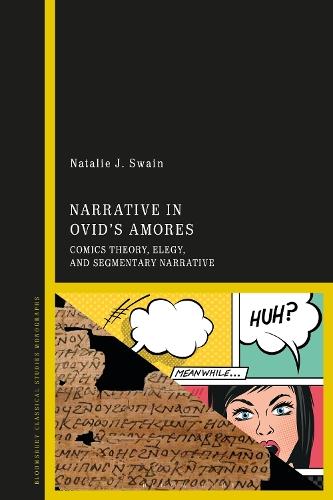
OverviewHow are comics and Latin elegy related? Comics tell their stories by placing individual images in a sequence, and Latin elegy builds narrative through sequence, encouraging readers to connect poems in order to reveal narrativity. Despite this, there has yet to be a definitive methodology that inspires readers to examine the function of this narrative tool. Examining Ovid’s Amores, Swain argues a comics-based methodology can offer us important new insights into the ancient genre of Latin elegy. This book applies theories such as the gutter (the space that exists between two comics panels), Groensteen’s braiding (the interaction of panels outside of a linear sequence), and the comics page-turn, all to release new readings that reveal the narrative found across the three books of this text. By analysing the way that Ovid creates a complex narrative mosaic in which key characters and motifs repeat across poems, this book explores how story segments are connected into a larger unified narrative. Full Product DetailsAuthor: Natalie Swain (Acadia University, Canada)Publisher: Bloomsbury Publishing PLC Imprint: Bloomsbury Academic Dimensions: Width: 15.60cm , Height: 2.50cm , Length: 23.40cm Weight: 0.454kg ISBN: 9781350407244ISBN 10: 1350407240 Pages: 208 Publication Date: 08 January 2026 Audience: College/higher education , Postgraduate, Research & Scholarly Format: Hardback Publisher's Status: Forthcoming Availability: Manufactured on demand Table of ContentsIntroduction Chapter 1: Reading the Elegiac Gutter Chapter 2: Turn the Page: Splash-Pages & Elegiac Framing Chapter 3: Braiding Narrative Motifs (“Innertextuality”) Chapter 4: An Exception that Proves the Rule Conclusion Notes Bibliography IndexReviewsNatalie Swain's book shows an admirable grasp of recent scholarship on elegiac narrativity, as the author guides her readers through a new understanding of Ovid's Amores, one shaped by astute, nuanced analysis of the intertextual and innertextual resonance that leads from one narrative moment to the next. Her use of a comics based methodology, with its concentrated attention on the ancient material conditions of reading, will surely inspire new approaches to a much broader range of Latin poetry. -- Hunter Gardner, Professor of Classics, University of South Carolina, USA Author InformationNatalie J. Swain is an Instructor in Classics at the University of Winnipeg, Canada. She has published on Latin literature and the reception of the ancient Mediterranean world in comics. Tab Content 6Author Website:Countries AvailableAll regions |
||||