Overview
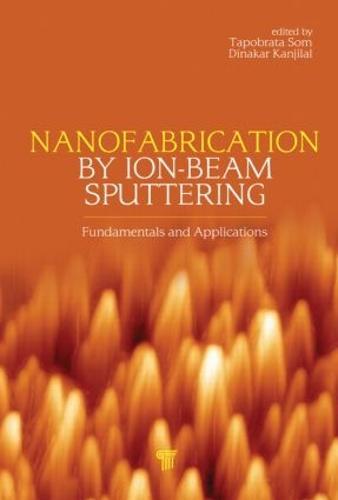
Considerable attention has been paid to ion beam sputtering as an effective way to fabricate self-organized nano-patterns on various substrates. The significance of this method for patterning surfaces is that the technique is fast, simple, and less expensive. The possibility to create patterns on very large areas at once makes it even more attractive. This book reviews various fascinating results, understand the underlying physics of ion induced pattern formation, to highlight the potential applications of the patterned surfaces, and to explore the patterning behavior by different irradiation parameters in order to create desired surface morphologies on specific materials.
Full Product Details
Author: Tapobrata Som ,
Dinakar Kanjilal
Publisher: Pan Stanford Publishing Pte Ltd
Imprint: Pan Stanford Publishing Pte Ltd
Dimensions:
Width: 15.20cm
, Height: 2.50cm
, Length: 22.90cm
Weight: 0.657kg
ISBN: 9789814303750
ISBN 10: 9814303755
Pages: 372
Publication Date: 27 November 2012
Audience:
College/higher education
,
Professional and scholarly
,
Tertiary & Higher Education
,
Professional & Vocational
Format: Hardback
Publisher's Status: Active
Availability: Manufactured on demand

We will order this item for you from a manufactured on demand supplier.
Reviews
""This volume provides a remarkable overview of the status of the evolving field of ion-beam sputtering and its promising applications as a process tool for tailoring self-organized patterned properties and periodic nanoscale topographic features of surfaces. The topical scope includes the fundamental physics of sputtering, advanced simulations of pattern formation, and selected experimental applications. The list of authors includes distinguished authorities in this field, and the book will surely become a highly cited reference source, as future manufacturing technologies develop."" —Dr. J. E. E. Baglin - IBM Almaden Research Center, USA ""Since the inception of nanotechnology in the 1970s, low-energy ion-beam sputtering of solids has been expected to rank among the top routes to nanostructures fabrication. In spite of the development that this technique has since undergone, to date a thorough revision is under way on the basic mechanisms controlling the pattern formation process, key to a full control of its practical implications. This book provides a broad and timely view of the topic through contributions by world-class specialists, from atomistic principles and discrete theoretical modeling to experiments and technological applications. It will be invaluable for both practitioners in the field and anyone interested in nanoscience, to assess the degree to which current developments enable the harnessing of the technique that is up to the well-founded expectations."" —Prof. Rodolfo Cuerno - Universidad Carlos III de Madrid, Spain ""Bombarding a solid surface with a broad ion beam can produce a remarkable variety of self-assembled nanoscale patterns, including periodic height modulations or ""ripples"" and mounds arranged in hexagonal arrays of astonishing regularity. This book gives a comprehensive overview of our current understanding of these intriguing phenomena. Written by leaders in the field, it covers both theoretical and experimental work, and the topics range from the fundamental to the applied. This volume will be an invaluable reference for both researchers in the field and those who are new to the topic."" —Prof. R. Mark Bradley - Colorado State University, USA
This volume provides a remarkable overview of the status of the evolving field of ion-beam sputtering and its promising applications as a process tool for tailoring self-organized patterned properties and periodic nanoscale topographic features of surfaces. The topical scope includes the fundamental physics of sputtering, advanced simulations of pattern formation, and selected experimental applications. The list of authors includes distinguished authorities in this field, and the book will surely become a highly cited reference source, as future manufacturing technologies develop. -Dr. J. E. E. Baglin - IBM Almaden Research Center, USA Since the inception of nanotechnology in the 1970s, low-energy ion-beam sputtering of solids has been expected to rank among the top routes to nanostructures fabrication. In spite of the development that this technique has since undergone, to date a thorough revision is under way on the basic mechanisms controlling the pattern formation process, key to a full control of its practical implications. This book provides a broad and timely view of the topic through contributions by world-class specialists, from atomistic principles and discrete theoretical modeling to experiments and technological applications. It will be invaluable for both practitioners in the field and anyone interested in nanoscience, to assess the degree to which current developments enable the harnessing of the technique that is up to the well-founded expectations. -Prof. Rodolfo Cuerno - Universidad Carlos III de Madrid, Spain Bombarding a solid surface with a broad ion beam can produce a remarkable variety of self-assembled nanoscale patterns, including periodic height modulations or ripples and mounds arranged in hexagonal arrays of astonishing regularity. This book gives a comprehensive overview of our current understanding of these intriguing phenomena. Written by leaders in the field, it covers both theoretical and experimental work, and the topics range from the fundamental to the applied. This volume will be an invaluable reference for both researchers in the field and those who are new to the topic. -Prof. R. Mark Bradley - Colorado State University, USA
This volume provides a remarkable overview of the status of the evolving field of ion-beam sputtering and its promising applications as a process tool for tailoring self-organized patterned properties and periodic nanoscale topographic features of surfaces. The topical scope includes the fundamental physics of sputtering, advanced simulations of pattern formation, and selected experimental applications. The list of authors includes distinguished authorities in this field, and the book will surely become a highly cited reference source, as future manufacturing technologies develop. -Dr. J. E. E. Baglin - IBM Almaden Research Center, USA Since the inception of nanotechnology in the 1970s, low-energy ion-beam sputtering of solids has been expected to rank among the top routes to nanostructures fabrication. In spite of the development that this technique has since undergone, to date a thorough revision is under way on the basic mechanisms controlling the pattern formation process, key to a full control of its practical implications. This book provides a broad and timely view of the topic through contributions by world-class specialists, from atomistic principles and discrete theoretical modeling to experiments and technological applications. It will be invaluable for both practitioners in the field and anyone interested in nanoscience, to assess the degree to which current developments enable the harnessing of the technique that is up to the well-founded expectations. -Prof. Rodolfo Cuerno - Universidad Carlos III de Madrid, Spain Bombarding a solid surface with a broad ion beam can produce a remarkable variety of self-assembled nanoscale patterns, including periodic height modulations or ripples and mounds arranged in hexagonal arrays of astonishing regularity. This book gives a comprehensive overview of our current understanding of these intriguing phenomena. Written by leaders in the field, it covers both theoretical and experimental work, and the topics range from the fundamental to the applied. This volume will be an invaluable reference for both researchers in the field and those who are new to the topic. -Prof. R. Mark Bradley - Colorado State University, USA
This volume provides a remarkable overview of the status of the evolving field of ion-beam sputtering and its promising applications as a process tool for tailoring self-organized patterned properties and periodic nanoscale topographic features of surfaces. The topical scope includes the fundamental physics of sputtering, advanced simulations of pattern formation, and selected experimental applications. The list of authors includes distinguished authorities in this field, and the book will surely become a highly cited reference source, as future manufacturing technologies develop. -Dr. J. E. E. Baglin - IBM Almaden Research Center, USA Since the inception of nanotechnology in the 1970s, low-energy ion-beam sputtering of solids has been expected to rank among the top routes to nanostructures fabrication. In spite of the development that this technique has since undergone, to date a thorough revision is under way on the basic mechanisms controlling the pattern formation process, key to a full control of its practical implications. This book provides a broad and timely view of the topic through contributions by world-class specialists, from atomistic principles and discrete theoretical modeling to experiments and technological applications. It will be invaluable for both practitioners in the field and anyone interested in nanoscience, to assess the degree to which current developments enable the harnessing of the technique that is up to the well-founded expectations. -Prof. Rodolfo Cuerno - Universidad Carlos III de Madrid, Spain Bombarding a solid surface with a broad ion beam can produce a remarkable variety of self-assembled nanoscale patterns, including periodic height modulations or ripples and mounds arranged in hexagonal arrays of astonishing regularity. This book gives a comprehensive overview of our current understanding of these intriguing phenomena. Written by leaders in the field, it covers both theoretical and experimental work, and the topics range from the fundamental to the applied. This volume will be an invaluable reference for both researchers in the field and those who are new to the topic. -Prof. R. Mark Bradley - Colorado State University, USA
Author Information
Tapobrata Som, Dinakar Kanjilal