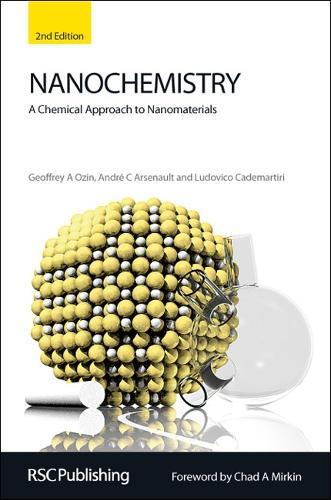
Full Product Details
Author: Geoffrey A Ozin (University of Toronto, Canada) ,
André Arsenault (Opalux Inc, Canada) ,
Ludovico Cademartiri (Iowa State University, USA) ,
Chad A Mirkin (Northwestern University)
Publisher: Royal Society of Chemistry
Imprint: Royal Society of Chemistry
Edition: 2nd edition
Dimensions:
Width: 15.60cm
, Height: 4.80cm
, Length: 23.40cm
Weight: 1.463kg
ISBN: 9781847558954
ISBN 10: 184755895
Pages: 874
Publication Date: 12 December 2008
Audience:
Professional and scholarly
,
Professional & Vocational
Format: Hardback
Publisher's Status: Active
Availability: In Print

This item will be ordered in for you from one of our suppliers. Upon receipt, we will promptly dispatch it out to you. For in store availability, please contact us.
Reviews
...this second edition is not only highly current and accessible, it is full of insights and ideas. I highly recommend this book. -- Education in Chemistry, Lee Cronin Education in Chemistry The book provides a very comprehensive description of various methodologies to fabricate, manipulate and characterize a large arsenal of nanomaterials. The readability is further improved by a large use of nice pictures and fabrication schemes, often in full colour. ...this book is well suited to be used as a textbook in nanoscience and nanotechnology and as a reference book for nano-researchers, being a very rich encyclopedia on the nanochemistry approaches. -- Materials Today, Vincenzo Palermo Materials Today
Reviews from the First Edition: <p> A central goal of nanotechnology is to make useful materials and devices through assembly and patterning of nanoscale building blocks. In this book, Ozin and Arsenault review the concepts and methods involved in synthesizing nanoscale building blocks with controlled size, shape, structure and composition. They further illustrate many techniques that have been developed to organize and integrate nanoscale building blocks into functional architectures and systems via self-assembly, templating, and lithography. Ozin is a veteran in nanochemistry, who published a widely cited review article on this subject in Advanced Materials (1992, 4, pp. 612-649) more than one decade ago. Written for an interdisciplinary audience, the authors of this book relate the basic concept of recent advances in simple terms with many pictures, few equations and little technical jargon. A series of open-ended questions after each chapter challenges the reader to creatively solve a problem with the concepts just learned. There are pertinent discussions of nanomaterials safety, and even a list of Nanolab experiments for the ambitious. <p>.,. Nanochemistry will be an invaluable reference book for undergraduate and graduate students looking for an easy way to educate themselves with the up-to-date advances made in chemical patterning, self-assembly, and nanomaterial synthesis. It could also serve as a superb textbook for teaching of materials chemistry and nanotechnology... it accomplishes its goal of familiarizing the reader with the nanochemistry of today, and encourages the creative thinking necessary to develop the nanochemistry of tomorrow. (Benjamin Wiley and Prof.Younan Xia, ADVANCED MATERIALS, 2006) <p> Nanotechnology is very interdisciplinary. It involves methods borrowed from physics, chemistry and biology, and has ambitions that reach deep into medicine and engineering, to name but a few of the disciplines it spans. With this breadth of the topic comes a communication challenge, because specialists trained in any of these disciplines will have to forgo their specific jargon and make themselves understood by nanoenthusiasts with a different background. <p> Following several attempts by physicists and application-oriented people, this appears to be the first textbook of the new nanosciences written from the perspective of chemists. Based on a course he developed at the University of Toronto, Geoffrey Ozin wrote this text with his student, AndrA(c) Arsenault. The result comes lavishly equipped with many full-colour illustrations, some 2000 references, lists of thoughtful questions, and home-made cartoons. <p> The bulkiest of the 13 chapters covers one-dimensional nano constructs such as rods, tubes and wires. Other chapters are dedicated to topics such as microspheres, nanoclusters, and printing techniques. Biologically inspired approaches, no matter whether structural or functional, are together in one chapter towards the end. An intriguing miscellany of interesting topics is stowed away in seven appendices. All in all this is a brave effort to capture a very fast-moving young research field and tie it up in a text book format. (Michael Gross, CHEMISTRY WORLD, January 2006) <p> Two excellent features of the book make it a useful, practical tool for teachers of materials chemistry, to this reviewer's joy. Ozin emphasizes his close ties withindustry that resulted in numerous inventions and technology transfer and this is reflected in the presence of 20 outline experiments at the end of the book; in addition, questions and problems are inserted at the end of each chapter. The book, after all, emerges from a thorough assembly of Ozin's lecture notes at the University of Toronto. <p> In a self organizing system of materials Ozin and Arsenault continue a particular architecture forms spontaneously with a structural design which is determined by size and shape of the individual nanocomponents and by the map of bonding forces between them. In the glorious European tradition of science teaching, Ozin (a native of London who studied at Oxford) refers extensively to the historic development of materials chemistry. Thus, for instance, Harting's work with biomineral formation (1873) and the classic 1917 Of Growth and Form of D'Arcy Thomson on the same topic find plenty of space in this textbook, showing how the effort to apply physico-geometrical principles to explain morphogenesis in the study of natural materials has been a constant driving force of scientific thought, of which modern materials chemistry is clearly a continuation. (Mario Pagliaro, THE CHEMICAL EDUCATOR, January 2006) <p> [T]his book is well worth buying. It is a kaleidoscopic compendium of the achievements of chemists working with materials scientists and physicists. (Trevor Rayment, LONDON TIMES HIGHER EDUCATION SUPPLEMENT, 24th February 2006)
Author Information
Geoffrey A Ozin obtained his undergraduate degree at Kings College London and his graduate degree at Oriel College Oxford. Following post-doctoral research as an ICI Fellow at Southampton University he joined the University of Toronto where he is now Government of Canada Research Chair in Materials Chemistry and University Professor. He is also Honorary Professor at The Royal Institution of Great Britain and University College London, as well as a Member of the London Centre for Nanotechnology. Andre C Arsenault is Chief Technology Officer and cofounder of Opalux Inc., a Toronto-based company developing products based on opal technology. He completed his honours degree in Biological Chemistry at the University of Toronto in 2001 followed by a PhD in the groups of Geoffrey A. Ozin and Ian Manners in 2006. He is currently the author of 21 scientific publications, and the holder of one US patent. His work has appeared several times in the news media. Ludovico Cademartiri is a PhD student in the group of Geoffrey A. Ozin at the University of Toronto. He completed his Laurea cum laude in Materials Science at the University of Parma, Italy in 2002 before joining the graduate program in interdisciplinary chemistry at the University of Toronto. He is the author of 12 scientific publications and has been awarded the CRC Graduate Prize in Chemistry and the CSC DIC Prize for Graduate Work in Inorganic Chemistry. He is currently working on his Postdoctural fellowship with Professor George Whitesides at Harvard University.