Overview
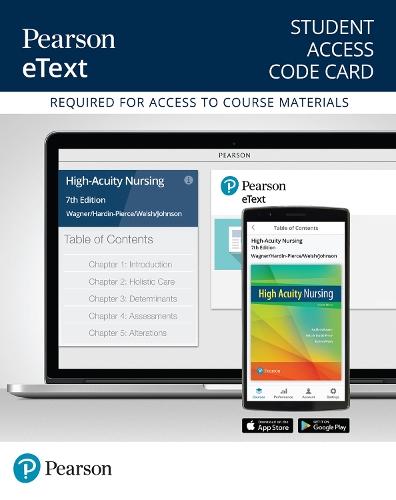
Complete guide to high-acuity nursing in all care settings High-Acuity Nursing provides a comprehensive knowledge set needed to care for adult patients with complex, unpredictable conditions across settings, from high-skill, long-term facilities to critical care units. Focusing on the relationship between pathophysiology and the nursing process, the text encourages students to think critically to reach optimal clinical decisions for high-acuity patients. All chapters in the 7th Edition have been updated and many have been reorganized and expanded. A new chapter focuses on palliative care and end-of-life issues, and new features address quality and safety, along with genetic considerations. For courses in critical care, acute care nursing, and as a supplemental text in advanced medical-surgical nursing. Pearson eText is an easy-to-use digital textbook that you can purchase on your own or instructors can assign for their course. The mobile app lets you keep on learning, no matter where your day takes you, even offline. You can also add highlights, bookmarks, and notes in your Pearson eText to study how you like. NOTE: This ISBN is for the Pearson eText access card. Pearson eText is a fully digital delivery of Pearson content. Before purchasing, check that you have the correct ISBN. To register for and use Pearson eText, you may also need a course invite link, which your instructor will provide. Follow the instructions provided on the access card to learn more.
Full Product Details
Author: Kathleen Wagner, RN, MSN, CS ,
Melanie Hardin-Pierce ,
Darlene Welsh ,
Karen Johnson, RN, PhD, CCRN
Publisher: Pearson Education (US)
Imprint: Pearson
Edition: 7th edition
Weight: 0.030kg
ISBN: 9780134880150
ISBN 10: 0134880153
Pages: 1080
Publication Date: 09 October 2018
Audience:
College/higher education
,
Tertiary & Higher Education
Format: Undefined
Publisher's Status: Active
Availability: Available To Order

We have confirmation that this item is in stock with the supplier. It will be ordered in for you and dispatched immediately.
Author Information
Kathleen Wagner, EdD, MSN, RN, is now faculty emerita, having recently retired from the University of Kentucky College of Nursing after many years of teaching pathophysiology, pathopharmacology, and high-acuity nursing to undergraduate nursing students. She was also the educational consultant for the Undergraduate Nursing Program at the University of Kentucky. She has a doctorate in instructional systems design and continues to work on a team developing web-based clinical simulations for nursing students. Melanie Hardin-Pierce, DNP, RN, APRN, ACNP-BC, is a tenured associate professor in the University of Kentucky College of Nursing, where she has over 30 years of experience as a critical care nurse and has taught high-acuity nursing to undergraduate and graduate nursing students. She currently teaches in the Doctor of Nursing Practice program and is the Coordinator of the Adult Geriatric Acute Care Nurse Practitioner DNP Option. In addition to teaching, she has been active in curriculum development in both baccalaureate and graduate nursing programs. She earned her Doctor of Nursing Practice degree at the University of Kentucky, having studied oral health in mechanically ventilated patients. She is a board-certified acute care nurse practitioner who practices as a critical care intensivist in the Veterans Health Administration Medical Center, Cooper Drive Division, Lexington. She is active in research of critically ill, mechanically ventilated patients; evidence-based practice; and interdisciplinary collaboration. Darlene Welsh, PhD, MSN, RN, is Associate Professor, BSN Program Director, and Assistant Dean of Undergraduate Faculty Affairs at the University of Kentucky College of Nursing. Dr. Welsh earned a PhD in Educational Psychology and an MS in Nursing from the University of Kentucky. Her experiences in the care of critically ill patients include direct patient care, the conduct of research, and supervision of undergraduate and graduate students. Her research interests center on the provision of dietary instruction for patients with heart failure and interprofessional education for clinicians.