Overview
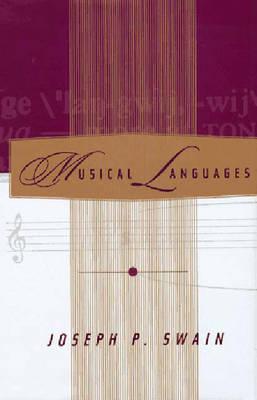
How is music like language, and so what if it is? Using this double-barreled question as a starting point, Joseph P. Swain takes us to the fascinating crossroads where the philosophy and theory of music meet the worlds of linguistics, perception, cognition, meaning, and even poetry. In Musical Languages, Swain revisits the age-old analogy between music and language in light of the latest advances in modern linguistics and cognitive psychology. The author examines the aptness of the analogy and the degree to which it can be stretched, not only demonstrating the essential similarities between music and language but also exposing where the analogy breaks down. This book picks up where Leonard Bernstein's The Unanswered Question leaves off, rendering the ubiquitous expression musical language fresh once again.
Full Product Details
Author: Joseph P. Swain
Publisher: WW Norton & Co
Imprint: WW Norton & Co
Dimensions:
Width: 24.00cm
, Height: 2.40cm
, Length: 16.00cm
Weight: 0.506kg
ISBN: 9780393040791
ISBN 10: 0393040798
Pages: 240
Publication Date: 17 August 1997
Audience:
College/higher education
,
Professional and scholarly
,
Undergraduate
,
Postgraduate, Research & Scholarly
Format: Hardback
Publisher's Status: Out of Print
Availability: Awaiting stock

Reviews
A dense, evocative, rewarding journey to the no-man's-land between the realms of music and language. Award-winning music scholar Swain (Colgate Univ.) has written a brave, boundary-breaking book for musical theorists and for those linguists with an excellent music education. Everyone else, however, will have to rely on their gut feelings that a great piece of music has spoken to them or that a poem in a foreign language had music that moved them - two points well explored here. Swain builds an eloquent case for comparing music and spoken language, establishing how musical elements are gathered and understood like speech elements; how that understanding is specific to a community of speakers and listeners; how the meaning of music may now broaden and now narrow, ever responsive to its context; how composers can use that context to teach their listeners to hear syntax that endures but for one piece, an ephemeral syntax that is music's answer to metaphor; how composers have imitated linguistic idealists in the production of artificial systems in our century; how music and language have similarly evolved. Swain's sentences are not usually this long, but this opening of his eighth and final chapter encapsulates much of the ambitious theorizing that goes on here. Just when we feel the author is stretching a point, he strikes a familiar note with insights such as his observation that we are much more forgiving of syntactic errors in the performance of natural language than in music. Swain also scores points when comparing the untranslatable quality of musically significant poems to the formless, unpredictable blur of sound of a foreign musical language. Such high-altitude mountain climbing is not for everyone, but this is a landmark expedition in the exploration of the upper reaches of human communication. (Kirkus Reviews)
Author Information
Joseph P. Swain is associate professor of music and head of the music theory curriculum at Colgate University in Hamilton, New York. He has written on an unusually wide range of subjects and is the author of two earlier books: Sound Judgment: Basic Ideas about Music and The Broadway Musical: A Critical Study, the 1991 winner of a Deems Taylor Award for excellence in writing about music.