Overview
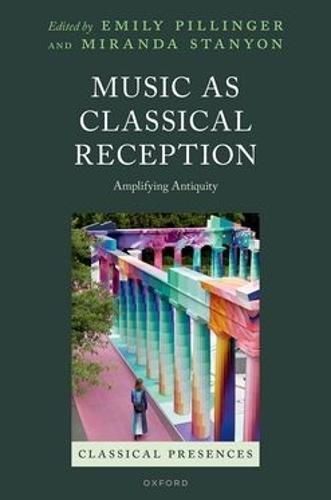
Musical as Classical Reception: Amplifying Antiquity investigates music as a site of classical reception from the early modern rise of opera to contemporary hip-hop. The volume's contributors explore topics across musical genres and classical sources--myth, epic, lyric, history, philosophy, archaeology--to demonstrate the enduring importance of music to engagements with classical antiquity, and vice versa. The wealth of music inspired by ancient Greece and Rome rests on an apparent paradox: compared with visual art, linguistic texts, or even material culture and architecture, precious little remains of ancient music, and what traces have remained are not audible in any straightforward sense; nonetheless, classical antiquity has provoked and permitted an extraordinary variety and volume of musical receptions. This edited collection offers case studies of the generative encounter between antiquity and later music makers, but also asks how new sounds are imagined as emerging from near-silence. Can a reception not only echo the past, but make the past louder, turning up the volume on what is currently muted or inaudible? In short, what does it mean to amplify antiquity? The volume proposes amplification as a new model for reception studies with relevance to the wider field, as a set of technologies, a rhetorical technique, and a sonic concept. Drawing on classics, music, sound studies, literary studies, and intellectual and cultural history, the chapters explore three different modes and contexts of reception: musical settings of ancient words; musical reimaginings of ancient lives, ideas, and myths; and the expansive and sometimes oblique encounters with Graeco-Roman antiquity that are powered by electric amplification and the media changes that come in its wake.
Full Product Details
Author: Emily Pillinger (Reader in Classics and Interdisciplinary Humanities, Reader in Classics and Interdisciplinary Humanities, King's College London) ,
Miranda Stanyon (Senior Lecturer in English Literature, Senior Lecturer in English Literature, University of Melbourne)
Publisher: Oxford University Press
Imprint: Oxford University Press
ISBN: 9780198957997
ISBN 10: 0198957998
Pages: 320
Publication Date: 18 December 2025
Audience:
College/higher education
,
Professional and scholarly
,
Postgraduate, Research & Scholarly
,
Professional & Vocational
Format: Hardback
Publisher's Status: Forthcoming
Availability: To order

Author Information
Miranda Stanyon is Senior Lecturer in English at the University of Melbourne, where her research is supported by an Australian Research Council DECRA. She received her doctorate from QMUL and held a Junior Research Fellowship at Cambridge, before joining King's College London as a Lecturer in Comparative Literature. Her work has appeared in Research in English Studies, Modern Philology, Huntington Library Quarterly, Journal of the Royal Musical Association, and Transactions of the Royal Historical Society, and she is co-editor of Music and the Sonorous Sublime in European Culture (Cambridge, 2020) and author of Resounding the Sublime (Pennsylvania, 2021). Emily Pillinger is Senior Lecturer in Classics and Liberal Arts at King's College London. She studied at Oxford and recerived a PhD at Princeton. She has held positions in the UK and USA as a teaching fellow (Marlboro College), postdoctoral researcher (Bristol), and lecturer (Oxford). She is the author of Cassandra and the Poetics of Prophecy (Cambridge, 2019). She has also studied the reception of Graeco-Roman myth in twentieth and twenty-first century music, publishing on Britten, Tippett, Xenakis, and Turnage. She has been engaging in creative music practice as research through the AHRC-funded project Penelope's Web.