Overview
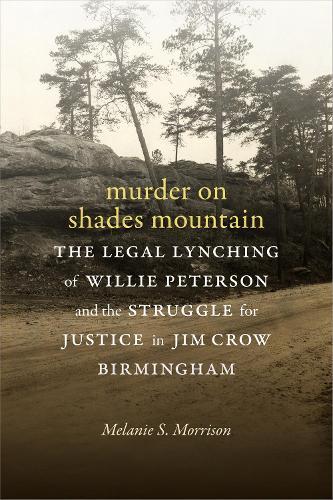
One August night in 1931, on a secluded mountain ridge overlooking Birmingham, Alabama, three young white women were brutally attacked. The sole survivor, Nell Williams, age eighteen, said a black man had held the women captive for four hours before shooting them and disappearing into the woods. That same night, a reign of terror was unleashed on Birmingham's black community: black businesses were set ablaze, posses of armed white men roamed the streets, and dozens of black men were arrested in the largest manhunt in Jefferson County history. Weeks later, Nell identified Willie Peterson as the attacker who killed her sister Augusta and their friend Jennie Wood. With the exception of being black, Peterson bore little resemblance to the description Nell gave the police. An all-white jury convicted Peterson of murder and sentenced him to death. In Murder on Shades Mountain Melanie S. Morrison tells the gripping and tragic story of the attack and its aftermath-events that shook Birmingham to its core. Having first heard the story from her father-who dated Nell's youngest sister when he was a teenager-Morrison scoured the historical archives and documented the black-led campaigns that sought to overturn Peterson's unjust conviction, spearheaded by the NAACP and the Communist Party. The travesty of justice suffered by Peterson reveals how the judicial system could function as a lynch mob in the Jim Crow South. Murder on Shades Mountain also sheds new light on the struggle for justice in Depression-era Birmingham. This riveting narrative is a testament to the courageous predecessors of present-day movements that demand an end to racial profiling, police brutality, and the criminalization of black men.
Full Product Details
Author: Melanie S. Morrison
Publisher: Duke University Press
Imprint: Duke University Press
Weight: 0.544kg
ISBN: 9780822371175
ISBN 10: 0822371170
Pages: 288
Publication Date: 06 April 2018
Audience:
College/higher education
,
Professional and scholarly
,
Tertiary & Higher Education
,
Professional & Vocational
Format: Hardback
Publisher's Status: Active
Availability: In Print

This item will be ordered in for you from one of our suppliers. Upon receipt, we will promptly dispatch it out to you. For in store availability, please contact us.
Reviews
(Starred Review) ""In this passionate account of Jim Crow–era injustice, educator and activist Morrison exposes how courtrooms 'could function like lynch mobs when the defendant was black.'... Morrison, who is white, shares this painful story with clarity and compassion, emphasizing how much has changed since the 1930s, how much white people need to 'critically interrogate' the past, and how much 'remains to be done' in the fight for justice."" (Publishers Weekly) ""The author deserves praise for identifying Peterson’s trial as an important precursor to the 1960s civil rights movement. Audiences will be enthralled and angered by this all-too-familiar account of a criminal justice system that was and remains biased against black Americans."" - Karl Helicher (Foreword Reviews) ""Morrison digs deeply into period newspapers and archives to uncover this story of injustice long overshadowed by the more famous Scottsboro Boys trial. A thoughtful look into a tale of prejudice and stolen justice that will find many readers who are interested in African American history, the early civil rights movement, and Southern history."" - Chad E. Statler (Library Journal) ""Morrison’s book is an ultimate tribute to a man who is seldom mentioned in the Civil Rights Movement, but was a true civil rights hero and who despite torture and mental cruelty always proclaimed his innocence."" - Bill Castanier (Lansing City Pulse) ""A straightforward, thoroughly researched nonfiction account of yet another disgraceful episode in Alabama racial history."" - Don Noble (Tuscaloosa News) ""An important and timely book.” - James L. Baggett (Birmingham Watch) ""The book ends, as it begins, with a call to each of us to do our own work. In the afterword, poignantly written in the form of a letter to her late father, Morrison states the brutal truth: 'The demonization and criminalization of black men remains a national disgrace.' Eighty-seven years after Willie Peterson was targeted on a Birmingham street corner, there is still much work to be done. This book offers inspiration to keep at it."" - Joyce Hollyday (Sojourners) ""iI shifting attention from Scottsboro's sleepy courthouse square to Birmingham's industrialized and highly stratified terrain, Morrison offers fresh perspective on the structural violence that undergirded white supremacy."" - Jason Morgan Ward (Southern Spaces) ""Recounted in painstaking detail by Morrison, this near century-old case emerges as a precedent for contemporary discussions of racism in the criminal justice system, reaffirming how firmly rooted racial profiling and the criminalization of blackness are in American culture."" - Ladee Hubbard (TLS) ""Morrison succeeds admirably in moving the literature beyond Scottsboro, which has garnered the lion’s share of historians’ attention. Morrison is at her best when she unearths legal records to explain how the criminal justice system was stacked against Peterson. . . . In Morrison’s hands, the Jim Crow justice system avoids caricature and emerges as a living, breathing system in which injustice is that much more evident and pernicious. . . . Compelling and beautifully written."" - David A. Varel (Journal of Southern History) ""[Murder on Shades Mountain's] detailed narrative of one little-known crime and its aftermath is powerful and evocative and offers a revealing window into the workings of white supremacy-one that is even more dramatic in some ways than the story of the Scottsboro Boys. . . . Morrison’s work offers a critical reminder that whites must interrogate all the stories about race that they have inherited, even those of white advocates for racial justice."" - Renee Romano (American Historical Review) ""Morrison forces the reader to grapple with the precarity of Black life in relation to white supremacist power structures like the criminal justice system.… Murder on Shades Mountain is a crucial text for tracing the genealogy of state-sanctioned anti-Black violence in America."" - Denzel Shabazz (Journal of African American History)
Because Birmingham is such a font of instruction about humanity and its opposite, the ordeal of Willie Peterson in Depression Alabama has until now been a neglected episode in civil rights history. Melanie Morrison's careful, compelling reconstruction of a tragic double-murder turned judicial lynching unearths profound and, alas, enduring truths about the ways race and ideology deform human decency as well as justice. In the process Morrison has belatedly bestowed a measure of both on Peterson himself. -- Diane McWhorter, author of the Pulitzer Prize-winning * Carry Me Home: Birmingham, Alabama: The Climactic Battle of the Civil Rights Revolution *
With detail not often found in narratives of anti-black violence, Melanie S. Morrison's account of Willie Peterson's officially sanctioned murder-which has almost disappeared from the canon of black struggle-teaches us not only of the destructive power of racism, but also of its systemic nature and the efforts long before the so-called 'civil rights era' to resist it. It resonates with the cradle-to-prison-pipeline that plagues much of black life today. Well worth reading. -- Charles E. Cobb Jr., author of * This Nonviolent Stuff'll Get You Killed: How Guns Made the Civil Rights Movement Possible * I devoured the whole impressive book, often reading late into the night. The ordeal of Willie Peterson in Depression Alabama has until now been a neglected episode in civil rights history. Melanie S. Morrison's careful, compelling reconstruction of a tragic double-murder turned judicial lynching unearths profound and, alas, enduring truths about the ways race and ideology deform human decency as well as justice. -- Diane McWhorter, author of * Carry Me Home: Birmingham, Alabama: The Climactic Battle of the Civil Rights Revolution *
Author Information
Melanie S. Morrison, founder and executive director of Allies for Change (www.alliesforchange.org), is a social justice educator, author, and activist with thirty years' experience designing and facilitating transformational group process. Morrison is author of The Grace of Coming Home: Spirituality, Sexuality, and the Struggle for Justice and her writing has appeared in numerous periodicals. As a keynote speaker at national and regional conferences, she addresses racial, disability, and sexual justice. In 1994 Morrison founded Doing Our Own Work, an antiracism intensive for white people that has attracted hundreds of participants across the country. She has a master of divinity from Yale Divinity School and a Ph.D. from the University of Groningen in the Netherlands. Ordained in the United Church of Christ, Morrison pastored congregations in Michigan and the Netherlands. As adjunct faculty, she has taught antiracism seminars at Chicago Theological Seminary and the Methodist Theological School in Ohio. She lives in Okemos, Michigan.