Overview
Mathematics is playing an ever more important role in the physical and biological sciences, provoking a blurring of boundaries between scienti?c disciplines and a resurgence of interest in the modern as well as the classical techniques of applied mathematics. This renewal of interest, both in research and teaching, has led to the establishment of the series Texts in Applied Mathematics (TAM). The development of new courses is a natural consequence of a high level of excitement on the research frontier as newer techniques, such as numerical and s- bolic computer systems, dynamical systems, and chaos, mix with and reinforce the traditional methods of applied mathematics. Thus, the purpose of this textbook - ries is to meet the current and future needs of these advances and to encourage the teaching of new couses. TAM will publish textbooks suitable for use in advanced undergraduate and - ginning graduate courses, and will complement the Applied Mathematical Sciences (AMS) series, which will focus on advanced textbooks and research-level mo- graphs. Pasadena, California J.E. Marsden New York, New York L. Sirovich College Park, Maryland S.S. Antman To my parentsA????? and?o?????? and to my brother?????o. Carry Home.????o???. For my children Natalie, Sebastian, and Isobel.
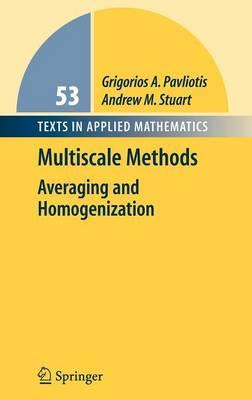
Full Product Details
Author: Grigoris Pavliotis ,
Andrew Stuart
Publisher: Springer-Verlag New York Inc.
Imprint: Springer-Verlag New York Inc.
Edition: 2008 ed.
Volume: 53
Dimensions:
Width: 15.50cm
, Height: 1.90cm
, Length: 23.50cm
Weight: 0.658kg
ISBN: 9780387738284
ISBN 10: 0387738282
Pages: 310
Publication Date: 19 February 2008
Audience:
College/higher education
,
Undergraduate
,
Postgraduate, Research & Scholarly
Format: Hardback
Publisher's Status: Active
Availability: In Print

This item will be ordered in for you from one of our suppliers. Upon receipt, we will promptly dispatch it out to you. For in store availability, please contact us.
Reviews
From the reviews: The book is devoted to introduce problems in which different scales may appear. The value of the book is that a wide class of problems is presented and consequently different techniques used to attack these problems are shown. The book is divided in three different parts. ... it can be used as a handbook for the arguements treated in the sequel. (Fabio Paronetto, Zentralblatt MATH, Vol. 1160, 2009)
"From the reviews: ""The book is devoted to introduce problems in which different scales may appear. The value of the book is that a wide class of problems is presented and consequently different techniques used to attack these problems are shown. The book is divided in three different parts. … it can be used as a handbook for the arguements treated in the sequel."" (Fabio Paronetto, Zentralblatt MATH, Vol. 1160, 2009)"
From the reviews: The book is devoted to introduce problems in which different scales may appear. The value of the book is that a wide class of problems is presented and consequently different techniques used to attack these problems are shown. The book is divided in three different parts. ! it can be used as a handbook for the arguements treated in the sequel. (Fabio Paronetto, Zentralblatt MATH, Vol. 1160, 2009)
From the reviews: The book is devoted to introduce problems in which different scales may appear. The value of the book is that a wide class of problems is presented and consequently different techniques used to attack these problems are shown. The book is divided in three different parts. ... it can be used as a handbook for the arguements treated in the sequel. (Fabio Paronetto, Zentralblatt MATH, Vol. 1160, 2009)