Overview
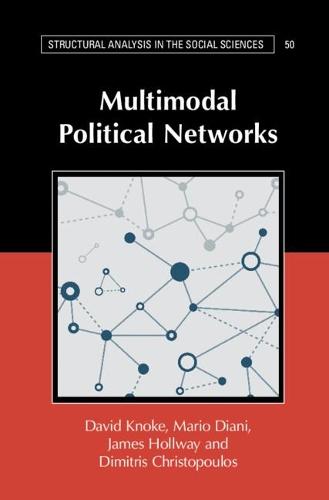
Research on social networks has become a significant area of investigation in the social sciences, and social network concepts and tools are widely employed across many subfields within the field. This volume introduces political theorists and researchers to new theoretical, methodological, and substantive tools for extending political network research into new realms and revitalizing established domains. The authors synthesize new understandings of multimodal political networks, consisting of two or more types of social entities - voters, politicians, parties, events, organizations, nations - and the complex relations between them. They discuss ways to theorize about multimodal connections, methods for measuring and analyzing multimodal datasets, and how the results can reveal new insights into political structures and action. Several empirical applications demonstrate in great detail how multimodal analysts can detect and visualize political communities consisting of diverse social entities.
Full Product Details
Author: David Knoke (University of Minnesota) ,
Mario Diani ,
James Hollway (Graduate Institute of International and Development Studies, Geneva) ,
Dimitris Christopoulos
Publisher: Cambridge University Press
Imprint: Cambridge University Press
Dimensions:
Width: 23.00cm
, Height: 2.00cm
, Length: 15.00cm
Weight: 0.440kg
ISBN: 9781108984720
ISBN 10: 110898472
Pages: 286
Publication Date: 27 May 2021
Audience:
College/higher education
,
Professional and scholarly
,
Tertiary & Higher Education
,
Professional & Vocational
Format: Paperback
Publisher's Status: Active
Availability: Manufactured on demand

We will order this item for you from a manufactured on demand supplier.
Reviews
'This book is a must have and must read for all policy researchers and social scientists interested in social network analysis and its application. It allows for the right mix between 'keeping complexity' to grasp the intricacies of the political game and 'reducing complexity' to come to systematic, comparative, and generalizable results. It gives essential guidelines on how to analyze two- and multi-mode networks.' Karin Ingold, University of Bern 'If you need to model 3-mode networks combining, for example, persons, organizations and events, this book is the perfect methodological and illustrative introduction to the new formalisms that have emerged for empirical explorations and theory building in the last decade, and that keep emerging today.' Emmanuel Lazega, Sciences Po, Paris 'this work brings together four international experts to provide robust exploration of multimodality in different types of political networks and demonstrate how computational social network analysis may be applied in their study ... The book would be a valuable addition to library collections supporting research in political science ... Recommended.' K. J. Whitehair, Choice
'This book is a must have and must read for all policy researchers and social scientists interested in social network analysis and its application. It allows for the right mix between 'keeping complexity' to grasp the intricacies of the political game and 'reducing complexity' to come to systematic, comparative, and generalizable results. It gives essential guidelines on how to analyze two- and multi-mode networks.' Karin Ingold, University of Bern 'If you need to model 3-mode networks combining, for example, persons, organizations and events, this book is the perfect methodological and illustrative introduction to the new formalisms that have emerged for empirical explorations and theory building in the last decade, and that keep emerging today.' Emmanuel Lazega, Sciences Po, Paris
'This book is a must have and must read for all policy researchers and social scientists interested in social network analysis and its application. It allows for the right mix between 'keeping complexity' to grasp the intricacies of the political game and 'reducing complexity' to come to systematic, comparative, and generalizable results. It gives essential guidelines on how to analyze two- and multi-mode networks.' Karin Ingold, University of Bern 'If you need to model 3-mode networks combining, for example, persons, organizations and events, this book is the perfect methodological and illustrative introduction to the new formalisms that have emerged for empirical explorations and theory building in the last decade, and that keep emerging today.' Emmanuel Lazega, Sciences Po, Paris
Author Information
David Knoke is Professor of Sociology at the University of Minnesota. Mario Diani is Professor of Sociology at the University of Trento. James Hollway is Associate Professor of International Relations/Political Science at the Graduate Institute, Geneva.