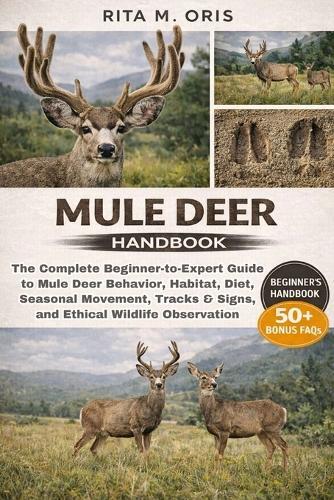
Mule Deer Handbook: The Complete Beginner-to-Expert Guide to Mule Deer Behavior, Habitat, Diet, Seasonal Movement, Tracks & Signs, and Ethical Wildlife Observation

Author:   Rita M Oris
Publisher:   Independently Published
ISBN:  

9798245257181


Pages:   222
Publication Date:   23 January 2026
Format:   Paperback
Availability:   Available To Order   Availability explained
We have confirmation that this item is in stock with the supplier. It will be ordered in for you and dispatched immediately.

Our Price $43.56 Quantity:  
Add to Cart

Share |

Mule Deer Handbook: The Complete Beginner-to-Expert Guide to Mule Deer Behavior, Habitat, Diet, Seasonal Movement, Tracks & Signs, and Ethical Wildlife Observation


Overview

INTRODUCTION Meeting the Mule DeerFirst ImpressionsIf you meet a mule deer for the first time in the wild, the encounter can feel almost quiet-like you're stepping into a scene that was already in progress long before you arrived. Mule deer don't announce themselves the way some animals do. Often you notice them only after you've already entered their space: a pale rump half-hidden behind sagebrush, the curve of an ear above a ridge, a motionless shape that becomes ""deer"" only when it decides to move. That first impression is important because it reveals something true about mule deer: they are built around caution, distance, and reading the world carefully. Their lifestyle isn't based on speed alone or strength alone. It's based on timing-when to feed, when to freeze, when to step away, and when to vanish. A mule deer that survives to adulthood is usually a mule deer that has learned how to be difficult to notice. Even in places where deer are common, mule deer still behave like animals that expect danger. They often watch people long before people realize they are being watched. If you stop and look around, you might catch small signs: ears rotating like radar dishes, a head held low but angled in your direction, a body standing ""ready"" rather than relaxed. In a single glance, a mule deer is collecting information: your distance, your speed, your posture, your attention, your path. It's not thinking in words, but it is assessing risk in a way that feels precise. What Makes a Mule Deer a Mule Deer Mule deer are not just ""a deer with big ears."" Those ears do matter-they're a signature feature-but what really defines a mule deer is the way the entire animal fits together for life in open, varied country. Mule deer thrive in landscapes where visibility changes constantly: open sage flats, broken foothills, pinyon-juniper slopes, canyon edges, mountain shrublands, and forest openings. They are at home in places with cover nearby, where a few steps can turn a clear line of sight into a maze of brush and shadow.

Full Product Details

Author:   Rita M Oris
Publisher:   Independently Published
Imprint:   Independently Published
Dimensions:   Width: 15.20cm , Height: 1.20cm , Length: 22.90cm
Weight:   0.304kg
ISBN:  

9798245257181


Pages:   222
Publication Date:   23 January 2026
Audience:   General/trade ,  General
Format:   Paperback
Publisher's Status:   Active
Availability:   Available To Order   Availability explained
We have confirmation that this item is in stock with the supplier. It will be ordered in for you and dispatched immediately.

Table of Contents

Reviews

Author Information

Tab Content 6

Author Website:  

Countries Available

All regions
Latest Reading Guide

April RG 26_2


Shopping Cart
Your cart is empty
Shopping cart
Mailing List