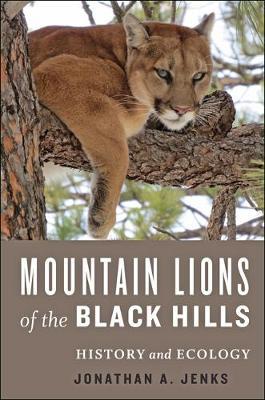
Full Product Details
Author: Jonathan A. Jenks (South Dakota State University)
Publisher: Johns Hopkins University Press
Imprint: Johns Hopkins University Press
Dimensions:
Width: 15.60cm
, Height: 1.70cm
, Length: 23.50cm
Weight: 0.408kg
ISBN: 9781421424422
ISBN 10: 1421424428
Pages: 160
Publication Date: 12 April 2018
Audience:
Professional and scholarly
,
Professional & Vocational
Format: Hardback
Publisher's Status: Active
Availability: Out of stock

The supplier is temporarily out of stock of this item. It will be ordered for you on backorder and shipped when it becomes available.
Reviews
The book is enriched by more than 25 years of research... All the chapters are interesting, highly readable and, in places, somewhat autobiographical... Likely to appeal to anyone interested in big cats or the ecology of large predators, this book should be particularly useful to wildlife professionals, including ecologists, conservationists and researchers. -- Sue Howarth CBiol FRSB * The Biologist * The book was an enjoyable read and is a valuable contribution to North America's predatory fauna... I loved all the pictures and thought that it complemented the text perfectly. In fact, I wish more scientifically-oriented books were like this: simple to read, containing concise information, and well illustrated! -- Jonathan Way, Eastern Coyote/Coywolf Research, Osterville, MA * The Canadian Field-Naturalist *
The book was an enjoyable read and is a valuable contribution to North America's predatory fauna . . . I loved all the pictures and thought that it complemented the text perfectly. In fact, I wish more scientifically-oriented books were like this: simple to read, containing concise information, and well illustrated! -- Jonathan Way, Eastern Coyote/Coywolf Research, Osterville, MA * The Canadian Field-Naturalist * The book is enriched by more than 25 years of research . . . All the chapters are interesting, highly readable and, in places, somewhat autobiographical . . . Likely to appeal to anyone interested in big cats or the ecology of large predators, this book should be particularly useful to wildlife professionals, including ecologists, conservationists and researchers. -- Sue Howarth CBiol FRSB * The Biologist *
The book is enriched by more than 25 years of research . . . All the chapters are interesting, highly readable and, in places, somewhat autobiographical . . . Likely to appeal to anyone interested in big cats or the ecology of large predators, this book should be particularly useful to wildlife professionals, including ecologists, conservationists and researchers. -- Sue Howarth CBiol FRSB * The Biologist * The book was an enjoyable read and is a valuable contribution to North America's predatory fauna . . . I loved all the pictures and thought that it complemented the text perfectly. In fact, I wish more scientifically-oriented books were like this: simple to read, containing concise information, and well illustrated! -- Jonathan Way, Eastern Coyote/Coywolf Research, Osterville, MA * The Canadian Field-Naturalist *
Author Information
Jonathan A. Jenks is a Distinguished Professor of Natural Resource Management at South Dakota State University. He is the editor of Managing Cougars in North America.