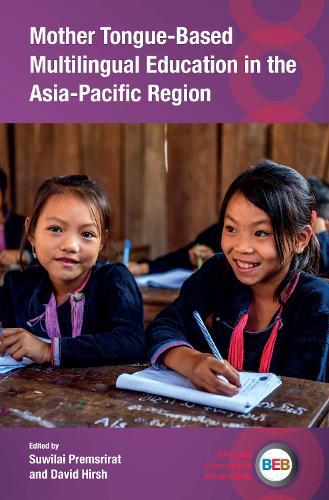
Full Product Details
Author: Suwilai Premsrirat ,
David Hirsh
Publisher: Multilingual Matters
Imprint: Multilingual Matters
Dimensions:
Width: 15.60cm
, Height: 1.70cm
, Length: 23.40cm
Weight: 0.600kg
ISBN: 9781800419728
ISBN 10: 1800419724
Pages: 278
Publication Date: 14 January 2025
Audience:
College/higher education
,
Postgraduate, Research & Scholarly
Format: Hardback
Publisher's Status: Active
Availability: In Print

This item will be ordered in for you from one of our suppliers. Upon receipt, we will promptly dispatch it out to you. For in store availability, please contact us.
Reviews
A movement towards multilingual education has emerged in Asia over the past three decades. Non-dominant languages are now used in many education systems in the region. This comprehensive work, written by some of the best-informed people of this movement, provides a detailed and multifaceted account of the developments. It’s a must-read for anyone interested in education that respects linguistic diversity. * Kimmo Kosonen, Payap University, Thailand and SIL Global * This volume, representing exciting collaborations between multilingual education scholars, implementers and representatives of non-dominant language communities, accomplishes so many things! There are practical guidelines and curricula for MLE implementers, empirical evidence of MLE’s positive impact on learners, and expert framing of language-in-education rights and policies – with implications for the region and well beyond. * Carol Benson, MLE International *
A movement towards multilingual education has emerged in Asia over the past three decades. Non-dominant languages are now used in many education systems in the region. This comprehensive work, written by some of the best-informed people of this movement, provides a detailed and multifaceted account of the developments. It’s a must-read for anyone interested in education that respects linguistic diversity. * Kimmo Kosonen, Payap University, Thailand and SIL Global *
A movement towards multilingual education has emerged in Asia over the past three decades. Non-dominant languages are now used in many education systems in the region. This comprehensive work, written by some of the best-informed people of this movement, provides a detailed and multifaceted account of the developments. It’s a must-read for anyone interested in education that respects linguistic diversity. * Kimmo Kosonen, Payap University, Thailand and SIL Global * This volume, representing exciting collaborations between multilingual education scholars, implementers and representatives of non-dominant language communities, accomplishes so many things! There are practical guidelines and curricula for MLE implementers, empirical evidence of MLE’s positive impact on learners, and expert framing of language-in-education rights and policies – with implications for the region and well beyond. * Carol Benson, MLE International * Suwilai Premsrirat and David Hirsh bring two decades of considerable carefully documented expertise detailing the challenges, progress, and implications of multilingual education in the Asia-Pacific, home to approximately 45% of the world’s languages. A quarter way through the International Decade of Indigenous Languages, this volume is an important contribution for policy, planning, implementation, and teacher preparation everywhere. * Kathleen Heugh, University of South Australia *
A movement towards multilingual education has emerged in Asia over the past three decades. Non-dominant languages are now used in many education systems in the region. This comprehensive work, written by some of the best-informed people of this movement, provides a detailed and multifaceted account of the developments. It’s a must-read for anyone interested in education that respects linguistic diversity. * Kimmo Kosonen, Payap University, Thailand and SIL Global * This volume, representing exciting collaborations between multilingual education scholars, implementers and representatives of non-dominant language communities, accomplishes so many things! There are practical guidelines and curricula for MLE implementers, empirical evidence of MLE’s positive impact on learners, and expert framing of language-in-education rights and policies – with implications for the region and well beyond. * Carol Benson, MLE International * Suwilai Premsirat and David Hirsh bring two decades of considerable carefully documented expertise detailing the challenges, progress, and implications of multilingual education in the Asia-Pacific, home to approximately 45% of the world’s languages. A quarter way through the International Decade of Indigenous Languages, this volume is an important contribution for policy, planning, implementation, and teacher preparation everywhere. * Kathleen Heugh, University of South Australia *
Author Information
Suwilai Premsrirat was Emeritus Professor of Linguistics and the Founding Director of the Resource Center for Documentation, Revitalization and Maintenance of Endangered Languages and Cultures, Research Institute for Languages and Cultures of Asia (RILCA) at Mahidol University, Thailand. Her work was dedicated to the study of minority languages, language revitalization and language education. David Hirsh is Associate Professor at the University of Sydney, Australia. His areas of focus include language revitalization, bilingual education and academic acculturation. Related publications include Endangered Languages, Knowledge Systems and Belief Systems (Peter Lang, 2013) and Language Revitalization: Insights from Thailand (co-edited with Suwilai Premsrirat, Peter Lang, 2018).