Overview
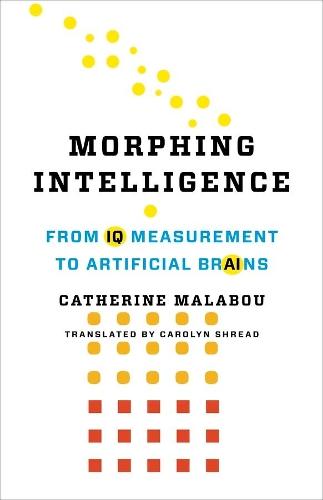
What is intelligence? The concept crosses and blurs the boundaries between natural and artificial, bridging the human brain and the cybernetic world of AI. In this book, the acclaimed philosopher Catherine Malabou ventures a new approach that emphasizes the intertwined, networked relationships among the biological, the technological, and the symbolic. Malabou traces the modern metamorphoses of intelligence, seeking to understand how neurobiological and neurotechnological advances have transformed our view. She considers three crucial developments: the notion of intelligence as an empirical, genetically based quality measurable by standardized tests; the shift to the epigenetic paradigm, with its emphasis on neural plasticity; and the dawn of artificial intelligence, with its potential to simulate, replicate, and ultimately surpass the workings of the brain. Malabou concludes that a dialogue between human and cybernetic intelligence offers the best if not the only means to build a democratic future. A strikingly original exploration of our changing notions of intelligence and the human and their far-reaching philosophical and political implications, Morphing Intelligence is an essential analysis of the porous border between symbolic and biological life at a time when once-clear distinctions between mind and machine have become uncertain.
Full Product Details
Author: Catherine Malabou (Professor Of Modern European Philosophy, Centre for Research in Modern European Philosophy / Kingston University) ,
Carolyn Shread
Publisher: Columbia University Press
Imprint: Columbia University Press
ISBN: 9780231187367
ISBN 10: 023118736
Pages: 224
Publication Date: 12 February 2019
Audience:
College/higher education
,
Professional and scholarly
,
Tertiary & Higher Education
,
Professional & Vocational
Format: Hardback
Publisher's Status: Active
Availability: Manufactured on demand

We will order this item for you from a manufactured on demand supplier.
Language: French
Reviews
Catherine Malabou is one of the rare philosophers who seriously engages contemporary biological research in her explorations of human experience. In this book, she turns her attention to the core question of intelligence, and with spectacular results. At stake is the very future of human thought, and Malabou is led to reflect on machine intelligence for the first time, generating singular insights. As ever, Malabou's prose is precise and elegant, deftly expressed in Carolyn Steadman's fluid translation.--David Bates, author of Plasticity and Pathology: On the Formation of the Neural Subject In this remarkable book Catherine Malabou focuses on the transformations of intelligence as it moves from genetics to epigenetics to automatism. Historically grounded, philosophically astute, and engagingly written, this book is highly recommended for anyone interested in intelligence--artificial and natural--and in contemporary configurations of what counts as human.--N. Katherine Hayles, author of Unthought: The Power of the Cognitive Nonconscious
Catherine Malabou is one of the rare philosophers who seriously engages contemporary biological research in her explorations of human experience. In this book, she turns her attention to the core question of intelligence, and with spectacular results. At stake is the very future of human thought, and Malabou is led to reflect on machine intelligence for the first time, generating singular insights. As ever, Malabou's prose is precise and elegant, deftly expressed in Carolyn Steadman's fluid translation. -- David Bates, author of <i>Plasticity and Pathology: On the Formation of the Neural Subject</i> In this remarkable book Catherine Malabou focuses on the transformations of intelligence as it moves from genetics to epigenetics to automatism. Historically grounded, philosophically astute, and engagingly written, this book is highly recommended for anyone interested in intelligence-artificial and natural-and in contemporary configurations of what counts as human. -- N. Katherine Hayles, author of <i>Unthought: The Power of the Cognitive Nonconscious</i>
Author Information
Catherine Malabou is professor of philosophy at the Centre for Research in Modern European Philosophy at Kingston University, London, and of comparative literature at the University of California, Irvine. Her many books include What Should We Do with Our Brain? (2008); Plasticity at the Dusk of Writing: Dialectic, Destruction, Deconstruction (Columbia, 2009); and Before Tomorrow: Epigenesis and Rationality (2016). Carolyn Shread is lecturer in French at Mount Holyoke College and teaches translation studies at Smith College. Her translations include several works by Catherine Malabou.