Overview
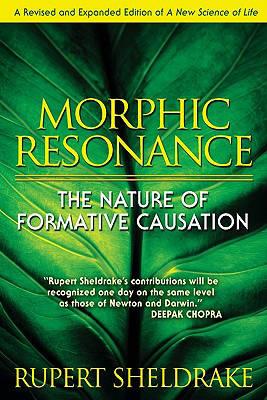
New updated and expanded edition of the groundbreaking book that ignited a firestorm in the scientific world with its radical approach to evolution - Explains how past forms and behaviors of organisms determine those of similar organisms in the present through morphic resonance - Reveals the nonmaterial connections that allow direct communication across time and space When A New Science of Life was first published the British journal Nature called it ""the best candidate for burning there has been for many years."" The book called into question the prevailing mechanistic theory of life when its author, Rupert Sheldrake, a former research fellow of the Royal Society, proposed that morphogenetic fields are responsible for the characteristic form and organization of systems in biology, chemistry, and physics--and that they have measurable physical effects. Using his theory of morphic resonance, Sheldrake was able to reinterpret the regularities of nature as being more like habits than immutable laws, offering a new understanding of life and consciousness. In the years since its first publication, Sheldrake has continued his research to demonstrate that the past forms and behavior of organisms influence present organisms through direct immaterial connections across time and space. This can explain why new chemicals become easier to crystallize all over the world the more often their crystals have already formed, and why when laboratory rats have learned how to navigate a maze in one place, rats elsewhere appear to learn it more easily. With more than two decades of new research and data, Rupert Sheldrake makes an even stronger case for the validity of the theory of formative causation that can radically transform how we see our world and our future.
Full Product Details
Author: Rupert Sheldrake
Publisher: Inner Traditions Bear and Company
Imprint: Park Street Press,U.S.
Edition: 4th Revised, Expanded ed.
Dimensions:
Width: 15.30cm
, Height: 2.10cm
, Length: 22.90cm
Weight: 0.428kg
ISBN: 9781594773174
ISBN 10: 1594773173
Pages: 352
Publication Date: 01 September 2009
Audience:
General/trade
,
General
Format: Paperback
Publisher's Status: Active
Availability: In Print

This item will be ordered in for you from one of our suppliers. Upon receipt, we will promptly dispatch it out to you. For in store availability, please contact us.
Reviews
. . . Sheldrake has steadily developed into one of the world's leading parapsychologists, conducting groundbreaking research in areas where well-behaved scientists fear to tread. . . . will appeal to any interested in new science, biology, and blends of new age thought. Sheldrake's theories continue to gain verification, and this book is particularly important because its implications affect the way we view the natural world, as well as ourselves, as one small part of it. Morphic Resonance is therefore strongly recommended to anyone interested in understanding current thought about what may lie behind the formation of all natural systems. Though his theory has much to say about the nature of evolution and the biological sciences, it also has a lot to say about consciousness, dreams, mental imagery and what I might consider ordinary and extraordinary dream/hypnotic experiences. Morphic Resonance is destined to become one of the landmarks in the history of biology. It is rare to find so profound a book so lucidly written. Morphic Resonance presents a revolutionary information-field understanding of the nature and evolution of life. Acquaintance with it is an essential part of new-paradigm scientific literacy. Books of this importance and elegance come along rarely. Those who read this new edition of A New Science of Life may do so with the satisfaction of seeing science history in the making. For decades, Rupert Sheldrake has been at the leading edge of highly innovative and controversial ideas about the organization of biological systems. Morphic Resonance poses a serious challenge to traditionalists and is a most welcome book about how we see the world and how we should head off into the future. Rupert Sheldrake is one of the most innovative and visionary scientists of our times. Rupert will be both vilified and praised for his theory of morphic resonance. Whatever your personal opinion of his work, he will not be ignored. In my opinion, his contributions will be recognized one day on the same level as those of Newton and Darwin. Sheldrake is an excellent scientist; the proper, imaginative kind that in an earlier age discovered continents and mirrored the world in sonnets. Well written, provocative and entertaining . . . Improbable? Yes, but so was Galileo.
. . . Sheldrake has steadily developed into one of the world's leading parapsychologists, conducting groundbreaking research in areas where well-behaved scientists fear to tread.
Author Information
Rupert Sheldrake, Ph.D., is a former research fellow of the Royal Society and former director of studies in biochemistry and cell biology at Clare College, Cambridge University. He is the author of more than 80 technical papers and articles appearing in peer-reviewed scientific journals and 10 books, including The Presence of the Past, The Rebirth of Nature, and Seven Experiments That Could Change the World.