Overview
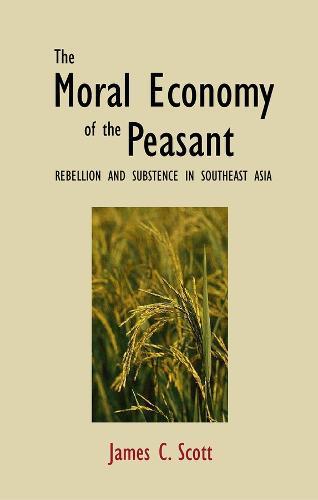
“This work is a profound and fundamental contribution to the issues addressed.”—Sociology “Vital to an understanding of peasant politics.”—Library Journal James C. Scott places the critical problem of the peasant household—subsistence—at the center of this study. The fear of food shortages, he argues persuasively, explains many otherwise puzzling technical, social, and moral arrangements in peasant society, such as resistance to innovation, the desire to own land even at some cost in terms of income, relationships with other people, and relationships with institutions, including the state. Once the centrality of the subsistence problem is recognized, its effects on notions of economic and political justice can also be seen. Scott draws from the history of agrarian society in lower Burma and Vietnam to show how the transformations of the colonial era systematically violated the peasants’ “moral economy” and created a situation of potential rebellion and revolution. Demonstrating keen insights into the behavior of people in other cultures and a rare ability to generalize soundly from case studies, Scott offers a different perspective on peasant behavior that will be of interest particularly to political scientists, anthropologists, sociologists, and Southeast Asianists.
Full Product Details
Author: James C. Scott
Publisher: Yale University Press
Imprint: Yale University Press
Dimensions:
Width: 15.60cm
, Height: 0.20cm
, Length: 23.50cm
Weight: 0.218kg
ISBN: 9780300021905
ISBN 10: 0300021909
Pages: 254
Publication Date: 10 September 1977
Audience:
College/higher education
,
Professional and scholarly
,
Undergraduate
,
Postgraduate, Research & Scholarly
Format: Paperback
Publisher's Status: Active
Availability: Out of stock

The supplier is temporarily out of stock of this item. It will be ordered for you on backorder and shipped when it becomes available.
Reviews
“A major work on peasant economy and cultural configurations which provides an original theoretical framework for comprehending peasant behavior and which explains the peasant’s existential dilemma.”—Sociology “In this major work, . . . Scott views peasants as political and moral actors defending their values as well as their individual security, making his book vital to an understanding of peasant politics.”—Library Journal “This book will last. No one interested in peasant societies in Southeast Asia, or for that matter elsewhere, can afford to ignore it, and paying it the attention it deserves causes little pan, because it is as well written as it is sophisticated and enlightening. It should be assigned, at least in parts, to undergraduates in ‘Third World’ courses, recommended as a matter of course to graduate students working on social change, and mentioned always to anyone puzzled by the intricacies of economic, social, and political structure in countries with large peasant populations.”—Daniel S. Lev, The Journal of Politics “In many ways this is a gem of a book. To a high level of scholarhsip conceptualization, analysis, and an original and consistent approach, it adds clear and readable prose. . . . The book should be useful to a wide variety of readers.”—The Annals “Scott bases his explanation of the technical, social and moral conditions of peasantry on the fear of food shortages. He states that their relationships with each other and with the government form an integral part of the peasant’s leanings towards rebellion and revolution. Based on several case studies, Scott’s investigation into the behavior of these people is rare and sympathetic.”—Asia Mail “[This book] is regarded in the field of Southeast Asian studies as one of the most important works of its time.”—Asia Bulletin “In this excellent discussion of social change in agrarian society Scott argues compellingly that problems of a secure subsistence are basic to an understanding of peasants’ reactions to development. His evenhanded, well-written argument uses this central theme and its implications for social justice to examine the violence wrought on peasants’ ‘moral economy’ during the colonial histories of Burma and Vietnam, but it goes far beyond by stressing regional variation and making use of an impressive range of comparisons.”—John W. Gatrell, Rural Sociology
Author Information
James C. Scott (1936–2024) was Sterling Professor of Political Science and Professor of Anthropology Emeritus at Yale University. His many books include Seeing Like a State, Agrarian Studies, The Art of Not Being Governed, and Against the Grain.