Overview
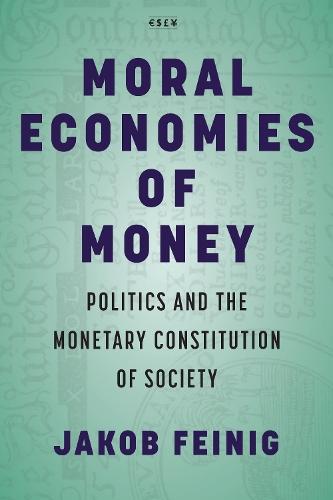
For much of American history, large numbers of people claimed that money was a public good and asserted the right to shape money creation practices. If popular knowledge about money creation was once widely shared, how and why did it disappear? In this astute new work, Jakob Feinig shows how the relation between money users and money-issuing governments changed from British colonial North America to today's United States, discussing how popular movements reshaped money-creating institutions, and how their opponents attempted to silence them. He also reveals how monetary and political history unfolds in the tension between ""moral economies of money"" and ""monetary silencing."" Offering an introduction to money creation practices since the colonial era, the book enables readers to understand why most people are disconnected from knowledge about money creation today. At the same time, the book also allows readers to situate the recent prominence of Modern Monetary Theory (MMT) against a broader historical background. Historians of capitalism, economic and political sociologists, social theorists, anthropologists of money, and anyone seeking to understand monetary activism, will find this book helps to clarify present-day possibilities in light of historical processes.
Full Product Details
Author: Jakob Feinig
Publisher: Stanford University Press
Imprint: Stanford University Press
Edition: New edition
ISBN: 9781503629172
ISBN 10: 1503629171
Pages: 208
Publication Date: 04 October 2022
Audience:
Professional and scholarly
,
Professional & Vocational
Format: Hardback
Publisher's Status: Active
Availability: To order

Stock availability from the supplier is unknown. We will order it for you and ship this item to you once it is received by us.
Reviews
In this book, Feinig sets out to make money visible as a practice. He does that with breath-taking effect. Brilliant, thought-provoking, and illuminating. -- Christine Desan * Harvard University * An absorbingly rich history of the struggles over money in the United States from colonial 'moral economies' to its expropriation by capitalist banking. -- Geoffrey Ingham * University of Cambridge * In this compelling fusion of sociological insight and historical narrative, Feinig succeeds in clarifying how money politics worked in the past, and why it should be revisited today. -- Roy Kreitner * Tel Aviv University *
In this compelling fusion of sociological insight and historical narrative, Feinig succeeds in clarifying how money politics worked in the past, and why it should be revisited today. -- Roy Kreitner * Tel Aviv University *
Author Information
Jakob Feinig is Assistant Professor in the Department of Human Development, College of Community and Public Affairs, Binghamton University.