Overview
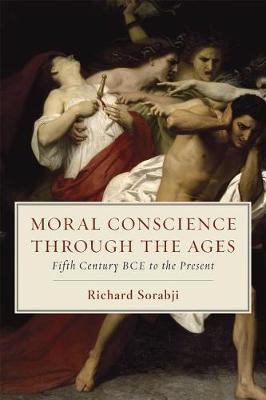
In Moral Conscience through the Ages, Richard Sorabji brings his erudition and philosophical acumen to bear on a fundamental question: what is conscience? Examining the ways we have conceived of that little voice in our heads-our self-directed judge-he teases out its most enduring elements, the aspects that have survived from the Greek playwrights in the fifth century BCE through St Paul, the Church Fathers, Catholics and Protestants, all the way to the 17th century's political unrest and the critics and champions of the eighteenth to twentieth centuries. Sorabji examines an impressive breadth of topics: the longing for different kinds of freedom of conscience, the proper limits of freedom itself, protests at conscience's being 'terrorized, ' dilemmas of conscience, the value of conscience to human beings, its secularization, its reliability, and ways to improve it. These historical issues are alive today, with fresh concerns about topics such as conscientious objection, the force of conscience, or the balance between freedoms of conscience, religion, and speech. The result is a stunningly comprehensive look at a central component of our moral understanding.
Full Product Details
Author: Richard Sorabji (University of Oxford UK)
Publisher: The University of Chicago Press
Imprint: University of Chicago Press
Dimensions:
Width: 15.00cm
, Height: 2.30cm
, Length: 22.60cm
Weight: 0.408kg
ISBN: 9780226528601
ISBN 10: 022652860
Pages: 240
Publication Date: 23 January 2018
Audience:
General/trade
,
General
Format: Paperback
Publisher's Status: Active
Availability: Available To Order

We have confirmation that this item is in stock with the supplier. It will be ordered in for you and dispatched immediately.
Reviews
Moral concepts have a history, and in this immensely learned and yet highly readable book, Sorabji traces the evolution of the idea of conscience from its earliest intimations in classical Greek and Latin down to our own time. Along the way, he raises questions about freedom of conscience, its reliability, its relation to religious beliefs and penitence, its role in legal systems, and its reemergence in modern psychology in the form of the super-ego. Every page offers insights, and I can in good conscience recommend this book to anyone interested in the foundations of a moral life. --David Konstan, New York University Sorabji convincingly establishes that many important philosophical issues emerge only if we situate the discussion of conscience in these wider contexts. As a result, his volume explores debates over whether one can effectively pressure conscience to change without hypocrisy, as well as the historical and philosophical connections among freedom of conscience, freedom of religion, and tolerance. Moreover, Sorabji traces discussions of conscience not just through the usual suspects, such as Socrates, Augustine, Aquinas, Butler, and Kant, but also through the classical Greek playwrights, St. Paul, Huss, Cromwell, and Gandhi. While the treatment of each thinker or movement is concise, Sorabji details how the relevant concepts and arguments change to address new social, political, or religious circumstances. It is in demonstrating these webs of connection and change across centuries that Sorabji is at his best....Sorabji's encyclopaedic investigation is an excellent starting point for scholars investigating the many debates over the scope and significance of conscience. --Jeffrey Hause The Philosophical Quarterly Moral Conscience through the Ages is an ambitious historical analysis of the changing meanings of moral conscience and related concepts from ancient Greek playwrights up to twentieth-century authors. I am not aware of any other book with this scope, let alone with such skill. Sorabji is eminently successful at proving his points, and his book will appeal to many audiences. --Robert Louden, author of Morality and Moral Theory Few authors have the breadth and depth of knowledge required to write such a history. Sorabji demonstrates in this work an impressive grasp of Western philosophy and an effortless ability to move across disciplinary boundaries, from moral philosophy to metaphysics, from psychology to politics, and from the history of law to current debates in legal theory. Moral Conscience through the Ages will quickly establish itself among scholars as the standard treatment of its subject. But what is most impressive is that, without sacrificing the rigour that academic researchers demand, he has also written a book that is accessible and practical enough to find its way into the hands of policy makers in debates concerning freedom of conscience and conscientious objection. --Michael Hickson, Trent University Sorabji's Moral Conscience through the Ages takes us from the earliest Greek tragedies to the life and writings of Mahatma Gandhi. Seldom has the notion of respect for conscience been shown to be capable of so many fascinating permutations. Seldom have so many great thinkers been shown wrestling throughout the ages with this topic. Their thoughts are brought alive for us by Sorabji with warm insight and with a vivid sense of the historical context of each. The book amounts to a rethinking of a central value in our own culture that remains as relevant today as it was over two millennia ago among the ancient Greeks and Romans. --Peter R. Brown, Princeton University Moral Conscience through the Ages is a fascinating and remarkable feat of historical scholarship and philosophical reflection. It is a critical history of a familiar but strangely elusive idea, one that makes its first appearance, in Greek drama, as the notion of sharing knowledge with oneself. Sorabji has a fascinating story to tell--a political and religious story--about how this concept evolved and became the locus of competing moral theories and visions of human moral competence. Enormous in its scope and erudition, yet concise and clear in its exposition, this work will enrich the study of the history of ethics and our understanding of the corruptibility of conscience and the value of religious freedom. ----Richard Kraut, Northwestern University
-Moral Conscience through the Ages is an ambitious historical analysis of the changing meanings of moral conscience and related concepts from ancient Greek playwrights up to twentieth-century authors. I am not aware of any other book with this scope, let alone with such skill. Sorabji is eminently successful at proving his points, and his book will appeal to many audiences.---Robert Louden, author of Morality and Moral Theory
Author Information
Richard Sorabji is honorary fellow of Wolfson College at Oxford University and fellow and emeritus professor at King's College, London. He is the editor of over one hundred books and author of fifteen books, including Necessity, Cause, and Blame; Self; and Gandhi and the Stoics, all published by the University of Chicago Press.