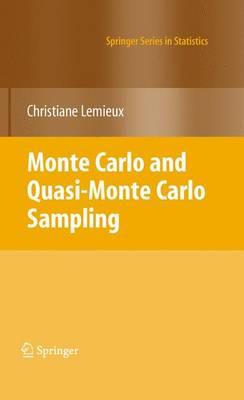
Full Product Details
Author: Christiane Lemieux
Publisher: Springer-Verlag New York Inc.
Imprint: Springer-Verlag New York Inc.
Edition: 2009 ed.
Dimensions:
Width: 15.50cm
, Height: 2.20cm
, Length: 23.50cm
Weight: 0.752kg
ISBN: 9780387781648
ISBN 10: 0387781641
Pages: 373
Publication Date: 27 February 2009
Audience:
College/higher education
,
Postgraduate, Research & Scholarly
Format: Hardback
Publisher's Status: Active
Availability: In Print

This item will be ordered in for you from one of our suppliers. Upon receipt, we will promptly dispatch it out to you. For in store availability, please contact us.
Reviews
This book is well structured as a complete guide to Monte Carlo and quasi Monte Carlo sampling methods. The author has done a nice job presenting the key concepts and explaining the theories of these valuable methods with examples and applications. Along with the problem sets provided at the end of each chapter, this book can serve well as a textbook for an advanced graduate course on Monte Carlo and quasi Monte Carlo sampling methods or as a reference book for a course on computational statistics or numerical methods. This book is definitely an important contribution to the computational statistics and mathematics community. (Technometrics) Monte Carlo and Quasi-Monte Carlo Sampling packs an enormous amount of material into a small space, while remaining very readable. The sections have a nice balance, with exposition, mathematical derivation, pseudocode, and numerical examples combining to introduce the reader to the intricacies of Monte Carlo methods. The book is strongest in its explanations of the basic Monte Carlo method and how quasi-Monte Carlo methods operate. That is, it is best at describing how to turn function evaluations into estimates, and how to decide where to take those function evaluations. ... This is a book aimed for the Monte Carlo novice and would be suitable for a student with a semester of undergraduate probability or statistics. The pace is fast, with many subsections lasting only a page or two. Despite the concise delivery, I found the descriptions very readable, and Lemieux has a talent for closing quickly to the essence of an algorithm or idea. In addition, the topics are very well referenced. ... In total, the result is a remarkably inclusive introduction to Monte Carlo and quasi-Monte Carlo methods. The coverage is not deep given the length devoted to most topics, but the wealth of references combined with a clear writing style make this a great text for a first course in Monte Carlo methods. (Journal of the American Statistical Association, June 2010, Vol. 105, No. 490)
From the reviews: “This book is well structured as a complete guide to Monte Carlo and quasi Monte Carlo sampling methods. The author has done a nice job presenting the key concepts and explaining the theories of these valuable methods with examples and applications. Along with the problem sets provided at the end of each chapter, this book can serve well as a textbook for an advanced graduate course on Monte “Carlo and quasi Monte Carlo sampling methods or as a reference book for a course on computational statistics or numerical methods. This book is definitely an important contribution to the computational statistics and mathematics community.” (Technometrics) “Monte Carlo and Quasi-Monte Carlo Sampling packs an enormous amount of material into a small space, while remaining very readable. The sections have a nice balance, with exposition, mathematical derivation, pseudocode, and numerical examples combining to introduce the reader to the intricacies of Monte Carlo methods. The book is strongest in its explanations of the basic Monte Carlo method and how quasi-Monte Carlo methods operate. That is, it is best at describing how to turn function evaluations into estimates, and how to decide where to take those function evaluations. … This is a book aimed for the Monte Carlo novice and would be suitable for a student with a semester of undergraduate probability or statistics. The pace is fast, with many subsections lasting only a page or two. Despite the concise delivery, I found the descriptions very readable, and Lemieux has a talent for closing quickly to the essence of an algorithm or idea. In addition, the topics are very well referenced. … In total, the result is a remarkably inclusive introduction to Monte Carlo and quasi-Monte Carlo methods. The coverage is not deep given the length devoted to most topics, but the wealth of references combined with a clear writing style make this a great text for a first course in Monte Carlo methods.” (Journal of the American Statistical Association, June 2010, Vol. 105, No. 490) “This book is a nice survey of some Monte Carlo and quasi-Monte Carlo (or quasirandom) approaches to integration problems. … This book focuses on the use of the quasirandom approach and its relationship to Monte Carlo. … A strong point of this book is its modern treatment of the quasirandom approach and its application. … The writing is very clear and enjoyable to read. … an excellent source for a graduate student or researcher who wants to learn more about the quasi-Monte Carlo approach.” (Michael J. Evans, Mathematical Reviews, Issue 2012 b)
Author Information
Christiane Lemieux is an Associate Professor and the Associate Chair for Actuarial Science in the Department of Statistics and Actuarial Science at the University of Waterloo in Canada. She is an Associate of the Society of Actuaries and was the winner of a “Young Researcher Award in Information-Based Complexity” in 2004.