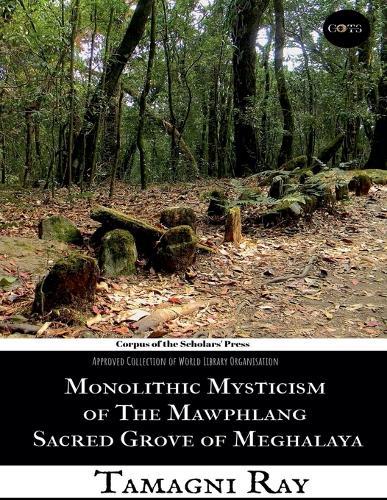
Overview
Preface: Whispers in the Living Cathedral The book was born not from a desire to study, but from a feeling of being gently, yet irrevocably, absorbed. My first encounter with the Mawphlang Sacred Grove was not as a scholar, but as a wanderer. Stepping from the sun-drenched, windswept Khasi hills into its cool, dappled shadow was a transition that felt less geographical and more anatomical-as if crossing a threshold into a different realm of being. The air changed, thick with the scent of damp earth, ancient bark, and quiet decay. The sound changed; the outside world receded, replaced by the symphony of rustling leaves, trickling water, and a silence so profound it had its own texture. The light itself changed, filtered through a verdant canopy into a luminous, green-gold twilight that seemed to pool around the moss-clad monoliths standing sentinel among the trees. In that moment, a simple truth announced itself: this was not merely a forest. It was a library. But its texts were not written in ink on paper. They were inscribed in the symbiosis of root and fungus, in the silent language of lichen on stone, in the seasonal rituals of bloom and decay, and in the collective memory held within the gnarled trunks of trees that have witnessed centuries. The monoliths-rough-hewn, solemn, and scattered in seemingly purposeful disorder-were not relics of a dead past. They were active punctuation marks in an ongoing story, the bone structure of a living faith. Monolithic Mysticism of the Mawphlang Sacred Grove of Meghalaya is an attempt to learn how to read this library. It is a journey into the heart of a worldview where the sacred is not abstract, but rooted; not transcendent above nature, but immanent within it. Here, divinity is negotiated through a profound covenant between the human and the more-than-human, a covenant safeguarded by the unwavering law of the grove: nothing may be taken, and nothing may be desecrated. The stones (mawbyrsi) are not just memorials; they are altars, witnesses, and conduits. The grove itself is the temple, the deity, and the community all at once-a perfect, closed system of reverence and ecological wisdom.
Full Product Details
Author: Tamagni Ray
Publisher: Cots (Corpus of the Scholars')
Imprint: Cots (Corpus of the Scholars')
Dimensions:
Width: 21.60cm
, Height: 1.00cm
, Length: 27.90cm
Weight: 0.440kg
ISBN: 9798232352714
Pages: 184
Publication Date: 25 December 2025
Audience:
General/trade
,
General
Format: Paperback
Publisher's Status: Active
Availability: Available To Order

We have confirmation that this item is in stock with the supplier. It will be ordered in for you and dispatched immediately.
Author Information
Tamagni Ray is an accomplished archaeologist, prehistorian, and anthropologist whose multidisciplinary expertise spans ancient Indian history, underwater archaeology, heritage management, and museology. Academic Excellence Ray's academic journey began with distinction at Kalyani University Experimental High School. Her passion for history led her to pursue a Bachelor of Arts in History (Honours) from St. Paul's Cathedral Mission College, University of Calcutta (2018-2021), where she graduated with first-class first distinction. Building upon this foundation, Ray pursued advanced studies at the prestigious Deccan College Post-Graduate and Research Institute (DCPGRI) in Pune, earning her Master of Arts in Ancient Indian History, Culture & Archaeology (2021-2023) with Grade A, 1st class distinction. Other qualification also includes an MA in Anthropology 2022-2024 from IGNOU. Her commitment to specialised knowledge led her to simultaneously complete multiple postgraduate diplomas: Heritage Management and Conservation, Underwater Archaeology, and Museology. Research and Publications Ray's research portfolio demonstrates her versatility across archaeological and anthropological domains. Her master's dissertation, ""Monolithic Mysticism of the Mawphlang Sacred Grove in Meghalaya"" (2023), showcases her expertise in ethnoarchaeological investigations. Her underwater archaeology research on ""Past Maritime Activities in the coastal Shankarpur region of West Bengal"" reflects her specialised training in marine archaeological methods. Currently, Ray is working on several ongoing research projects, including studies on Neolithic metallurgy, nutritional anthropology among pre-adolescent children in West Bengal, and comparative analyses of pilgrimage sites. Her recent contribution to ""The Princess Royal Shipwreck 1990"" (ISBN: 978-81-967928-1-7), published in February 2025, demonstrates her engagement with maritime archaeological literature.