Overview
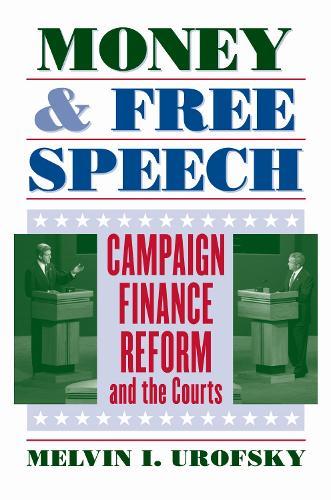
Money greases the wheels of American politics from the local level to the White House. In the 2004 presidential campaign, President George W. Bush alone raised nearly $400 million in private and public funds - nearly twenty times the combined total raised by John Kennedy and Richard Nixon in 1960 - to defeat challenger John F. Kerry, further fueling anxiety over the power of money to dictate political results. Melvin Urofsky, one of our nation's most respected legal historians, takes a fresh look at efforts to rein in campaign spending and counter efforts in the courts to preserve the status quo. He offers a thoughtful and balanced overview of campaign finance reform and the legal responses to it, from the Progressive era through the Supreme Court's landmark ruling in McConnell v. FEC (2003) and its impact on the 2004 election. Urofsky focuses especially on the 1971 Federal Election Campaign Act and 2002 McCain-Feingold or Bipartisan Campaign Reform Act (BCRA), and on challenges to both in the Supreme Court. In Buckley v. Valeo (1976), the Court upheld contribution limits but struck down expenditure caps on First Amendment grounds. In McConnell it upheld the key provisions of McCain-Feingold. In both cases, however, opponents argued that congressional control of campaign financing was an unconstitutional infringement of the free speech rights of campaign contributors. Urofsky deftly steers the reader through this contentious and complex history, revealing how both Congress and the courts have navigated uneasily between the Scylla of potential corruption and the Charybdis of suppressing political speech. Ironically, despite the Court's decision upholding McCain-Feingold, the 2004 presidential election was the most expensive in history - because, as Urofsky notes, money is the mother's milk of politics and both candidates and donors will always find ways to keep it flowing. His book provides an excellent and succinct guide to the controversies and historical debates emerging from that fact.
Full Product Details
Author: Melvin I. Urofsky
Publisher: University Press of Kansas
Imprint: University Press of Kansas
Dimensions:
Width: 16.10cm
, Height: 2.70cm
, Length: 23.40cm
Weight: 0.650kg
ISBN: 9780700614035
ISBN 10: 0700614036
Pages: 336
Publication Date: 09 September 2005
Audience:
General/trade
,
General
Format: Hardback
Publisher's Status: Active
Availability: Temporarily unavailable

The supplier advises that this item is temporarily unavailable. It will be ordered for you and placed on backorder. Once it does come back in stock, we will ship it out to you.
Reviews
A splendid, concise, lucid, and highly readable history of the politics of campaign finance reform and the leading rulings of the Supreme Court on the matter. It is also timely, useful for understanding the ongoing dialogue and debate over the subject. --David M. O'Brien, author of Storm Center: The Supreme Court in American Politics An extremely well-written and well-argued account of a very complex and significant component of our political system. I learned a great deal from it and could easily assign the book to my senior undergraduate students. --Charles L. Zelden, author of The Battle for the Black Ballot: Smith v. Allwright and the Defeat of the Texas All-White Primary
A splendid, concise, lucid, and highly readable history of the politics of campaign finance reform and the leading rulings of the Supreme Court on the matter. It is also timely, useful for understanding the on-going dialogue and debate over the subject.
Author Information
Melvin I. Urofsky is professor emeritus of history and professor of law and public policy at Virginia Commonwealth University. His many books include A March of Liberty: A Constitutional History of the United States and The Continuity of Change: The Supreme Court and Individual Liberties, 1953-1986.