Overview
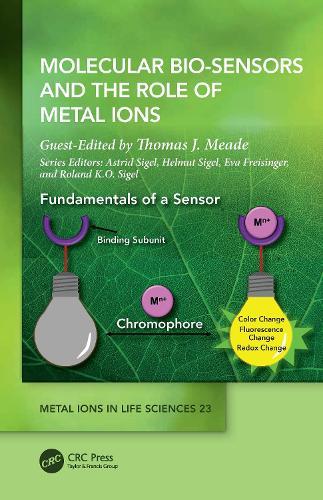
Volume 23, entitled Molecular Bio-Sensors and the Role of Metal Ions, of the series Metal Ions in Life Sciences (MILS) represents a milestone of contemporary progress and understanding of molecular bio-sensors for metal ions. It is bringing together the latest research in academia and industry, and it also emphasizes the spectrum of evolving regulations from regulatory bodies. This vibrant research area is covered by 31 internationally recognized experts. The impact of MILS-23 is manifested by more than 1300 references and close to 200 figures, more than 100 of them in color; further information is summarized in several tables. In conclusion, Volume 23 significantly advances our understanding of Molecular Bio-Sensors, it is therefore an essential resource for scientists working in the wide range from earth sciences, material sciences, physics, pharmacology, enzymology, analytical, organic, and inorganic biochemistry all the way through to medicine including the clinic. • It provides an understanding of the roles that metals play in living systems. • It offers an insight for the demands needed in the clinic. • It reveals the interplay between bio-sensors and therapies. The Series METAL IONS IN LIFE SCIENCES increases our understanding of the relationship between the chemistry of metals and life processes. The volumes reflect the interdisciplinary nature of Biological Inorganic Chemistry and coordinate the efforts of researchers in fields like biochemistry, inorganic chemistry, coordination chemistry, molecular and structural biology, enzymology, toxicology, environmental chemistry, biophysics, pharmacy, and medicine. The volumes deal with the formation, stability, structure, and reactivity of metal-containing biological compounds of low and high molecular weight. The metabolism and transport of metal ions and their complexes as well as new models of complicated natural structures and processes are in the focus. Consequently, the volumes are an essential source for researchers in the mentioned fields as well as for teachers preparing courses, e.g., in Bioinorganic Chemistry.
Full Product Details
Author: Thomas J. Meade (Northwestern University, IL, USA)
Publisher: Taylor & Francis Ltd
Imprint: CRC Press
Weight: 0.600kg
ISBN: 9781032135861
ISBN 10: 1032135867
Pages: 330
Publication Date: 19 December 2024
Audience:
College/higher education
,
Professional and scholarly
,
Tertiary & Higher Education
,
Professional & Vocational
Format: Paperback
Publisher's Status: Active
Availability: In Print

This item will be ordered in for you from one of our suppliers. Upon receipt, we will promptly dispatch it out to you. For in store availability, please contact us.
Reviews
Taken from the book review of Mark D. Pagel in Coord. Chem. Rev. 478 (2023) 214994 The book Molecular Bio-Sensors and the Role of Metal Ions consists of 10 chapters that review the roles of calcium, vanadium, manganese, iron, copper, zinc, arsenic, and cadmium in the life sciences. The volume especially focuses on the development of bio-sensors that can be used with a variety of analytical methods that cover a wide range of spatial and temporal scales. Importantly, many of these analytical methods can be used to evaluate biological specimens to improve our understanding of biology and physiology, and many of these methods can be translated into the workflow of medical practice. Overall, this book is comprehensive while presenting content at a very approachable level. The figures add to the quality of the writing, especially by presenting schematics that clarify complicated concepts, chemical structures that clarify subtle differences between agents, and biological & biomedical images that are eye-catching reminders of the value of molecular imaging. Although each chapter stands alone, insights for the detection and utility of detection of each metal can be gleaned from other chapters. Together, the 10 chapters of Volume 23 clearly continue the strong value of this book series, and clearly justify the rebranding of this series with the expanded title of Metal Ions in Life Sciences (MILS).