Overview
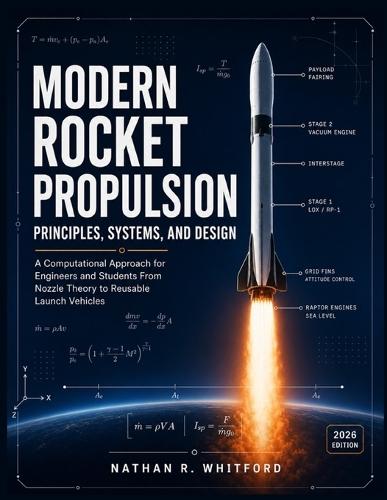
The rocket engines powering today's launch vehicles operate on principles that most textbooks still explain using yesterday's examples. Modern Rocket Propulsion bridges the gap between classical propulsion theory and the engineering reality of current generation systems. This book takes you from the Tsiolkovsky rocket equation through nozzle thermodynamics, combustion chemistry, and propellant performance, then applies those fundamentals to the systems making headlines: full flow staged combustion engines, electric pump fed cycles, methane/LOX architectures, Hall effect thrusters for satellite constellations, and reusable booster recovery. What sets this book apart from traditional propulsion textbooks is a computational approach built into every chapter. Python code labs walk you through delta v budget calculations, nozzle optimization, chemical equilibrium solvers, engine cycle comparison tools, regression rate prediction, low thrust trajectory simulation, and multistage vehicle optimization. You do not just read about propulsion engineering. You compute it. Every chapter includes a Design Decision Map that shows how real engineering teams navigate the trade space between performance, cost, complexity, reliability, and reusability. These maps connect textbook theory to the decisions that practicing engineers actually face. This book covers all major propulsion system types. Liquid rocket engines are examined across six cycle architectures with detailed treatment of thrust chambers, injectors, turbomachinery, and cooling systems. Solid rocket motor fundamentals include grain design, internal ballistics, and propellant chemistry. Hybrid propulsion receives dedicated coverage of boundary layer combustion physics and regression rate modeling. Electric propulsion systems are covered from resistojets through Hall effect thrusters and gridded ion engines, with attention to power processing and low thrust mission design. The final chapters address flight performance and vehicle design, including staging optimization and orbital mechanics, followed by advanced concepts such as nuclear thermal propulsion, solar sails, rotating detonation engines, additive manufacturing for propulsion components, and in space propellant production. The book closes with propulsion system integration, ground testing methodology, qualification processes, and reusability engineering. Modern Systems Spotlights throughout the book provide engineering analysis of current operational systems including the SpaceX Raptor, Rocket Lab Rutherford, Aerojet Rocketdyne RL 10, NASA NEXT C ion thruster, Starlink Hall effect thrusters, Northrop Grumman GEM 63XL, and the DARPA DRACO nuclear thermal demonstrator. Whether you are an aerospace engineering student looking for a computationally integrated companion to your coursework, a working engineer transitioning into the propulsion field from an adjacent discipline, or a systems engineer who needs propulsion literacy for program decision making, this book delivers the fundamentals, the modern context, and the computational tools in one volume.
Full Product Details
Author: Nathan R Whitford
Publisher: Independently Published
Imprint: Independently Published
Dimensions:
Width: 21.60cm
, Height: 2.30cm
, Length: 27.90cm
Weight: 1.034kg
ISBN: 9798195844158
Pages: 450
Publication Date: 06 May 2026
Audience:
General/trade
,
General
Format: Paperback
Publisher's Status: Active
Availability: Available To Order

We have confirmation that this item is in stock with the supplier. It will be ordered in for you and dispatched immediately.