Overview
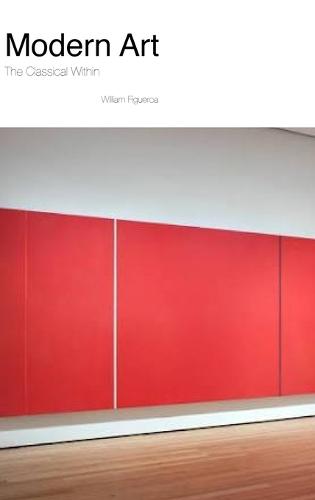
Modern art is often understood as a break with the past-a rejection of classical form, proportion, and tradition. Yet when the history of art is viewed across its full span, a different pattern emerges. From the earliest monumental structures to the luminous spaces of Gothic cathedrals, from the geomertà of Greek sculpture to the discoveries of Renaissance perspective, artists consistently disclose a common structural condition: the intelligible order underlying form. Proportion, geometry, rhythm, and light recur as the grammar through which form becomes coherent. Modern abstraction does not abandon this tradition. It brings it into full view. Beginning with Cézanne's structural reorganization of nature and continuing through Cubism, geometric abstraction, and the color-field paintings of the twentieth century, representation gradually recedes. What remains is the relational structure that has always governed form. Through a sweeping historical investigation-from ancient architecture to modern painting-Modern Art: The Classical Within traces the progressive recognition of this intelligible order across civilizations and centuries. Seen in this light, modern abstraction is not a rupture with the classical condition but its most explicit disclosure. The intelligible does not vanish. It remains as the condition under which form appears-and awaits recognition.
Full Product Details
Author: William Figueroa
Publisher: Light Form Press
Imprint: Light Form Press
Dimensions:
Width: 15.20cm
, Height: 1.40cm
, Length: 22.90cm
Weight: 0.472kg
ISBN: 9798995318736
Pages: 162
Publication Date: 09 March 2026
Audience:
General/trade
,
General
Format: Hardback
Publisher's Status: Active
Availability: Available To Order

We have confirmation that this item is in stock with the supplier. It will be ordered in for you and dispatched immediately.
Reviews
Book Review: Modern Art: The Classical Within by William Figueroa Light Form Press, 2026 160 pages In an era when much writing on modern art celebrates rupture, fragmentation, and novelty, William Figueroa's Modern Art: The Classical Within arrives as a quiet, luminous counter-statement. This concise yet sweeping monograph argues that the deepest achievements of non-objective abstraction do not break with the classical tradition-they fulfill it. The ""classical condition,"" as Figueroa defines it, is not a period style but an ontological reality: the intrinsic intelligibility of being made visible through determinate relation, proportion, and structured coherence. From Göbekli Tepe's concentric stone circles to Barnett Newman's Vir Heroicus Sublimis, form has never been arbitrary. It has been sustained wherever differentiation stabilizes into measurable harmony. Figueroa traces this single structural thread across Western art with remarkable economy and precision. The opening chapters establish an ontological foundation-drawing on Plato's analogy of the sun and Aristotle's hylomorphism-before moving through the great epochs: Greek articulation of ratio, Roman volumetric order, Gothic incarnate light, Renaissance perspective, Cézanne's structural recovery, Cubism's compositional language, and finally the pure relational field of abstraction. Each stage refines the same constant: relation governs form. Representation recedes, but intelligibility does not. In non-objective painting, line, interval, plane, and color stand forth as the content itself. Abstraction, Figueroa writes, ""is not rupture. It is clarification."" What makes the book especially compelling is its method. Rather than layering on dense theory or biographical anecdote, Figueroa proceeds through direct structural demonstration. The prose is spare, declarative, and unusually lucid-free of academic jargon yet philosophically rigorous. The integrated plates function not as decoration but as visual proof: the same grammar of center and perimeter, vertical and horizontal, measure and rhythm appears across millennia. In this final edition, the author's note has been gracefully expanded to acknowledge dialogue with key thinkers (Goethe, Merleau-Ponty, Arnheim, Saussure), adding a layer of scholarly generosity without diluting the book's original voice. Subtle footnotes in Chapter I further anchor the argument in its classical and phenomenological sources. Critics may note that the treatment of counter-movements (Dada, Surrealism, or postmodern relativism) is brief, and some chapters remain elegantly concise rather than exhaustive. Yet these are not flaws so much as choices of focus. Figueroa is not writing a survey; he is revealing a pattern that, once seen, becomes difficult to unsee. The book succeeds exactly as its author hopes: it makes visible a recurring structural condition that has animated art for ten thousand years. For artists, students of art history, and anyone who has ever stood before a Rothko or a Mondrian and felt something ancient stirring beneath the surface, Modern Art: The Classical Within offers a profound reorientation. It is not merely a defense of abstraction; it is a quiet affirmation that the classical never left us-it simply became more explicit. Elegant, intellectually courageous, and beautifully produced, this is one of the most original and persuasive contributions to the philosophy of modern form to appear in recent years. Highly recommended. Rating: 9/10 A refined, assured work that deserves a wide readership among those who care about the deeper continuities of visual culture.
Author Information
William Figueroa is an artist, architect, and educator whose work exploresthe relationship between form, perception, and intelligibility across phi-losophy, visual art, and design. He holds a Bachelor of Architecture and aMaster of Fine Arts, and has taught art, aesthetics, and visual theory at thecollegiate level. His work investigates the structural relationships betweensound, color, geometry, and form.