Overview
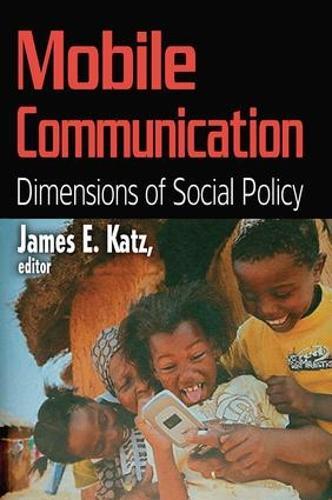
In the few short decades since their commercial deployment, 5 billion people—about three-quarters of all humanity, including children—have become mobile phone users. No technology has even approached the mobile phone's wildfire success. Effects of this success are apparent everywhere, ranging from accident scenes and earthquake rescue efforts to demeanor in the classroom and at dinner tables. No one interested in the next generation of issues provoked by the mobile communication revolution will want to miss this important new collection of essays. The mobile phone has given near-transcendent power to ordinary people. All aspects of social life have been touched by mobile technology. An ever-growing host of tracking, immersion, gaming, and commercial applications are becoming available. The community of mobile communication scholars has blossomed from a handful of pioneers a decade ago to a large and dynamic intellectual community that spans the globe. Area researchers have gained much insight into cultural, symbolic, and social interaction aspects of mobile communication as well as its relevance to commerce. To address the social policy dimension of the mobile communication revolution, this volume presents analyses by leading thinkers in the field. The volume offers novel and keen insights into the topic. Subjects include the role of mobiles in policy formation and evaluation in several areas including the mobile-digital divide and political campaigns. Also explored are processes and policy implications of mobiles in creating or alleviating social problems including social isolation and family dispersion. Other chapters analyze social policies for mobile devices, including attempts to regulate the use of the technology and to understand and moderate its potential harm to human health. The contributors' scope ranges across five continents and they address concerns at local, national, and international levels.
Full Product Details
Author: James E. Katz
Publisher: Taylor & Francis Inc
Imprint: Routledge
Dimensions:
Width: 15.20cm
, Height: 2.30cm
, Length: 22.90cm
Weight: 0.608kg
ISBN: 9781412814683
ISBN 10: 1412814685
Pages: 340
Publication Date: 15 May 2011
Audience:
College/higher education
,
General/trade
,
Tertiary & Higher Education
,
General
Format: Hardback
Publisher's Status: Active
Availability: In Print

This item will be ordered in for you from one of our suppliers. Upon receipt, we will promptly dispatch it out to you. For in store availability, please contact us.
Reviews
Katz notes that three-quarters of the world's population (5 billion people) now uses mobile phones for thousands of applications that run from simple telephone calls to mobile banking. Most of this has happened in the past decade. Among the fascinating and important topics covered are the role of social networks during disasters (with case examples from China and Sri Lanka), how mobile phones are being used in elections (with case examples from South Africa and the United States), location-based services, SMS wars, m-government, and the use of mobile phones by criminals inside and outside of prison. Running through these case studies are important policy themes--industrial, political, and social. This work is a major contribution to our understanding of mobile communication. Editor and contributor James Katz is joined by a virtual who's who of communication scholars including Campbell, Fortunati, Goggin, and Ling, to name just a few. It is a must read for anyone who follows mobile communication. --John Carey, professor of communications and media management, Fordham University Mobile communication is a global phenomenon. James Katz has put together a remarkable book which discusses the role of mobile phones in a global society with powerful theoretical articulation and cutting-edge empirical findings. There is no doubt that this unique book's interdisciplinary approach and international perspective will appeal to a large general audience, as well as be essential reading to students and professionals worldwide. --Boxu Yang, professor of journalism and communication, Peking University -Katz notes that three-quarters of the world's population (5 billion people) now uses mobile phones for thousands of applications that run from simple telephone calls to mobile banking. Most of this has happened in the past decade. Among the fascinating and important topics covered are the role of social networks during disasters (with case examples from China and Sri Lanka), how mobile phones are being used in elections (with case examples from South Africa and the United States), location-based services, SMS wars, m-government, and the use of mobile phones by criminals inside and outside of prison. Running through these case studies are important policy themes--industrial, political, and social. This work is a major contribution to our understanding of mobile communication. Editor and contributor James Katz is joined by a virtual who's who of communication scholars including Campbell, Fortunati, Goggin, and Ling, to name just a few. It is a must read for anyone who follows mobile communication.- --John Carey, professor of communications and media management, Fordham University -Mobile communication is a global phenomenon. James Katz has put together a remarkable book which discusses the role of mobile phones in a global society with powerful theoretical articulation and cutting-edge empirical findings. There is no doubt that this unique book's interdisciplinary approach and international perspective will appeal to a large general audience, as well as be essential reading to students and professionals worldwide.- --Boxu Yang, professor of journalism and communication, Peking University
Katz notes that three-quarters of the world's population (5 billion people) now uses mobile phones for thousands of applications that run from simple telephone calls to mobile banking. Most of this has happened in the past decade. Among the fascinating and important topics covered are the role of social networks during disasters (with case examples from China and Sri Lanka), how mobile phones are being used in elections (with case examples from South Africa and the United States), location-based services, SMS wars, m-government, and the use of mobile phones by criminals inside and outside of prison. Running through these case studies are important policy themes--industrial, political, and social. This work is a major contribution to our understanding of mobile communication. Editor and contributor James Katz is joined by a virtual who's who of communication scholars including Campbell, Fortunati, Goggin, and Ling, to name just a few. It is a must read for anyone who follows mobile communication. --John Carey, professor of communications and media management, Fordham University Mobile communication is a global phenomenon. James Katz has put together a remarkable book which discusses the role of mobile phones in a global society with powerful theoretical articulation and cutting-edge empirical findings. There is no doubt that this unique book's interdisciplinary approach and international perspective will appeal to a large general audience, as well as be essential reading to students and professionals worldwide. --Boxu Yang, professor of journalism and communication, Peking University
Author Information
James E. Katz is professor and chair of the Department of Communication at Rutgers University where he also directs the Center for Mobile Communication Studies. In 2009, he was the Fulbright Distinguished Chair in Twentieth Century Communications History (Italy). Prior to coming to Rutgers, Katz headed a social science research unit at Bell Communications Research. He has two patents in the telecommunications field and has held fellowships at Harvard and MIT. He is the author of Magic in the Air: Mobile Communication and the Transformation of Social Life and Connections: Social and Cultural Studies of the Telephone in American Life, published by Transaction.