Overview
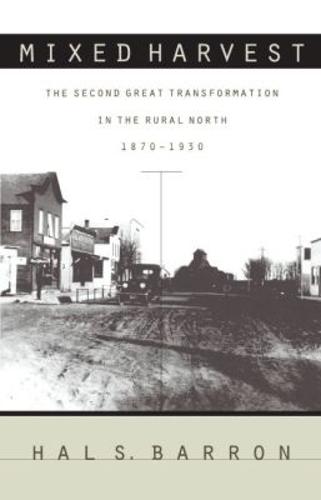
Mixed Harvest explores rural responses to the transformation of the northern United States from an agricultural society into an urban and industrial one. According to Hal S. Barron, country people from New England to North Dakota negotiated the rise of large-scale organizational society and consumer culture in ways marked by both resistance and accommodation, change and continuity. Between 1870 and 1930, communities in the rural North faced a number of challenges. Reformers and professionals sought to centralize authority and diminish local control over such important aspects of rural society as schools and roads; large-scale business corporations wielded increasing market power, to the detriment of independent family farmers; and an encroaching urban-based consumer culture threatened rural beliefs in the primacy of their local communities and the superiority of country life. But, Barron argues, by reconfiguring traditional rural values of localism, independence, republicanism, and agrarian fundamentalism, country people successfully created a distinct rural subculture. Consequently, agrarian society continued to provide a counterpoint to the dominant trends in American society well into the twentieth century.
Full Product Details
Author: Hal S. Barron
Publisher: The University of North Carolina Press
Imprint: The University of North Carolina Press
Dimensions:
Width: 15.50cm
, Height: 2.80cm
, Length: 23.40cm
Weight: 0.721kg
ISBN: 9780807823545
ISBN 10: 0807823546
Pages: 320
Publication Date: 31 October 1997
Audience:
College/higher education
,
Professional and scholarly
,
Undergraduate
,
Postgraduate, Research & Scholarly
Format: Hardback
Publisher's Status: Out of Print
Availability: Out of stock

Reviews
""[An] excellent study"" -- Agricultural History ""A significant contribution to the study of cultural history. . . . For historians of technology the work demonstrates the heterogenous beliefs and behaviors of rural northerners toward new technology and strategies. It is an excellent survey of the complexities of rural life in the Northern United States in the period from 1870 to 1930."" -- Technology & Culture ""Ambitious and masterful, an exceptional addition to the new rural history."" -- Reviews in American History ""An excellent study of how rural northerners responded to the profound changes of America's industrial transformation from 1870 to 1930. Barron breaks new ground in explaining how farm families both resisted and accepted the new organizational society and consumer culture of the twentieth century."" -- David E. Hamilton, University of Kentucky ""An important and insightful contribution to the literature of rural America during the Progressive Era."" -- New England Quarterly ""Barron's book is a major contribution not only to rural social history but also to the literature on the transformations that characterized this era. Barron moves our perspective from the city to the country, a worthwhile journey that will be anything but a mixed harvest for those who make it.""American Historical Review ""Barron's work deserves . . . the keen attention of American rural, social, cultural, and political historians."" -- Journal of Illinois History ""Deeply researched . . . [and] described with clear prose, and analyzed with subtlety and sensitivity. Barron succeeds in skillfully connecting patterns of change in rural America to their better-studied counterparts in urban America."" -- Wisconsin Magazine of History ""Demonstrates the heterogeneous beliefs and behaviors of rural northerners toward new technology and strategies. . . . An excellent survey of the complexities of rural life in the Northern United States in the period from 1870 to 1930."" -- Technology and Culture
Author Information
Hal S. Barron, author of Those Who Stayed Behind: Rural Society in Nineteenth-Century New England, is professor of history at Harvey Mudd College and a member of the history faculty at the Claremont Graduate School in California, USA.