Overview
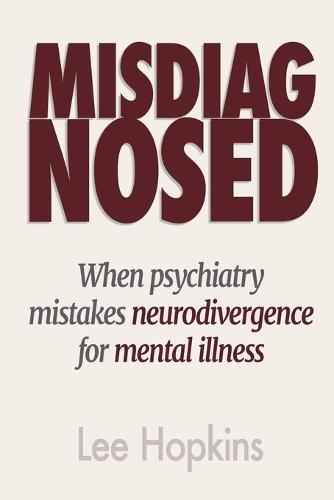
Every year, countless autistic, ADHD, AuDHD, and otherwise neurodivergent people walk into a psychiatrist's office seeking clarity and walk out with a diagnosis that fits poorly, explains little, and often makes life worse. Depression, anxiety, bipolar, borderline, personality disorders, treatment-resistant this, medication-heavy that, lifelong labels assigned in minutes. For many, the real story isn't mental illness at all. It's neurodivergence that went unrecognised, misunderstood, or misinterpreted under outdated clinical frameworks. Misdiagnosed exposes how this happens, why it keeps happening, and the profound consequences for the people caught in the gap between psychiatry's assumptions and neurodivergent reality. Drawing from research, lived experience, clinical practice, and the growing scientific shift toward neurodevelopmental explanations, this book shows how sensory overload, autistic burnout, rejection sensitivity, executive dysfunction, emotional dysregulation, masking, trauma histories, chronic sleep disruption, and rigid social expectations can mimic or be mistaken for psychiatric disorders. Instead of presenting neurodivergent people as disordered, broken, or deficient, Misdiagnosed reframes these presentations as adaptive responses, mismatches, and misunderstood communication styles. It details the specific patterns that lead clinicians toward incorrect diagnoses, the blind spots that persist in psychiatric training, and the systemic pressures that reward quick labels over deep understanding. For individuals, families, and professionals, this book offers practical tools for recognising neurodivergent presentations, distinguishing them from illness-based symptomology, and communicating more effectively with healthcare providers. It outlines what good assessment actually looks like, what questions to ask, what red flags to watch for, and what steps to take if you suspect a diagnosis missed its mark. Misdiagnosed is not anti-psychiatry. It is pro-accuracy, pro-humanity, and pro-understanding. It argues for a future where neurodivergent distress is not pathologised but contextualised, where support replaces stigma, and where clinicians listen before labelling. If you've ever felt that your diagnosis doesn't quite fit, that treatments haven't worked, or that something essential about your brain has been overlooked, this book offers the language, clarity, and framework you've been searching for.
Full Product Details
Author: Lee Hopkins
Publisher: Lee Hopkins
Imprint: Lee Hopkins
Dimensions:
Width: 15.20cm
, Height: 0.90cm
, Length: 22.90cm
Weight: 0.227kg
ISBN: 9798233407031
Pages: 162
Publication Date: 21 February 2026
Audience:
General/trade
,
General
Format: Paperback
Publisher's Status: Active
Availability: Available To Order

We have confirmation that this item is in stock with the supplier. It will be ordered in for you and dispatched immediately.