Overview
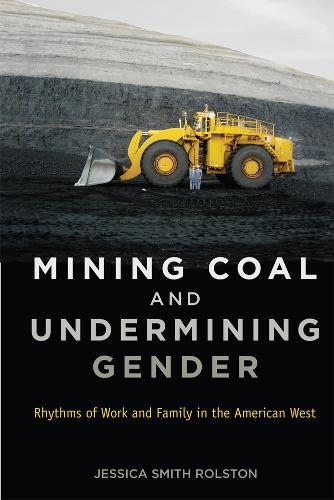
Winner of the 2018 Distinguished Book Award from the Western Social Science Association? Though mining is an infamously masculine industry, women make up 20 percent of all production crews in Wyoming's Powder River Basin-the largest coal-producing region in the United States. How do these women fit into a working culture supposedly hostile to females? This is what anthropologist Jessica Smith Rolston, herself a onetime mine worker and the daughter of a miner, set out to discover. Her answers, based on years of participant-observation in four mines and extensive interviews with miners, managers, engineers, and the families of mine employees, offer a rich and surprising view of the working ""families"" that miners construct. In this picture, gender roles are not nearly as straightforward-or as straitened-as stereotypes suggest. Gender is far from the primary concern of coworkers in crews. Far more important, Rolston finds, is protecting the safety of the entire crew and finding a way to treat each other well despite the stresses of their jobs. These miners share the burden of rotating shift work-continually switching between twelve-hour day and night shifts-which deprives them of the daily rhythms of a typical home, from morning breakfasts to bedtime stories. Rolston identifies the mine workers' response to these shared challenges as a new sort of constructed kinship that both challenges and reproduces gender roles in their everyday working and family lives. Crews' expectations for coworkers to treat one another like family and to adopt an ""agricultural"" work ethic tend to minimize gender differences. And yet, these differences remain tenacious in the equation of masculinity with technical expertise, and of femininity with household responsibilities. For Rolston, such lingering areas of inequality highlight the importance of structural constraints that flout a common impulse among men and women to neutralize the significance of gender, at home and in the workplace. At a time when the Appalachian region continues to dominate discussion of mining culture, this book provides a very different and unexpected view-of how miners live and work together, and of how their lives and work reconfigure ideas of gender and kinship.
Full Product Details
Author: Jessica Smith Rolston
Publisher: Rutgers University Press
Imprint: Rutgers University Press
Dimensions:
Width: 15.20cm
, Height: 1.70cm
, Length: 22.90cm
Weight: 0.513kg
ISBN: 9780813563688
ISBN 10: 0813563682
Pages: 264
Publication Date: 31 March 2014
Audience:
Professional and scholarly
,
Professional and scholarly
,
Professional & Vocational
,
Professional & Vocational
Format: Hardback
Publisher's Status: Active
Availability: Manufactured on demand

We will order this item for you from a manufactured on demand supplier.
Reviews
This elegantly written, theoretically sophisticated, and ethnographically rich book makes an important contribution to cultural understanding of labor, gender and kinship in the complex context of twenty-first century capitalism. --Janet L. Finn author of Mining Childhood: Growing Up in Butte, Montana, 1900-1960 (05/09/2013) A profound contribution to new kinship studies and temporality studies in anthropology, women and gender studies, labor studies, and political economic literature. --Anthropology of Work Review
This elegantly written, theoretically sophisticated, and ethnographically rich book makes an important contribution to cultural understanding of labor, gender and kinship in the complex context of twenty-first century capitalism. --Janet L. Finn author of Mining Childhood: Growing Up in Butte, Montana, 1900-1960 (05/09/2013)
"""A profound contribution to new kinship studies and temporality studies in anthropology, women and gender studies, labor studies, and political economic literature.""-- ""Anthropology of Work Review"" ""This elegantly written, theoretically sophisticated, and ethnographically rich book makes an important contribution to cultural understanding of labor, gender and kinship in the complex context of twenty-first century capitalism.""--Janet L. Finn ""author of Mining Childhood: Growing Up in Butte, Montana, 1900-1960"""
""This elegantly written, theoretically sophisticated, and ethnographically rich book makes an important contribution to cultural understanding of labor, gender and kinship in the complex context of twenty-first century capitalism."" - Janet L. Finn (author of Mining Childhood: Growing Up in Butte, Montana, 1900-1960) ""A profound contribution to new kinship studies and temporality studies in anthropology, women and gender studies, labor studies, and political economic literature."" (Anthropology of Work Review)
Author Information
JESSICA SMITH ROLSTON is the Hennebach Assistant Professor of Energy Policy in the Division of Liberal Arts and International Studies at the Colorado School of Mines. An anthropologist by training, she also publishes on corporate social responsibility in extractive industries.