Full Product Details
Author: Jeremiah J. Sims ,
Jeremiah J. Sims ,
Jennifer Taylor-Mendoza ,
Lasana O. Hotep
Publisher: Peter Lang Publishing Inc
Imprint: Peter Lang Publishing Inc
Edition: New edition
Volume: 1
Weight: 0.466kg
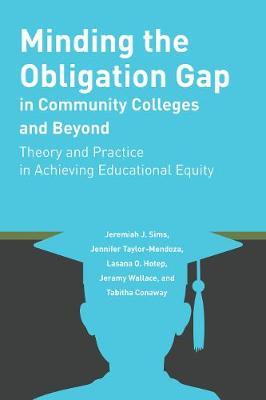
ISBN: 9781433177132
ISBN 10: 1433177137
Pages: 250
Publication Date: 29 May 2020
Audience:
Professional and scholarly
,
Professional & Vocational
Format: Hardback
Publisher's Status: Active
Availability: Manufactured on demand

We will order this item for you from a manufactured on demand supplier.
Reviews
This book will serve as a guide and invaluable resource to educators at community colleges who seek to create pipelines to opportunity for students who have historically been under-served and poorly served by these institutions. With a keen understanding of the obstacles many students face, the authors draw upon their knowledge and experience to show how barriers that presently limit access to education can be disrupted and knocked down. Inspiring and engaging, this book is a must-read for educators who truly seek to make a difference. Pedro A. Noguera, PhD, Distinguished Professor of Education UCLA Graduate School of Education & Information Studies Grounded in a strength-based perspective, Minding the Obligation Gap in Community Colleges and Beyond makes a compelling case for educators to recognize the power and impact of their words on students' lives. The authors not only interrogate common educational perspectives, but they deconstruct common practices of the academy that often perpetuate inequities. This book compels educators to look within when considering needed change so that typically marginalized and minoritized students can share the sheer majesty of their intellect and talent - and be recognized for it. --Dr. Regina Stanback Stroud, Chancellor for the Peralta Community College District
This book will serve as a guide and invaluable resource to educators at community colleges who seek to create pipelines to opportunity for students who have historically been under-served and poorly served by these institutions. With a keen understanding of the obstacles many students face, the authors draw upon their knowledge and experience to show how barriers that presently limit access to education can be disrupted and knocked down. Inspiring and engaging, this book is a must-read for educators who truly seek to make a difference. -Pedro A. Noguera, Distinguished Professor of Education, UCLA Graduate School of Education & Information Studies Grounded in a strength-based perspective, Minding the Obligation Gap in Community Colleges and Beyond makes a compelling case for educators to recognize the power and impact of their words on students' lives. The authors not only interrogate common educational perspectives, but they deconstruct common practices of the academy that often perpetuate inequities. This book compels educators to look within when considering needed change so that typically marginalized and minoritized students can share the sheer majesty of their intellect and talent-and be recognized for it. -Regina Stanback Stroud, Chancellor, Peralta Community College District
Author Information
Jeremiah J. Sims, inaugural Director of Equity for the College of San Mateo (California), is an alumnus of the University of California, Berkeley where he earned a B.A. in rhetoric, with honors, as well as an M.A. and Ph.D. in education. Jeremiah’s work, chronicled in his first book, Revolutionary STEM Education: Critical-Reality Pedagogy and Social Justice in STEM for Black Males (Lang, 2018), details his experiences as an educator working toward a revolutionary, paradigm shift in the STEM education of and for Black boys. Jennifer Taylor-Mendoza is Vice President of Instruction at Skyline College (California), with over twenty years of higher education experience. Dr. Taylor-Mendoza is continually inspired by the brilliance, power, and endless potential of community college students. Her research focuses on the intrinsic resiliency of students of color and institutional approaches to addressing systemic, structural inequities. She holds a B.A. in psychology from California State University, Los Angeles, an M.S. in counseling from California State University, Northridge, and a Ph.D. in education from Claremont Graduate University. Lasana O. Hotep, inaugural Dean of Student Equity and Support Programs and founding Executive Director of the Equity Institute at Skyline College (California), earned his B.A. in speech communications and history at Texas State University, San Marcos and his M.A. in history from Arizona State University. For over 15 years, he has worked at large research universities, two-year colleges, and as a consultant to educational and corporate entities in addressing issues of race, gender, and social justice and their impact on organizational success. Jeramy Wallace, Associate Professor of English at the College of San Mateo in San Mateo, California, received his M.A. in English from Notre Dame de Namur University and his postsecondary teaching credentials from San Francisco State University. He has written and presented widely on race, educational equity, and social justice in community colleges. Tabitha Conaway, Basic Skills Coordinator at the College of San Mateo, holds a B.A. in African American studies from University of California, Los Angeles, an M.A. in education from National University, an M.A. in history from California State University, Sacramento, and a doctorate in education from San Francisco State University. Her research interests include juvenile hall-to-college pipelines for previously incarcerated youth, counter-narratives, and creating educational equity concerns for historically underserved and underrepresented students in higher education.