Overview
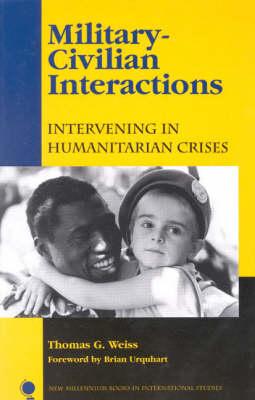
Is it possible and worthwhile to use the military in conjunction with humanitarian action to thwart violence and mitigate civilian suffering? This timely book seeks to answer this question by looking at the contemporary context and history of military-civilian interactions, developing a framework for assessing military costs and civilian benefits, and examining in depth the five most prominent cases-Northern Iraq, Somalia, Bosnia, Rwanda, and Haiti. Visit our website for sample chapters!
Full Product Details
Author: Thomas G. Weiss ,
Brian Urquhart
Publisher: Rowman & Littlefield
Imprint: Rowman & Littlefield
Dimensions:
Width: 14.80cm
, Height: 1.60cm
, Length: 22.80cm
Weight: 0.399kg
ISBN: 9780847687466
ISBN 10: 0847687465
Pages: 304
Publication Date: 23 December 1998
Audience:
College/higher education
,
Professional and scholarly
,
Undergraduate
,
Postgraduate, Research & Scholarly
Format: Paperback
Publisher's Status: Out of Print
Availability: Out of print, replaced by POD

We will order this item for you from a manufatured on demand supplier.
Reviews
This book adds real flesh to the bones of comparative analysis of humanitarian-military response. -- S Neil MacFarlane, University of Oxford The author's technique of analyzing five major interventions using a parallel framework is quite effective and will make the book useful in classes that emphasize the systematic analysis of political situations. It could well become a classic. -- Philip Schrodt, University of Kansas Well-written, interesting, and timely... This well-researched book includes an excellent bibliography and a helpful glossary, maps, and tables. It could serve as a valuable text in undergraduate and graduate national security and foreign policy classes and deserves a spot in university and professional libraries. CHOICE It is difficult to imagine anyone being more rigorous or consistent ... The case studies are well covered and there is plenty of wisdom in the excellent concluding chapter... in a debate which will keep academics and policy makers alike busy for many years, he has laid the foundations on which others may build. -- Commodore Tim Laurence, Royal Navy, JSCSC Bracknell Royal United Services Institute For Defense Studies An ambitious and well-meaning book. Provides a wealth of data and will be very valuable for refence and as a guide to source material. International Affairs Only a very courageous author would lead the first reconnaissance patrol into this murky and booby-trapped territory. That is what Thomas Weiss has done in this book. His work provides a very useful starting point from which governments and others can begin to devise better ways to meet humanitarian emergencies in the future. -- Brian Urquhart, from the foreword This valuable book is a sober analysis by a well-regarded scholar with wide UN experience, and a former director of the International Peace Academy. International Journal on World Peace
This book adds real flesh to the bones of comparative analysis of humanitarian-military response. -- S Neil MacFarlane, University of Oxford The author's technique of analyzing five major interventions using a parallel framework is quite effective and will make the book useful in classes that emphasize the systematic analysis of political situations. It could well become a classic. -- Philip Schrodt, University of Kansas Well-written, interesting, and timely... This well-researched book includes an excellent bibliography and a helpful glossary, maps, and tables. It could serve as a valuable text in undergraduate and graduate national security and foreign policy classes and deserves a spot in university and professional libraries. CHOICE It is difficult to imagine anyone being more rigorous or consistent ... The case studies are well covered and there is plenty of wisdom in the excellent concluding chapter... in a debate which will keep academics and policy makers alike busy for many years, he has laid the foundations on which others may build. -- Commodore Tim Laurence, Royal Navy, JSCSC Bracknell Royal United Services Institute For Defense Studies An ambitious and well-meaning book. Provides a wealth of data and will be very valuable for refence and as a guide to source material. International Affairs Only a very courageous author would lead the first reconnaissance patrol into this murky and booby-trapped territory. That is what Thomas Weiss has done in this book. His work provides a very useful starting point from which governments and others can begin to devise better ways to meet humanitarian emergencies in the future. -- Brian Urquhart, from the foreword This valuable book is a sober analysis by a well-regarded scholar with wide UN experience, and a former director of the International Peace Academy. International Journal On World Peace
The author 's technique of analyzing five major interventions using a parallel framework is quite effective and will make the book useful in classes that emphasize the systematic analysis of political situations. It could well become a classic.--Philip Schrodt
Author Information
Thomas G. Weiss is distinguished professor of political science at the Graduate School and University Center, City University of New York.