Overview
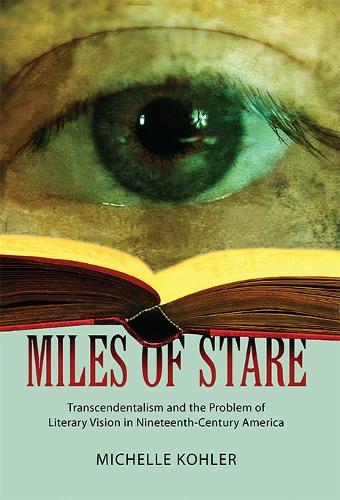
Miles of Stare explores the problem of nineteenth-century American literary vision: the strange conflation of visible reality and poetic language that emerges repeatedly in the metaphors and literary creations of American transcendentalists. The strangeness of nineteenth-century poetic vision is exemplified most famously by Emerson’s transparent eyeball. That disembodied, omniscient seer is able to shed its body and transcend sight paradoxically in order to see - not to create - poetic language “manifest” on the American landscape. In Miles of Stare, Michelle Kohler explores the question of why, given American transcendentalism’s anti-empiricism, the movement’s central trope becomes an eye purged of imagination. And why, furthermore, she asks, despite its insistent empiricism, is this notorious eye also so decidedly not an eye? What are the ethics of casting a boldly equivocal metaphor as the source of a national literature amidst a national landscape fraught with slavery, genocide, poverty, and war? Miles of Stare explores these questions first by tracing the historical emergence of the metaphor of poetic vision as the transcendentalists assimilated European precedents and wrestled with America’s troubling rhetoric of manifest destiny and national identity. These questions are central to the work of many nineteenth-century authors writing in the wake of transcendentalism, and Kohler offers examples from the writings of Douglass, Hawthorne, Dickinson, Howells, and Jewett that form a cascade of new visual metaphors that address the irreconcilable contradictions within the transcendentalist metaphor and pursue their own efforts to produce an American literature. Douglass’s doomed witness to slavery, Hawthorne’s reluctantly omniscient narrator, and Dickinson’s empty “miles of Stare” variously skewer the authority of Emerson’s all-seeing poetic eyeball while attributing new authority to the limitations that mark their own literary gazes. Tracing this metaphorical conflict across genres from the 1830s through the 1880s, Miles of Stare illuminates the divergent, contentious fates of American literary vision as nineteenth-century writers wrestle with the commanding conflation of vision and language that lies at the centre of American transcendentalism- and at the core of American national identity.
Full Product Details
Author: Michelle Kohler
Publisher: The University of Alabama Press
Imprint: The University of Alabama Press
Edition: 4th
Dimensions:
Width: 15.20cm
, Height: 2.70cm
, Length: 23.10cm
Weight: 0.513kg
ISBN: 9780817318352
ISBN 10: 0817318356
Pages: 256
Publication Date: 30 June 2014
Audience:
College/higher education
,
Postgraduate, Research & Scholarly
Format: Hardback
Publisher's Status: Active
Availability: Temporarily unavailable

The supplier advises that this item is temporarily unavailable. It will be ordered for you and placed on backorder. Once it does come back in stock, we will ship it out to you.
Reviews
In the most comprehensive analysis to date, Michelle Kohler opens up the surprising heterogeneity of nineteenth-century American literary vision: how--as problematic figure, pervasive theme, and shared cultural activity--writers variously contested and revised national vision to make a place for other eyes, other identities, other modes of knowledge. This is Americanist literary scholarship at its best: generous, historically and culturally astute, forcefully and lucidly written, and rich with subtle readings of central works.--William Rossi, coeditor of Emerson and Thoreau: Figures of Friendship
""With a rare combination of thoroughgoing erudition and playful close reading, Michelle Kohler redefines Ralph Waldo Emerson's consequence for the American scene....A milestone in American studies, Miles of Stare establishes a focused but flexible outlook on the difficult fascination of American literary vision."" --The Emily Dickinson Journal ""Impressive close readings, rich historical context, and graceful prose make this a strong addition to the many scholarly considerations of the 19th-century problem of seeing."" --CHOICE In the most comprehensive analysis to date, Michelle Kohler opens up the surprising heterogeneity of nineteenth-century American literary vision: how--as problematic figure, pervasive theme, and shared cultural activity--writers variously contested and revised national vision to make a place for other eyes, other identities, other modes of knowledge. This is Americanist literary scholarship at its best: generous, historically and culturally astute, forcefully and lucidly written, and rich with subtle readings of central works. --William Rossi, coeditor of Emerson and Thoreau: Figures of Friendship ""Miles of Stare is ambitious, important, and convincing. Kohler pursues her argument across a significant portion of American literary history and thoughtfully challenges the standard reception of the texts under discussion. By analyzing the influence of American transcendentalism on literature through American Realism, Kohler pursues a vexing question in literary scholarship: what is the precise influence of the transcendentalists' 'strange and strained conflation of visible reality and literary language, ' and how might a better understanding of this influence revise scholarly understandings of American Realism? Kohler provides a most compelling answer."" --Rochelle L. Johnson, author of Passions for Nature: Nineteenth-Century America's Aesthetics of Alienation
""In the most comprehensive analysis to date, Michelle Kohler opens up the surprising heterogeneity of nineteenth-century American literary vision: how--as problematic figure, pervasive theme, and shared cultural activity--writers variously contested and revised national vision to make a place for other eyes, other identities, other modes of knowledge. This is Americanist literary scholarship at its best: generous, historically and culturally astute, forcefully and lucidly written, and rich with subtle readings of central works."" --William Rossi, coeditor of Emerson and Thoreau: Figures of Friendship ""With a rare combination of thoroughgoing erudition and playful close reading, Michelle Kohler redefines Ralph Waldo Emerson's consequence for the American scene....A milestone in American studies, Miles of Stare establishes a focused but flexible outlook on the difficult fascination of American literary vision."" --The Emily Dickinson Journal ""Impressive close readings, rich historical context, and graceful prose make this a strong addition to the many scholarly considerations of the 19th-century problem of seeing."" --CHOICE ""Miles of Stare is ambitious, important, and convincing. Kohler pursues her argument across a significant portion of American literary history and thoughtfully challenges the standard reception of the texts under discussion. By analyzing the influence of American transcendentalism on literature through American Realism, Kohler pursues a vexing question in literary scholarship: what is the precise influence of the transcendentalists' 'strange and strained conflation of visible reality and literary language, ' and how might a better understanding of this influence revise scholarly understandings of American Realism? Kohler provides a most compelling answer."" --Rochelle L. Johnson, author of Passions for Nature: Nineteenth-Century America's Aesthetics of Alienation
Miles of Stare is ambitious, important, and convincing. Kohler pursues her argument across a significant portion of American literary history and thoughtfully challenges the standard reception of the texts under discussion. By analyzing the influence of American transcendentalism on literature through American Realism, Kohler pursues a vexing question in literary scholarship: what is the precise influence of the transcendentalists strange and strained conflation of visible reality and literary language, and how might a better understanding of this influence revise scholarly understandings of American Realism? Kohler provides a most compelling answer. Rochelle L. Johnson, author of Passions for Nature: Nineteenth-Century America s Aesthetics of Alienation
Author Information
Michelle Kohler is assistant professor of English at Tulane University.