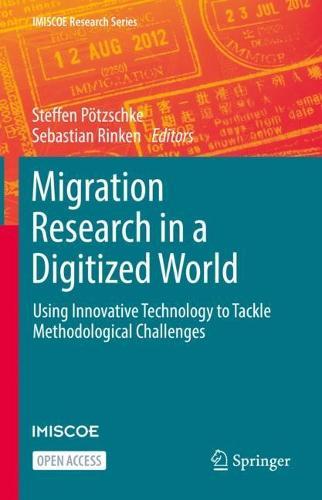
Migration Research in a Digitized World: Using Innovative Technology to Tackle Methodological Challenges

Author:   Steffen Pötzschke ,  Sebastian Rinken
Publisher:   Springer International Publishing AG
Edition:   1st ed. 2022
ISBN:  

9783031013188


Pages:   220
Publication Date:   13 July 2022
Format:   Hardback
Availability:   Manufactured on demand   Availability explained
We will order this item for you from a manufactured on demand supplier.

Our Price $116.41 Quantity:  
Add to Cart

Share |

Migration Research in a Digitized World: Using Innovative Technology to Tackle Methodological Challenges


Overview

This open access book explores implications of the digital revolution for migration scholars’ methodological toolkit. New information and communication technologies hold considerable potential to improve the quality of migration research by originating previously non-viable solutions to a myriad of methodological challenges in this field of study. Combining cutting-edge migration scholarship and methodological expertise, the book addresses a range of crucial issues related to both researcher-designed data collections and the secondary use of “big data”, highlighting opportunities as well as challenges and limitations. A valuable source for students and scholars engaged in migration research, the book will also be of keen interest to policymakers.

Full Product Details

Author:   Steffen Pötzschke ,  Sebastian Rinken
Publisher:   Springer International Publishing AG
Imprint:   Springer International Publishing AG
Edition:   1st ed. 2022
Weight:   0.530kg
ISBN:  

9783031013188


ISBN 10:   3031013182
Pages:   220
Publication Date:   13 July 2022
Audience:   Professional and scholarly ,  Professional & Vocational
Format:   Hardback
Publisher's Status:   Active
Availability:   Manufactured on demand   Availability explained
We will order this item for you from a manufactured on demand supplier.

Table of Contents

Chapter 1. Introduction: Using Innovative Technologies to Tackle Methodological Challenges in Migration Research.- Part I: INNOVATION IN MIGRANT SURVEYS.- Chapter 2. Innovative Sample Designs for Studies of Refugees and Internally Displaced Persons.- Chapter 3. Targeting on Social Networking Sites as Sampling Strategy for Online Migrant Surveys: The Challenge of Biases and Search for Possible Solutions.- Chapter 4. Web-Based Respondent-Driven Sampling in Research on Multiple Migrants: Challenges and Opportunities.- Chapter 5. Computer-assisted Migration Research: What We Can Learn about Source Questionnaire Design and Translation from the Software Localization Field.- Chapter 6. Surveying Illiterates: Are Audio Files in Computer-assisted Self-interviews a Useful Supportive Tool?.- Part II: NEW DATA SOURCES AND THEIR POTENTIAL.- Chapter 7. Leveraging the Web for Migration Studies: Data Sources and Data Extraction.- Chapter 8. How Canada’s Data Ecosystem Offers Insights on the Optionsfor Studying Migration in an Unprecedented Era of Information.- Chapter 9. Assessing Transnational Human Mobility on a Global Scale.- Chapter 10. Google Trends as a Tool for Public Opinion Research: An Illustration of the Perceived Threats of Immigration.- Chapter 11. Conclusion: Migration Research in Times of Ubiquitous Digitization.

Reviews

Author Information

Steffen Pötzschke is a postdoctoral researcher and deputy team leader of the GESIS Panel at the GESIS – Leibniz-Institute for the Social Sciences in Mannheim (Germany). Furthermore, he is a corresponding member of the Institute for Migration Research and Intercultural Studies (University of Osnabrück, Germany). Steffen holds a master’s degree in International Migration and Intercultural Relations and a doctorate (Dr. phil.) from the University of Osnabrück. Steffen participated in several migration research projects and has profound practical knowledge in designing and implementing cross-cultural surveys. In his recent research, he investigates the possibility of using social networking sites as tools to sample hard-to-reach populations. Sebastian Rinken (PhD, European University Institute, 1996) is deputy director of the Spanish Research Council’s Institute for Advanced Social Studies (IESA-CSIC) in Córdoba. He has published widely on immigrant populations’ social integration and natives’ attitudes toward immigration and immigrants, addressing issues such as the relation between ideological polarization and anti-immigrant sentiment, as well as the methodological challenge of eluding social desirability bias, among many others. His methodological repertoire includes qualitative approaches, probability-based surveys, non-probability sampling for on-site and online surveys, and survey experiments.

Tab Content 6

Author Website:  

Countries Available

All regions
Latest Reading Guide

NOV RG 20252


Shopping Cart
Your cart is empty
Shopping cart
Mailing List