Overview
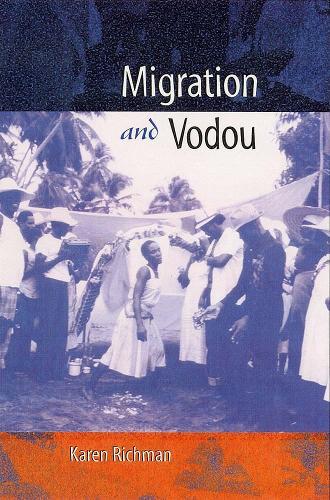
This book and accompanying compact disc provide a rare insight in the innovative ways a community of Haitian migrants in South Florida has maintained religious traditions and familial connections. It demonstrates how religion, ritual, and cultural practices affect lives on both sides of the Caribbean, and it debunks myths of exotic and primitive vodou (often spelled """"voo doo""""), which have long been used against Haitians. As Karen Richman shows, Haitians at home and in migrant settlements make ingenious use of audio and video tapes to extend the boundaries of their ritual spaces and to reinforce the moral and spiritual anchors to one another. The book and CD were produced in collaboration to give the reader intimate access to this new expressive media. Sacred songs are recorded on tapes and circulated among the communities. Migrants are able to hear not only the performance sounds - drumming, singing, and chatter - but also a description, as narrators tell of offerings, sacrifices, prayers, and the exchange of possessions. Spirits who inhabit the bodies of ritual actors are aware of the recording devices and personally address the absent migrants, sometimes warning them of their financial obligations to family members in Haiti. The migrants' dependence on their home village is dramatically reinforced while their economic independence is restricted. Using standard ethnographic methods, Richman's work illuminates the connections among social organization, power, production, ritual, and aesthetics. With its transnational perspective, it shows how labor migration has become one of Haiti's chief economic exports.
Full Product Details
Author: Karen E. Richman
Publisher: University Press of Florida
Imprint: University Press of Florida
Dimensions:
Width: 16.40cm
, Height: 2.60cm
, Length: 23.50cm
Weight: 0.677kg
ISBN: 9780813028354
ISBN 10: 0813028353
Pages: 360
Publication Date: 31 July 2005
Audience:
College/higher education
,
Professional and scholarly
,
Undergraduate
,
Postgraduate, Research & Scholarly
Format: Hardback
Publisher's Status: Out of Print
Availability: Out of stock

Reviews
"""Much more than just a good ethnography. It is the sensitive account of Richman's deeply personal experience of Haitian culture. It joins the ranks of powerful and compassionate ethnographies that take us to the heart of the anthropological enterprise. . . . A must read.""--American Anthropologist ""A tour de force of social history, narrative ethnography and ritual analysis.""--Anthropological Quarterly ""A very close look into diverging expectations and needs separating the Haitian transnational community and the ethos of extended families who compete for resources, power and moral integrity.""--Ethnos ""A work of great scholarship, compassion, and insight. . . . [T]he skill with which the author incorporates multi-sited ethnography, issues of transnational community, the development of a specific form of Vodou, political economy, and history in a single, rich narrative should serve as an example to other ethnographers.""--Journal of Latin American and Caribbean Anthropology ""Sets a new standard for Haitian ethnography.""--Journal of Latin American Geography ""Detailed and moving . . ., the end product of many years of research.""--H-Net"
Much more than just a good ethnography. It is the sensitive account of Richman's deeply personal experience of Haitian culture. It joins the ranks of powerful and compassionate ethnographies that take us to the heart of the anthropological enterprise. . . . A must read. --American Anthropologist A tour de force of social history, narrative ethnography and ritual analysis. --Anthropological Quarterly A very close look into diverging expectations and needs separating the Haitian transnational community and the ethos of extended families who compete for resources, power and moral integrity. --Ethnos A work of great scholarship, compassion, and insight. . . . [T]he skill with which the author incorporates multi-sited ethnography, issues of transnational community, the development of a specific form of Vodou, political economy, and history in a single, rich narrative should serve as an example to other ethnographers. --Journal of Latin American and Caribbean Anthropology Sets a new standard for Haitian ethnography. --Journal of Latin American Geography Detailed and moving . . ., the end product of many years of research. --H-Net
Author Information
Karen E. Richman, assistant professor of anthropology and fellow at the Kellogg Institute for International Studies and Institute for Latino Studies at the University of Notre Dame, is the author of articles on Haitian society, language, religion, migration, and politics.