Overview
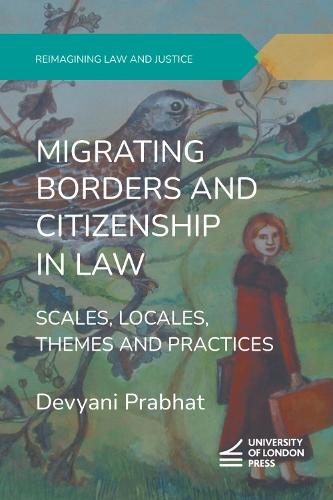
Borders not only demarcate nations and territories, but transform people into migrants. Hand-in-hand with law and law enforcement, borders create residents and foreigners. The law ascertains who crosses borders and who does not, and who remains foreign despite being within national borders. Migrating Borders and Citizenship in Law argues that law has multiple roles and mechanisms for breathing life into borders, operating at different locales and scales (from worldwide to the nation; from the family to the workplace), and through different practices, for example, preventing entry or withholding access to resources. It examines case law, legislation and press accounts relating to several key events in recent times that have changed the legal landscape on migration control, such as the Immigration and Nationality Acts in the UK, the end of empire, the arrival of Empire Windrush, Brexit, Covid and the case of Shamima Begum. Focusing on race and ethnicity, gender and class, as well as crime and control, the book contextualises the legal debates around these historical and political developments, the question of who belongs, the consequences of behaviour for immigration status and citizenship, and the links with conduct and national security. With its wide interdisciplinary framing of the law, drawing from sociology, politics, philosophy and history, this groundbreaking book will appeal to all readers with broad interests in migration studies.
Full Product Details
Author: Devyani Prabhat (Professor of Law, University of Bristol (United Kingdom))
Publisher: University of London
Imprint: University of London Press
ISBN: 9781911507499
ISBN 10: 1911507494
Pages: 272
Publication Date: 19 March 2026
Audience:
Professional and scholarly
,
Professional & Vocational
Format: Paperback
Publisher's Status: Forthcoming
Availability: Manufactured on demand

Reviews
Devyani Prabhat, inspired by her grandmother’s and mother’s migration experiences, brings together the many ways the law sorts people into those who belong and those who don’t, both across and within states. From its imperial origins to present-day immigration controls, she also shows how ‘bordering’, broadly understood, invades homes, workplaces and neighborhoods. A deeply impressive study. — Steven Lukes, Professor Emeritus, New York University, USA
Author Information
Devyani Prabhat is Professor of Law at University of Bristol Law School, UK, with legal practice experience in Constitutional law. She has a LLM and a PhD from New York University & is an enrolled Attorney at Law, NY. She researches and teaches Migration, Citizenship and Nationality from a socio-legal and comparative perspective. She is also an Associate Director of Border Criminologies, Oxford Law Faculty.