Overview
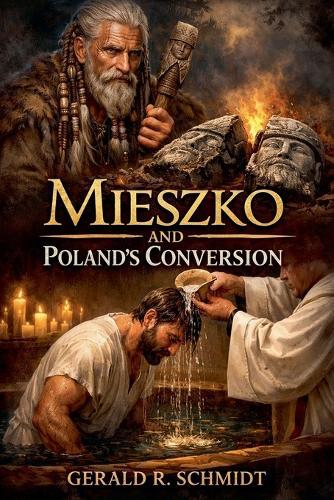
In this gripping historical novel, pagan Duke Mieszko I of the Polans converts to Christianity to wed Dobrawa, daughter of Czech Boleslav I, forging a vital alliance against threats by Saxony and the Empire. Set in 10th-C Europe, the story blends political intrigue, spiritual conflict, and supernatural tension. Mieszko's decision-demanded by Dobrawa and negotiated thru envoys-avoids Emperor Otto I's attempt at dominance while gaining legitimacy. Dobrawa's faith drives the terms: public baptism or no marriage. Shaman Mścislaw fiercely opposes the shift from Mt. Ślęża, increasingly corrupted by Veles, who offers dark power to preserve the old ways. Winter brings Mieszko's Easter decision and relocation to Ostrów Lednicki. The baptism occurs despite Mścislaw's failed supernatural disruption. Seeds of conversion take root thru Dobrawa's gentle influence, while pagan resistance hardens. Freshly Christian Poland faces immediate resistance and external peril. Mścislaw retreats to Mt. Ślęża, fortifying it as a pagan stronghold. Dobrawa builds a Christian household thru charity and example. Mieszko establishes Christian governance-curtailing feuds but provoking nobles. Fr. Jordan secures an independent bishopric from Rome, thwarting imperial control and enraging Otto I. Pagan elites withdraw to the country, forming shadow networks. Mścislaw strengthens Ślęża, while Veles spreads corruption via doubt and excess. Tensions rise until Mieszko marches on Ślęża. Amid a brutal ascent and supernatural clash with Veles, Mieszko's forces seize the summit; Mścislaw flees unconverted, his influence lingering. Rebuilding follows: churches, literacy, and law take root, though syncretism persists. Dobrawa's patient evangelization grows. Mścislaw grapples with doubt after human endurance trumps divine signs. Saxon threat escalates under Margrave Odo; Veles exploits fear via Mścislaw. Christian unity strains but holds. At Cedynia (972), Polans repel a Saxon invasion thru discipline and terrain. Victory unites Christians and pagans in national pride, transcending divides and weakening Veles' hold on Mścislaw. Victory solidifies Mieszko's rule, enabling deeper Christianization. Dobrawa's influence expands thru works of mercy and women's networks, softening resistance. Mieszko enforces law uniformly, curbing noble autonomy while granting lands to the church. Pagan holdouts dwindle in rural pockets, some blending rites quietly. Mścislaw, isolated and conflicted, witnesses the old powers' irrelevance; Veles' corruption backfires, alienating followers. Dobrawa's health declines amid tireless labor; her final days emphasize love over force. Upon her death (977), grief unites factions-Mieszko mourns deeply, nobles honor her legacy. Her passing secures Christianity's emotional hold, as heir Boleslaw grows under mixed tutors. Mieszko consolidates borders, negotiates with Czechia and the Holy Roman Empire. Paganism fades from public life; transformation completes thru structure, grief, and quiet acceptance, cementing Poland's Christian identity. Mieszko's mature reign brings stability and expansion. Christian infrastructure matures-a bishopric, monasteries, churches. Boleslaw trains as the heir, blending warrior ethos with faith. Internal peace prevails; former pagans integrate, some become clergy. Mścislaw, aged and reflective, confronts his life's futility-Veles' promises hollow. Mieszko, aging, focuses on legacy: alliances, church patronage, and succession. Final years emphasize peace thru faith. In 992, weakened by illness, Mieszko dies peacefully, entrusting Poland to Boleslaw. His reign transforms a pagan duchy into a recognized Christian kingdom, balanced between East and West.
Full Product Details
Author: Gerald R Schmidt
Publisher: Gerald R. Schmidt
Imprint: Gerald R. Schmidt
Dimensions:
Width: 15.20cm
, Height: 1.50cm
, Length: 22.90cm
Weight: 0.363kg
ISBN: 9798233175039
Pages: 270
Publication Date: 29 January 2026
Audience:
General/trade
,
General
Format: Paperback
Publisher's Status: Active
Availability: Available To Order

We have confirmation that this item is in stock with the supplier. It will be ordered in for you and dispatched immediately.
Author Information
Gerald was born in 1937 in Chicago. As a child he was an avid reader of How to Draw books. One day at age 11 he wandered over to the Grown-up Books section of the public library and pulled down a picture-book of gothic cathedrals. He fell in love with their beauty. His mother used to give him the white paper in which the butcher had wrapped meat. Finding a large piece of plywood, he became ""the only kid on his block"" who used to sketch up gothic cathedral façades. He began studying Architecture in 1955 and worked his way thru college, earning a Bachelor of Architecture degree from the University of Illinois in 1966. He is proud to say that he never took a penny of student loans. He received an Illinois license in 1972. Sometime after that he began conducting genealogical research on his ancestors. He speaks Polish, German, and Spanish to some extent. He has a gift for language. Gerald has undergone three intensifications of faith in his life: one at age fourteen, when, as a child prodigy he became the object of three years of abuse by his classmates. He endured and graduated. The second was at age twenty-two, when it appeared he was about to die. He told himself, ""If I'm gonna die, I'm gonna go out in a blaze of glory"", and joined volunteer groups that kept him active every night of the week. The third was in 1982, when a concurrence of events, including the loss of a job, left him ""down and out"", and God gave him a new image of Himself as a very loving Father. After this last intensification in 1982 began to feel the call to do something more directly to promote Jesus' kingdom on earth. He began to explore religious life. It saddened him to see the majority of adult Catholics coasting thru life on a few simplistic ideas that they picked up in early life. In 1992 he sold a condo in Chicago and used the money from the sale for education. He entered Franciscan University of Steubenville, Ohio in September, 1992. Once there he responded to a call by Fr. Michael Scanlon TOR and entered Holy Apostles Seminary for older men in Cromwell, CT. in fall, 1993. He spent 3 1/2 months doing door-to-door evangelization in Ceres and Modesto, CA in summer, 1994 while on assignment at St. Jude's parish, Ceres. He concluded that religious life was not for him and returned to Franciscan U. and earned a Master of Arts degree in Theology and Christian Ministry in 1996. Unable to find work with his degree, and running out of money, he found a job as an archit...