Overview
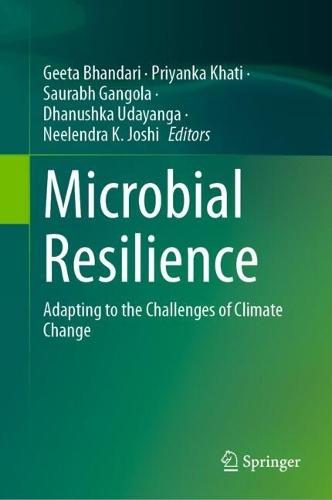
The book is a comprehensive resource that explores the critical relationship between microorganisms and a changing climate. It examines how shifting environmental conditions—such as rising temperatures, altered precipitation, and ocean acidification—impact microbial communities and their essential roles in ecosystems. The book also highlights the remarkable ways microbes adapt to these changes, from genetic and physiological shifts to ecological adjustments. Through chapters covering diverse topics like microbial contributions to greenhouse gases, soil carbon sequestration, responses to extreme weather, and bioremediation strategies, this book offers both theoretical insights and practical solutions. It is an invaluable resource for environmental scientists, microbiologists, climate researchers, advanced students, and policymakers seeking to understand and address the role of microbes in the global climate crisis.
Full Product Details
Author: Geeta Bhandari ,
Priyanka Khati ,
Saurabh Gangola ,
Dhanushka Udayanga
Publisher: Springer Verlag, Singapore
Imprint: Springer Verlag, Singapore
ISBN: 9789819588824
ISBN 10: 9819588820
Pages: 379
Publication Date: 26 May 2026
Audience:
Professional and scholarly
,
College/higher education
,
Professional & Vocational
,
Postgraduate, Research & Scholarly
Format: Hardback
Publisher's Status: Forthcoming
Availability: Not yet available

This item is yet to be released. You can pre-order this item and we will dispatch it to you upon its release.
Author Information
1. Dr. Geeta Bhandari Dr. Geeta Bhandari is currently an Assistant Professor at Swami Rama Himalayan University, Dehradun, Uttarakhand, India. She has over a decade of experience in teaching and research, focusing on innovative solutions to environmental challenges. 2. Dr. Priyanka Khati Dr. Priyanka Khati is a Scientist at the Indian Council of Agricultural Research-Vivekananda Parvatiya Krishi Anusandhan Sansthan (ICAR-VPKAS), Almora, Uttarakhand, India. She specializes in agricultural microbiology with a focus on bioinoculants, nanotechnology applications, and stress-alleviation mechanisms in crops. 3. Dr. Saurabh Gangola Dr. Saurabh Gangola is an Assistant Professor in the Department of Microbiology at Graphic Era University, Dehradun, India. With more than six years of experience, his research focuses on environmental microbiology, specifically biodegradation and bioremediation of pollutants such as pesticides, dyes, and heavy metals. 4. Professor Dhanushka Udayanga Professor Dhanushka Udayanga is a faculty member at the Department of Applied Sciences, Sri Lanka Institute of Information Technology (SLIIT), Malabe, Sri Lanka specializing in biotechnology and mycology. His research delves into molecular systematics and fungal applications in agriculture and environmental science. 5. Dr. Neelendra K. Joshi Dr. Neelendra K. Joshi is an Associate Professor at the University of Arkansas, Fayetteville, USA, where he focuses on pesticide toxicology, biodiversity, and conservation of beneficial species.