Overview
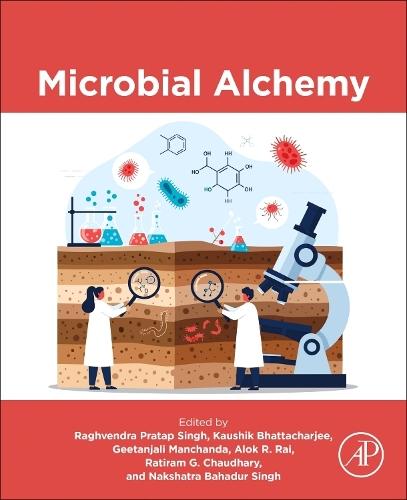
Microbial Alchemy offers an interdisciplinary exploration of microorganisms, their chemical properties, and their ability to transform substances through metabolic processes and sythesize them into bioproducts of commercial value and sustainable application. This book opens with an introduction to microbial alchemy covering cellular and molecular mechanism for alchemy production, secondary metabolites, and fermentation alchemy. It provides an analysis of the chemistry produced by microbes that influence eco-enterprising strategies and explores the bioprospecting of an array of microbial metabolic products and their applications in various fields and industries. With additional coverage on compliance, regulations, and market acceptance in microbial-derived products, Microbial Alchemy is a useful resource to explore the potential of microbial metabolic and transformative abilities.
Full Product Details
Author: Raghvendra Pratap Singh (Chief Scientist and Head, R&D, Azoth Biotech Pvt. Ltd., Noida, UP, India) ,
Kaushik Bhattacharjee (Division of Life Sciences, Institute of Advanced Study in Science and Technology, Guwahati, India) ,
Geetanjali Manchanda (Head, Department of Botany and Environment Studies, DAV University, Jalandhar, India) ,
Alok R. Rai (Associate Professor and Head of the Postgraduate, Department of Microbiology, SK Porwal College of Arts, Science and Commerce, Kamptee, India)
Publisher: Elsevier Science Publishing Co Inc
Imprint: Academic Press Inc
Weight: 0.450kg
ISBN: 9780443364112
ISBN 10: 0443364117
Pages: 590
Publication Date: 13 March 2026
Audience:
Professional and scholarly
,
Professional & Vocational
Format: Paperback
Publisher's Status: Forthcoming
Availability: Not yet available

This item is yet to be released. You can pre-order this item and we will dispatch it to you upon its release.
Author Information
Dr. Raghvendra Pratap Singh is an eminent scientist in the Microbial Biotechnology. He has received his PhD from Gurukul Kangri University, India and is presently working in Research and Development Division, Uttaranchal University, Dehradun. Since 2014-2016, He worked as Research Scientist in Shandong University. His research contributions relate to the area of ecology of myxobacteria, plant-microbes interaction and microbial genomics. He is member of Aquatic Biodiversity Society and has a certification from Food and Drug association of India. He has received several awards and grants from various scientific agencies and societies such as Young Scientist award by ABA-2017, SERB-DST grant, Chinese Postdoctoral Grant, DBT travel grant etc. He has participated as Speaker in several National and International scientific meets and conferences such as FEMS-2013 in Stresa, Italy, Myxo-2016 in Switzerland, AMI, PTPB-2014 etc. Dr Kaushik Bhattacharjee is a scientist in the field of Microbiology in the Division of Life Sciences at the Institute of Advanced Study in Science and Technology, Guwahati, India. Dr Kaushik Bhattacharjee received his PhD in microbiology from the North-Eastern Hill University of India, by conducting research into the inter-disciplinary field of microbial diversity in extreme environments, pharmaceutical microbiology, and medicinal chemistry. His post-doctoral training was at the Department of Botany, North-Eastern Hill University of India and at IASST, Guwahati, India. He has so far contributed over 20 publications in journals of high repute and has published about six book chapters. He also serves as an editorial board member and invited journal reviewer for many highly reputed journals with publishing groups, such as Springer Nature, Elsevier, PLoS, Taylor & Francis. He was presented with the Outstanding Reviewer Award from Elsevier for the year 2018. He also serves as a certified mentor at Publons Academy, Clarivate Analytics, USA. His broad area of research interests includes, environmental microbiology, and pharmaceutical microbiology. Dr. Geetanjali Manchanda is working as Head of the Department of Botany and Environment Studies in DAV University, Jalandhar, India. She received MSc degree from Delhi University and PhD from Panjab University, Chandigarh. She has extensively worked on plant microbe interactions in stressed and contaminated environments with special focus on mycorrhizae for the fortification of various crops. She has received the prestigious research grants from DST, India, and IFS Sweden. She has contributed immensely to the scientific community by publishing research papers and book chapters. She had recently authored three books in which one book is on the use of omics technology for microbiology that has been published by ICAR, New Delhi, India. Alok R Rai is Associate Professor and Head of the Postgraduate Department of Microbiology, at SK Porwal College of Arts, Science and Commerce, Kamptee, India. His research areas are environmental microbiology, bionanomaterials, biological application of nanoparticles, metal oxide nanoparticles, antimicrobial assay, microbial diversity, and plant microbial interaction. Ratiram G Chaudhary is Associate Professor and Head of the Postgraduate Department of Chemistry, SK Porwal College of Arts, Science and Commerce, Kamptee, India. His research areas are bionanomaterials, carbon-based nanomaterials, metal oxide nanoparticles, coordination polymers, antimicrobial assay, catalysis, and photo catalytical performances. Prof. N.B.Singh, former Head of the Chemistry Department and Former Dean of the Faculty of Science at DDU Gorakhpur University, is presently Emeritus Professor in the Chemistry Dept., SBSR and Research and Technology Development Centre, Sharda University, Greater Noida, UP, India. Dr. Singh was an Alexander von Humboldt fellow and has worked at TH, Aachen, University of Clausthal, University Kassel and TU Dortmund University, Germany. Dr. Singh did his post doctoral fellowship at the Free University of Brussels, Belgium. Dr. Singh is a recipient of the NETZSCH - ITAS Award 2002 and was presented with the ISCAS Gold Medal and Lifetime Achievement Award from the Indian Association for Solid State Chemists and Allied Scientists at VIT Vellore (Nov. 2009) for contributions in the area of solid state chemistry. Dr. Singh is former president of the Indian Association for Solid State Chemists and Allied Scientists.