Overview
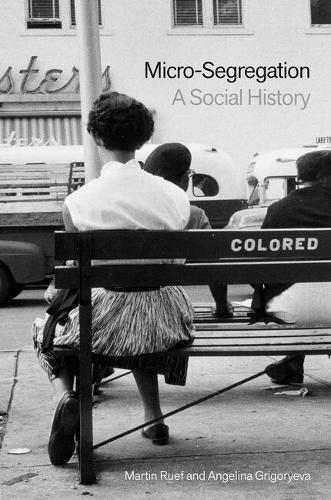
We often envision segregation by class or caste at a large scale and in objective terms. It seems easy to identify a ""slum city"" or a ""ghetto,"" particularly when profound differences in infrastructure differentiate them from other neighborhoods and residents have been explicitly minoritized. But what about the segregated microcosms that are peppered throughout human existence? In Micro-Segregation, Martin Ruef and Angelina Grigoryeva draw on archaeological, archival, ethnohistorical, and geospatial materials to document micro-segregation in a variety of societies and economic systems. They explain that micro-segregation occurs in social situations where interactions between individuals from distinct groups are not inhibited by sheer physical distance, but by institutional constraints and spatial configurations. From physical barriers to regulations regarding the use of amenities, micro-segregation prevents personal contact and social exchange. In so doing, it often produces an adverse impact on the self-efficacy of subordinate groups who are subject to institutionalized separation and violates conditions that might allow for a reduction in interpersonal prejudice. Despite the ostensibly fragile boundaries of micro-segregation, Ruef and Grigoryeva argue that it presents both a historically durable and pernicious constraint on human interaction, persisting on the basis of ingrained understandings and material inequalities even in the absence of formal prohibitions on intergroup contact. By addressing the ways social groups are kept apart across various activities and settings, the authors illustrate what that sorting process reveals about underlying social hierarchies and inequalities. They argue that if historians, policymakers, publics, and social scientists care about the patterns of segregation that produce marginalization, then we can ill afford to overlook the causes and consequences of micro-segregation.
Full Product Details
Author: Martin Ruef (Duke University) ,
Angelina Grigoryeva (University of Toronto)
Publisher: Oxford University Press
Imprint: Oxford University Press
ISBN: 9780197841433
ISBN 10: 0197841430
Pages: 304
Publication Date: 15 June 2026
Audience:
General/trade
,
General
Format: Paperback
Publisher's Status: Forthcoming
Availability: Not yet available

This item is yet to be released. You can pre-order this item and we will dispatch it to you upon its release.
Author Information
Martin Ruef is the Jack and Pamela Egan Professor in the Department of Sociology at Duke University. His research projects examine the historical evolution of segregation, labor market institutions, and entrepreneurship. He is the author of The Entrepreneurial Group (2010) and Between Slavery and Capitalism (2014), both published by Princeton University Press, and is a co-author of Organizations Evolving (2020, 3rd edition), published by Edward Elgar. Angelina Grigoryeva is an Assistant Professor in the Department of Sociology at the University of Toronto. Her research interests include inequality and stratification, economic sociology, social demography, and quantitative and computational methodology. Her research examines the social history of segregation and inequality by race, gender, and wealth.