Overview
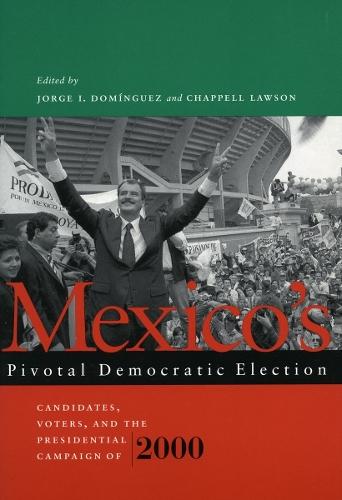
The 2000 Mexican presidential race culminated in the election of opposition candidate Vicente Fox and the end of seven decades of one-party rule. This book, which traces changes in public opinion and voter preferences over the course of the race, represents the most comprehensive treatment of campaigning and voting behavior in an emerging democracy. It challenges the ""modest effects"" paradigm of national election campaigns that has dominated scholarly research in the field. Chapters cover authoritarian mobilization of voters, turnout patterns, electoral cleavages, party strategies, television news coverage, candidate debates, negative campaigning, strategic voting, issue-based voting, and the role of the 2000 election in Mexico's political transition. Theoretically-oriented introductory and concluding chapters situate Mexico's 2000 election in the larger context of Mexican politics and of cross-national research on campaigns. Collectively, these contributions provide crucial insights into Mexico's new politics, with important implications for elections in other countries.
Full Product Details
Author: Jorge I. Dominguez ,
Chappell H. Lawson
Publisher: Stanford University Press
Imprint: Stanford University Press
Edition: New edition
Dimensions:
Width: 15.20cm
, Height: 3.00cm
, Length: 22.90cm
Weight: 0.662kg
ISBN: 9780804749732
ISBN 10: 0804749736
Pages: 392
Publication Date: 23 October 2003
Audience:
General/trade
,
Professional and scholarly
,
College/higher education
,
General
,
Professional & Vocational
Format: Hardback
Publisher's Status: Active
Availability: In Print

This item will be ordered in for you from one of our suppliers. Upon receipt, we will promptly dispatch it out to you. For in store availability, please contact us.
Reviews
Dominguez and Lawson's book fills an important gap in the systematic, analytical, empirical, and theoretical study of Mexican electoral politics. - Latin American Politics and Society A major effort at analyzing the pivotal Mexican presidential elections of July 2000, using best practices derived from American electoral studies. This book will serve as a benchmark for subsequent studies within Mexico, and for comparative international studies. - Laurence Whitehead,Director, Centre for Mexican Studies, Oxford University
A major effort at analyzing the pivotal Mexican presidential elections of July 2000, using best practices derived from American electoral studies. This book will serve as a benchmark for subsequent studies within Mexico, and for comparative international studies. --Laurence Whitehead, Director, Centre for Mexican Studies, Oxford University
Dominguez and Lawson's book fills an important gap in the systematic, analytical, empirical, and theoretical study of Mexican electoral politics. -Latin American Politics and Society A major effort at analyzing the pivotal Mexican presidential elections of July 2000, using best practices derived from American electoral studies. This book will serve as a benchmark for subsequent studies within Mexico, and for comparative international studies. -Laurence Whitehead,Director, Centre for Mexican Studies, Oxford University
Author Information
Jorge I. Domínguez is the Director of the Weatherhead Center for International Affairs at Harvard University. Chappell H. Lawson is Associate Professor of Political Science at MIT.