Overview
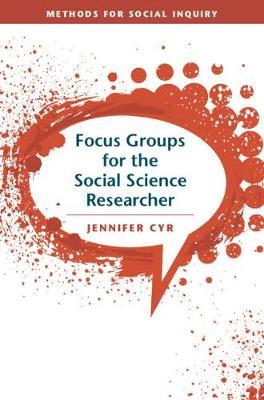
What is a focus group? Why do we use them? When should we use them? When should we not? Focus Groups for the Social Science Researcher provides a step-by-step guide to undertaking focus groups, whether as a stand-alone method or alongside other qualitative or quantitative methods. It recognizes the challenges that focus groups encounter and provides tips to address them. The book highlights three unique, inter-related characteristics of focus groups. First, they are inherently social in form. Second, the data emerge organically through conversation; they are emic in nature. Finally, focus groups generate data at three levels of analysis: the individual, group, and interactive level. The book builds from these three characteristics to explain when focus groups can usefully be employed in different research designs. This is an essential text for students and researchers looking for a concise and accessible introduction to this important approach to data collection.
Full Product Details
Author: Jennifer Cyr (University of Arizona)
Publisher: Cambridge University Press
Imprint: Cambridge University Press
Dimensions:
Width: 15.80cm
, Height: 1.10cm
, Length: 23.50cm
Weight: 0.330kg
ISBN: 9781107189164
ISBN 10: 1107189160
Pages: 142
Publication Date: 28 March 2019
Audience:
Professional and scholarly
,
Professional & Vocational
Format: Hardback
Publisher's Status: Active
Availability: Available To Order

We have confirmation that this item is in stock with the supplier. It will be ordered in for you and dispatched immediately.
Reviews
Advance priase: 'Focus Groups for the Social Science Research by Jennifer Cyr articulates explicit, clear, and excellent suggestions on how to effectively use focus groups in social science research. It is likely to be the standard reference on this subject. In the future, whenever my students are considering using focus groups, I will direct them to this valuable work.' Scott Mainwairing, Jorge Paulo Lemann Professor of Brazil Studies, Harvard Kennedy School Advance praise: 'Focus groups constitute a core and essential methodology, particularly in field research settings. Cyr provides an in-depth analysis of the core uses of focus groups in survey construction, etc. In addition she treats the new and important uses of focus groups for multimethod research in its various forms. It comprehensively ranges from the research design to practical details.' Gary Goertz, Kroc Institute for International Peace Studies, University of Notre Dame, Indiana Advance praise: 'Cyr's book is a unique and significant contribution to qualitative social science methodology. Her analysis not only provides step-by-step guidance on how to organize and facilitate a focus group but highlights why a scholar might take on what can be a daunting set of logistical, ethical and analytic challenges. Cyr unpacks what is distinctive about the method and shows us how to maximize the analytic leverage provided by the social interactions of focus group discussions.' Lauren M. MacLean, Arthur F. Bentley Chair, Indiana University, Bloomington Advance priase: `Focus Groups for the Social Science Research by Jennifer Cyr articulates explicit, clear, and excellent suggestions on how to effectively use focus groups in social science research. It is likely to be the standard reference on this subject. In the future, whenever my students are considering using focus groups, I will direct them to this valuable work.' Scott Mainwairing, Jorge Paulo Lemann Professor of Brazil Studies, Harvard Kennedy School Advance praise: `Focus groups constitute a core and essential methodology, particularly in field research settings. Cyr provides an in-depth analysis of the core uses of focus groups in survey construction, etc. In addition she treats the new and important uses of focus groups for multimethod research in its various forms. It comprehensively ranges from the research design to practical details.' Gary Goertz, Kroc Institute for International Peace Studies, University of Notre Dame, Indiana Advance praise: `Cyr's book is a unique and significant contribution to qualitative social science methodology. Her analysis not only provides step-by-step guidance on how to organize and facilitate a focus group but highlights why a scholar might take on what can be a daunting set of logistical, ethical and analytic challenges. Cyr unpacks what is distinctive about the method and shows us how to maximize the analytic leverage provided by the social interactions of focus group discussions.' Lauren M. MacLean, Arthur F. Bentley Chair, Indiana University, Bloomington
Author Information
Jennifer Cyr is Associate Professor of Political Science and Latin American Studies at the University of Arizona. She published The Fates of Political Parties: Institutional Crisis, Continuity, and Change in Latin America (Cambridge, 2017), and has published in several journals, including Comparative Political Studies, Comparative Politics, PS: Political Science and Politics, Studies in Comparative International Development, and Sociological Methods and Research. She is co-founder of the Southwest Workshop on Mixed Methods Research and co-editor of Qualitative and Multi-Method Research.