Overview
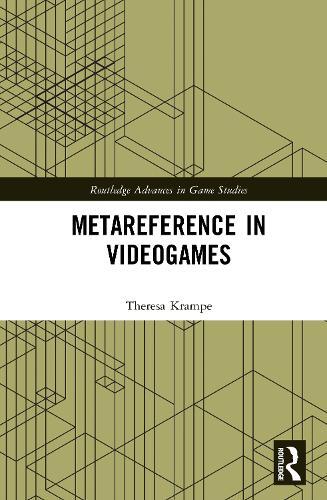
Taking an original, in-depth approach, this book investigates the forms and functions of metareference in videogames. Drawing on a rich body of research in game studies, transmedial narratology, and neighbouring disciplines, the author combines detailed close-reading-style analyses of the indie games What Remains of Edith Finch, The Magic Circle and OneShot with a breadth of examples and systematic analyses that span multiple genres as well as several decades of videogaming. In doing so, the book maps different metareferential elements that can be found in videogames and proposes an original model for their analysis, while showcasing the complex interrelations among different metareferential elements in contemporary videogames. This book will appeal to videogame researchers and transmedial narratologists as well as to those interested in metaization in media and popular culture across disciplines.
Full Product Details
Author: Theresa Krampe (University of Tübingen, Germany)
Publisher: Taylor & Francis Ltd
Imprint: Routledge
Weight: 0.520kg
ISBN: 9781032978949
ISBN 10: 1032978945
Pages: 256
Publication Date: 10 September 2025
Audience:
College/higher education
,
Professional and scholarly
,
Tertiary & Higher Education
,
Professional & Vocational
Format: Hardback
Publisher's Status: Active
Availability: Not yet available

This item is yet to be released. You can pre-order this item and we will dispatch it to you upon its release.
Reviews
“This outstanding monograph develops a comprehensive conceptualization of metareference in videogames that systematically takes into account transmedial and medium-specific aspects, offering an impressively broad survey of the metareferential strategies that videogames use as well as a theoretically sophisticated model for the close analysis of videogame-specific forms and functions of metareference.” - Prof. Dr. Jan-Noël Thon, Osnabrück University ""Much has been written about self-reflexivity in games and other digital fictions, about anti-, meta- and paraludic forms and structures. Yet a full-fledged, systematic study on how games can break fourth walls, create metaleptic transgressions and more generally refer to, parody and problematize their own gameness has long been overdue. Krampe’s diligent work delights as much as it enlightens not only the critical, postmodern and/or scholarly reader/player in us, but indeed anyone wishing to understand the unique creative and literally game-changing affordances of a medium more often misunderstood for its apparently one-sided effects than appreciated for its ultimate complexity and innate, deep metareferentiality."" - Prof. Dr. Astrid Ensslin, Director of DAS|LAB, University of Regensburg
“This outstanding monograph develops a comprehensive conceptualization of metareference in videogames that systematically takes into account transmedial and medium-specific aspects, offering an impressively broad survey of the metareferential strategies that videogames use as well as a theoretically sophisticated model for the close analysis of videogame-specific forms and functions of metareference.” - Professor Dr. Jan-Noël Thon, Osnabrück University, Germany ""Much has been written about self-reflexivity in games and other digital fictions, about anti-, meta- and paraludic forms and structures. Yet a full-fledged, systematic study on how games can break fourth walls, create metaleptic transgressions and more generally refer to, parody and problematize their own gameness has long been overdue. Krampe’s diligent work delights as much as it enlightens not only the critical, postmodern and/or scholarly reader/player in us, but indeed anyone wishing to understand the unique creative and literally game-changing affordances of a medium more often misunderstood for its apparently one-sided effects than appreciated for its ultimate complexity and innate, deep metareferentiality."" - Prof. Dr. Astrid Ensslin, Director of DAS|LAB, University of Regensburg
Author Information
Theresa Krampe is a Postdoctoral Research Associate at the International Center for Ethics in the Sciences and Humanities (IZEW) at the University of Tübingen, Germany, and a Guest Researcher in Media Studies at Osnabrück University, Germany.