Overview
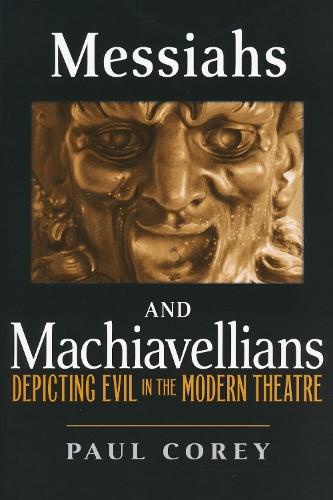
Messiahs and Machiavellians is an innovative exploration of ""modern evil""in works of early- and late-modern theatre, raising issues about ethics, politics, religion, and aesthetics that speak to our present condition. Paul Corey examines how theatre-which expressed a key political dynamic both in the Renaissance and the twentieth century-lays open the impulses that instigated modernity and, ultimately, unparalleled levels of violence and destruction. Starting with Albert Camus' Caligula and Samuel Beckett's Waiting for Godot, then turning to Machiavelli's Mandragola and Shakespeare's Measure for Measure, Corey traces the emergence of two dominant, intertwining features of modern evil: an unrestrained pursuit of power and the utopian desire for perfection. Corey's imaginative and convincing readings of these plays, based on detailed textual analysis, move beyond the accounts usually offered by literary critics. Drawing on political, theological, and philosophical sources-a combination as fertile as it is unusual-Corey's methodology allows him to make keen and subtle arguments about the eschatological nature of modern politics.
Full Product Details
Author: Paul Corey
Publisher: University of Notre Dame Press
Imprint: University of Notre Dame Press
Dimensions:
Width: 15.20cm
, Height: 2.10cm
, Length: 22.90cm
Weight: 0.553kg
ISBN: 9780268022952
ISBN 10: 026802295
Pages: 376
Publication Date: 27 May 2008
Audience:
General/trade
,
General
Format: Paperback
Publisher's Status: Active
Availability: To order

Stock availability from the supplier is unknown. We will order it for you and ship this item to you once it is received by us.
Reviews
Corey's engaging book centers on the close analysis of four plays, each one depicting evil in a particular light: Albert Camus' Caligula, Samuel Beckett's Waiting for Godot, Machiavelli's Mandragola, and Shakespeare's Measure for Measure. Corey carefully distinguishes between endeavors that might achieve temporary success within definite limits and those that claim a boundless victory that will destroy evil forever. --First Principles Corey's lucid, compelling treatise argues for a radical reconsideration of the role of tragedy in dealing with the shifting metaphysical and metatheatrical sands of the contemporary era. While the study begins with an examination of mid-20th Century French existentialism--and the dramatic work of Beckett and Camus in particular--the book soon takes the reader on a fascinating voyage back into the 'problem' comedies of the Italian and English Renaissance theatre, and beyond that, into Greek tragedy to understand the evolving concept of 'evil' in the Western philosophical, theological, and dramatic tradition. Ending with a reflection on the new 'theatre' of terrorism entering the 21st Century, Corey poses the intriguing suggestion, that far from being irrelevant to the post-modern era, a 'new tragic sensibility' may become key to our gaining a 'lucid awareness of our current situation . . . the limits of politics, the indelible nature of violence, our inescapable mortality, and a need for prudence' -- Moira Day, University of Saskatchewan Corey's engaging book centers on the close analysis of four plays, each one depicting evil in a particular light: Albert Camus' Caligula, Samuel Beckett's Waiting for Godot, Machiavelli's Mandragola, and Shakespeare's Measure for Measure. Corey carefully distinguishes between endeavors that might achieve temporary success within definite limits and those that claim a boundless victory that will destroy evil forever. --First Principles Corey's engaging book centers on the close analysis of four plays, each one depicting evil in a particular light: Albert Camus' Caligula, Samuel Beckett's Waiting for Godot, Machiavelli's Mandragola, and Shakespeare's Measure for Measure. Corey carefully distinguishes between endeavors that might achieve temporary success within definite limits and those that claim a boundless victory that will destroy evil forever. First Principles Corey's engaging book centers on the close analysis of four plays, each one depicting evil in a particular light: Albert Camus' Caligula , Samuel Beckett's Waiting for Godot , Machiavelli's Mandragola , and Shakespeare's Measure for Measure . Corey carefully distinguishes between endeavors that might achieve temporary success within definite limits and those that claim a boundless victory that will destroy evil forever. -- First Principles
Corey's engaging book centers on the close analysis of four plays, each one depicting evil in a particular light: Albert Camus' Caligula, Samuel Beckett's Waiting for Godot, Machiavelli's Mandragola, and Shakespeare's Measure for Measure. Corey carefully distinguishes between endeavors that might achieve temporary success within definite limits and those that claim a boundless victory that will destroy evil forever. First Principles Corey's engaging book centers on the close analysis of four plays, each one depicting evil in a particular light: Albert Camus' Caligula , Samuel Beckett's Waiting for Godot , Machiavelli's Mandragola , and Shakespeare's Measure for Measure . Corey carefully distinguishes between endeavors that might achieve temporary success within definite limits and those that claim a boundless victory that will destroy evil forever. -- First Principles
<p> Corey's engaging book centers on the close analysis of four plays, each one depicting evil in a particular light: Albert Camus' Caligula , Samuel Beckett's Waiting for Godot , Machiavelli's Mandragola , and Shakespeare's Measure for Measure . Corey carefully distinguishes between endeavors that might achieve temporary success within definite limits and those that claim a boundless victory that will destroy evil forever. -- First Principles
Author Information
Paul Corey teaches in the religious studies department at McMaster University.