Overview
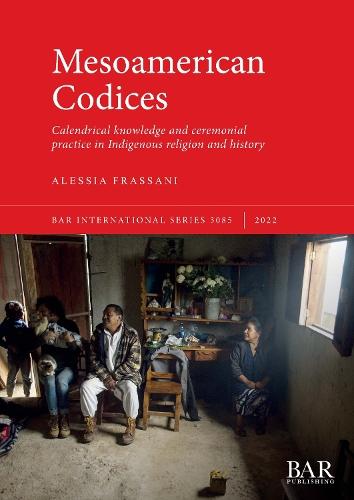
Religious manuscripts from ancient and early colonial Mexico offer a direct pathway into indigenous worldviews through the uniquely Mesoamerican medium of pictography. During the thousands of years preceding Spanish invasion, a complex calendrical system developed in the region, forming the basic organizing principle of this pictorial language. This book offers new interpretations and insights on both calendrics and the related iconography of Mesoamerican religious manuscripts, based on the author's field work in the Sierra Mazateca in northern Oaxaca. Detailed calendrical analysis is included, along with audio recordings of chants, prayers, and ceremonies available as an online download. The author's novel approach questions accepted notions of divination, chronology, and the dichotomy between ritual and historical time.
Full Product Details
Author: Alessia Frassani
Publisher: BAR Publishing
Imprint: BAR Publishing
Weight: 0.742kg
ISBN: 9781407359670
ISBN 10: 1407359673
Pages: 186
Publication Date: 30 June 2022
Audience:
Professional and scholarly
,
Professional & Vocational
Format: Paperback
Publisher's Status: Active
Availability: Available To Order

We have confirmation that this item is in stock with the supplier. It will be ordered in for you and dispatched immediately.
Reviews
'Frassani's book is a remarkable work, providing a fresh and thought-provoking interpretation of Mesoamerican religious pictorial manuscripts. The author's proposals are of great value and the book deserves to become a standard reference on the subject.' Professor Davide Domenici, University of Bologna 'There are plenty of books about codices but none quite like this. The author's approach to modern practices and ceremonies, shedding light on ancient religious pictography, is one of the strengths of the book and is something that sets it apart from other works on Mesoamerican pictographic manuscripts.' Dr Jeremy Coltman, University of California, Riverside
'Frassani's book is a remarkable work, providing a fresh and thought-provoking interpretation of Mesoamerican religious pictorial manuscripts. The author's proposals are of great value and the book deserves to become a standard reference on the subject.' Professor Davide Domenici, University of Bologna 'There are plenty of books about codices but none quite like this. The author's approach to modern practices and ceremonies, shedding light on ancient religious pictography, is one of the strengths of the book and is something that sets it apart from other works on Mesoamerican pictographic manuscripts.' Dr Jeremy Coltman, University of California, Riverside
'Frassani's book is a remarkable work, providing a fresh and thought-provoking interpretation of Mesoamerican religious pictorial manuscripts. The author's proposals are of great value and the book deserves to become a standard reference on the subject.' Professor Davide Domenici, University of Bologna 'There are plenty of books about codices but none quite like this. The author's approach to modern practices and ceremonies, shedding light on ancient religious pictography, is one of the strengths of the book and is something that sets it apart from other works on Mesoamerican pictographic manuscripts.' Dr Jeremy Coltman, University of California, Riverside
Author Information
Alessia Frassani holds a PhD in Art History from the City University of New York. She was an Assistant Professor in the Art Department of the Universidad de los Andes and a Researcher at the Faculty of Archaeology of Leiden University in the Netherlands. Her previous book Building Yanhuitlan was published in 2017.