Overview
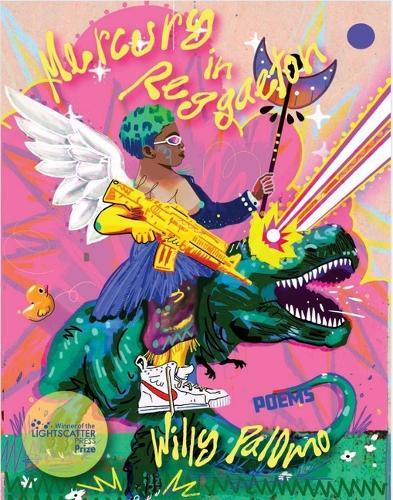
Mercury in Reggaetón was written after the poet suffered after the worst breakup of his life within the same month-span Trump won the first election. The book aims was to capture the particular political-psycho-sexual turmoil of the author's early twenties. At the time of these poems' writing, the author was in grad school leading an undocumented student group and the fight for a sanctuary campus in a deeply red state. He was uncovering his own pansexuality and gender fluidity and deepening my understanding of his racial and national identities. In this way, many of the poems have coming-of-age ""first book"" energy. The poems narrate wrestles with identity, frustration with the politics of our era, and how both of those elements infused erotic experiences. The poet wrote to reflect the emotional flood that is at its most raw and visceral in one's young adulthood, aiming to capture the fury most poignantly and painfully expressed in radical LGBTQ+ and/or POC young adults, struggling to heal from their intergenerational wounds while confronting an increasingly hostile and horrifying world. There's a particular kind of anger that fuels them, but will kill them if they don't find gentler or sturdier ways of holding it. The poems and songs were created between 2012 and 2023, from 19 to 30. On a formal level, the poet fully embraces the musicality and rhythm intrinsic to the hip-hop and spoken word roots of his voice and pursued it both in content and form with songs dedicated to and explicitly alluding to the work of rappers, as well as actual songs included in the book. The poet's bilingualism is a literal manifestation of the cultural clashes inherit to his identity as a queer Salvadoran. The writing tends to shatter any sense of stylistic fidelity or tonal decorum, shifting between strict formal poetry and neat, tightly line-broken stanzas to raps and the more rant-like verse common in spoken word spaces. Part of what gives the collection its depth is its rootedness in history, culture, and community. The poet borrows and transforms the form of popular works by rappers and poets alike, and shouts out and directly collaborates with contemporaries like Janel Pineda and Zac Ivie. These voices cocoon the collection in its artistic neighborhood. In content, the poet slingshots between the present, the history of la Conquista, and the history of the past century. Historical trauma, like any other, has a tendency to intrude onto the present and jumble up your sense of time. The poems about la Conquista, in particular, provide a historic heft that helps the collection surpass its youthful emotional landscape. It provides context to the struggles, both internal and political, the protagonist navigates. There's a sort of sublime in the powerlessness felt in the almost deterministic weight that our historic, intergenerational, and personal trauma carries in these times that the poet tries to capture and confront: thus, the title Mercury in Reggaetón, which nods to the astrological phenomena many people associate with social and interpersonal turmoil, flipped to introduce reggaeton, a bluntly sexual, Latinx genre that recently has been subverted by lesbians and queer rappers, such as Rebeca Lane, Audry Funk, Chocolate Remix, and others to articulate a rageful politics leading with an in-your-face twerk.
Full Product Details
Author: Willy Palomo ,
Josué Andrés Moz
Publisher: Lightscatter Press
Imprint: Lightscatter Press
ISBN: 9781962206334
ISBN 10: 1962206335
Pages: 186
Publication Date: 01 May 2026
Audience:
General/trade
,
General
Format: Paperback
Publisher's Status: Active
Availability: In Print

This item will be ordered in for you from one of our suppliers. Upon receipt, we will promptly dispatch it out to you. For in store availability, please contact us.
Author Information
Willy Palomo (he/they/she) is the author of Mercury in Reggaetón, winner of the Lightscatter Press Prize, and Wake the Others (Editorial Kalina/Glass Spider Publishing, 2023), a winner of a Foreword Prize in Poetry and an International Latino Book Award honorable mention in Bilingual Poetry. In November 2024, his Spanish-to-English translation of Tres Tercas Trincheras by Marielos Oliva was published in Europe by FormArti. In 2023, he released an independent reggaeton and rap album with his brother Enter Da BoomBow. A veteran of the Salt Lake City poetry slam scene, his fiction, essays, poetry, translations, and songs can be found across print and web pages, including the Best New Poets 2018, Latino Rebels, The Wandering Song: Central American Writing in the United States, and more. He has performed at or keynoted in 170+ public engagements since 2011, including the SUU Pride Film Festival, el Festival Internacional de Poesia Amada Libertad, and many more. He has taught classes on literature, rap, and creative writing in universities, juvenile detention centers, high schools, and community centers. He is the son of two refugees from El Salvador. In 2018, he received an MFA in Poetry and MA in Latin American and Caribbean Studies from Indiana University - Bloomington. He is a Macondo fellow. Josué Andrés Naranjo Moz is a poet, book seller, editor, and cultural organizer. He has published five books, including Carcoma, Pesebre, Babel, El libro del Carnero, and Revólver. His work has been translated into English, Italian, Arabic, and French.