Overview
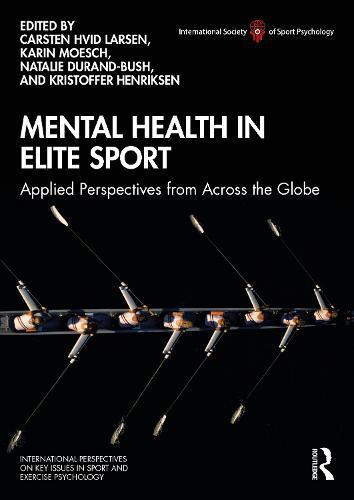
Mental Health in Elite Sport: Applied Perspectives from Across the Globe provides a focused, exhaustive overview of up-to-date mental health research, models, and approaches in elite sport to provide researchers, practitioners, coaches, and students with contemporary knowledge and strategies to address mental health in elite sport across a variety of contexts. Mental Health in Elite Sport is divided into two main parts. The first part focuses globally on mental health service provision structures and cases specific to different world regions and countries. The second part focuses on specific mental health interventions across countries but also illustrates specific case studies and interventions as influenced by the local context and culture. This tour around the world offers readers an understanding of the massive global differences in mental health service provision within different situations and organizations. This is the first book of its kind in which highly experienced scholars and practitioners openly share their programs, methods, reflections, and failures on working with mental health in different contexts. By using a global, multi-contextual analysis to address mental health in elite sport, this book is an essential text for practitioners such as researchers, coaches, athletes, as well as instructors and students across the sport science and mental health fields.
Full Product Details
Author: Carsten Larsen ,
Karin Moesch ,
Natalie Durand-Bush ,
Kristoffer Henriksen
Publisher: Taylor & Francis Ltd
Imprint: Routledge
Weight: 0.740kg
ISBN: 9780367427689
ISBN 10: 0367427680
Pages: 150
Publication Date: 27 May 2021
Audience:
Professional and scholarly
,
Professional & Vocational
Format: Paperback
Publisher's Status: Active
Availability: In Print

This item will be ordered in for you from one of our suppliers. Upon receipt, we will promptly dispatch it out to you. For in store availability, please contact us.
Reviews
When people talk about sport competition they often enjoy those critical moments, fantastic performance, and unbelievable comeback in a final. They may well understand philosophy of no pain, no gain in elite sport they still, however, underestimate how much pain those athletes stand in long term training. Tough training, high physical demanding, and high pressure are often beyond expectation or competence of athletes, and thus arouse mental health (MH) concerns from sport psychologists. As one of the ISSP book series, the book, Mental health in elite sport: Applied perspectives from across the globe, edited by Professor Carsten Hvid Larsen, Andreas Kuttel, Karin Moesch, Natalie Durand-Bush and Kristoffer Henriksen give us a good opportunity to have both an overall picture and a detailed view to understand how important MH is for athletes' sport career and long-term development. The discussions covered in this book include variety of topics from conceptualization and definition of MH in elite sport to specific MH interventions across countries. Those ideas and research findings about MH of elite sport are really very informative and inspiring for coaches, sport administration officers, athletes' parents, as well as applied psychology students and sport psychologists. I feel that it is also a must for those professionals and supporting team staff working with elite sports. Without understanding psychological aspect of elite sport one can not understand elite sport as a whole. With the same reason without understanding MH of elite athletes one cannot understand elite athletes as a whole. So you are greatly encouraged to read this book. It is worth your time. -Liwei Zhang, Beijing Sport University, China
When people talk about sport competition they often enjoy those critical moments, fantastic performance, and unbelievable comeback in a final. They may well understand the philosophy of no pain, no gain, but in elite sport they still, however, underestimate how much pain those athletes stand in long term training. Tough training, high physical demand, and high pressure are often beyond the expectation or competence of athletes, and thus arouse mental health (MH) concerns from sport psychologists. As a book in the ISSP book series, Mental Health in Elite Sport: Applied Perspectives from Across the Globe, Professor Carsten Hvid Larsen, Karin Moesch, Natalie Durand-Bush, and Kristoffer Henriksen give us a good opportunity to have both an overall picture and a detailed view to understand how important MH is for athletes' sport career and long-term development. The discussions covered in this book include a variety of topics from conceptualization and definition of MH in elite sport to specific MH interventions across the globe. Those ideas and research findings about MH in elite sport are really very informative and inspiring for coaches, sport administration officers, athletes' parents, as well as applied psychology students and sport psychologists. I feel that it is also a must for those professionals and supporting team staff working within elite sports. Without understanding the psychological aspect of elite sport one can not understand elite sport as a whole. With the same reasoning, without understanding the MH of elite athletes one cannot understand elite athletes as a whole. So you are greatly encouraged to read this book. It is worth your time. -Liwei Zhang, Beijing Sport University, China
Author Information
Carsten Hvid Larsen is an associate professor at the Faculty of Sport Science and Clinical Biomechanics at the University of Southern Denmark and head of sport psychology and sport psychology consultant in FC Nordsjaelland football club. Karin Moesch is employed as a sport psychologist at the Department for Elite Sports at the Swedish Sports Confederation. She also holds a position as a researcher at the Department of Psychology at Lund University. Natalie Durand-Bush is a sport psychology professor, scientist, and practitioner in the School of Human Kinetics at the University of Ottawa in Ottawa, Canada. Natalie is the Director of the SEWP LAB and the co-founder of the Canadian Centre for Mental Health and Sport (CCMHS). Kristoffer Henriksen is an associate professor at the Faculty of Sport Science and Clinical Biomechanics at the University of Southern Denmark and sport psychology practitioner in Team Denmark.