Awards
- Winner of American Historical Association James Henry Breasted Prize 1989
- Winner of American Historical Association James Henry Breasted Prize 1989.
- Winner of James H. Breasted Prize, American Historical Association 1989 (United States)
Overview
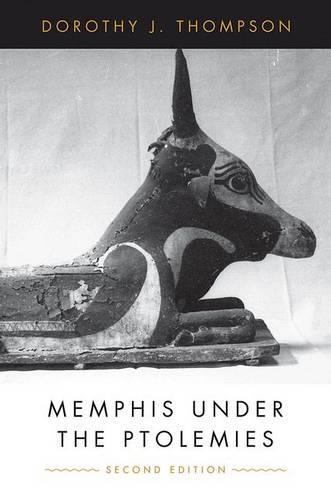
Drawing on archaeological findings and an unusual combination of Greek and Egyptian evidence, Dorothy Thompson examines the economic life and multicultural society of the ancient Egyptian city of Memphis in the era between Alexander and Augustus. Now thoroughly revised and updated, this masterful account is essential reading for anyone interested in ancient Egypt or the Hellenistic world. The relationship of the native population with the Greek-speaking immigrants is illustrated in Thompson's analysis of the position of Memphite priests within the Ptolemaic state. Egyptians continued to control mummification and the cult of the dead; the undertakers of the Memphite necropolis were barely touched by things Greek. The cult of the living Apis bull also remained primarily Egyptian; yet on death the bull, deified as Osorapis, became Sarapis for the Greeks. Within this god's sacred enclosure, the Sarapieion, is found a strange amalgam of Greek and Egyptian cultures.
Full Product Details
Author: Dorothy J. Thompson
Publisher: Princeton University Press
Imprint: Princeton University Press
Edition: Second Edition
Dimensions:
Width: 15.20cm
, Height: 2.30cm
, Length: 23.50cm
Weight: 0.539kg
ISBN: 9780691140339
ISBN 10: 0691140332
Pages: 360
Publication Date: 26 February 2012
Audience:
College/higher education
,
Professional and scholarly
,
General/trade
,
Tertiary & Higher Education
,
Professional & Vocational
Format: Paperback
Publisher's Status: Active
Availability: Temporarily unavailable

The supplier advises that this item is temporarily unavailable. It will be ordered for you and placed on backorder. Once it does come back in stock, we will ship it out to you.
Language: English
Reviews
Winner of the 1989 James H. Breasted Prize, American Historical Association ""This thoroughly revised edition of a masterpiece of historical writing examines with precision and verve the ancient Egyptian city of Memphis in the period between Alexander and Augustus... She is especially sensitive to the syncretic, sometimes cacophonous, metropolitan life produced by a population drawn from throughout the Mediterranean basin, and by the confrontation of classical civilization itself on the verge of cultural upheaval, as Roman power gradually eclipsed Greek prestige and influence--with a civilization that reached back millennia. The result is a meticulous, vivid portrait of a profoundly foreign world.""--The Atlantic ""[A] masterful analysis of the surviving evidence for ancient Memphis.""--John F. Oates, American Journal of Philology ""[T]his book greatly enhances understanding of Egyptian history in the Ptolemaic period and the author is to be congratulated on her skill in welding the disparate sources into such an attractive whole.""--Amelie Kuhrt, History ""[A] book of utmost importance to all readers interested in ancient civilizations... Thompson's concentration on the Hellenistic period provides a penetrating study of all aspects of this city from the time of Alexander to Augustus.""--C. C. Lamberg-Karlovsky, Choice ""This, in so many ways, is a book aimed at students and for that target audience is successful, and would make a sensible purchase.""--Kate Phizackerley, Egyptological.com ""Scott Soames' new book, What Is Meaning?, is an important book, both in the issues it raises and in its shortcomings. It is the first serious discussion of meaning (not 'semantic content' or some other term designed to sidestep the real issue) by a leading analytic philosopher of language in a long while, and its findings lead to a more realistic understanding of meaning and language.""--Sergeiy Sandler, European Legacy ""The text of the book is closely packed and authoritative in its presentation of the facts. Whilst this is not an 'easy read' the text is surprisingly readable and engaging. Indeed there is so much to be learned from these pages that one wants to turn the page and read on, and once a chapter is started it is difficult to put the book down... In short a masterful piece of scholarship looking at a complex and often overlooked period of Egyptian history. A book that any serious student of the Ptolemaic Period, or the Hellenistic world, would greatly benefit from reading.""--Victor Blunden, Ancient Egypt
This thoroughly revised edition of a masterpiece of historical writing examines with precision and verve the ancient Egyptian city of Memphis in the period between Alexander and Augustus... She is especially sensitive to the syncretic, sometimes cacophonous, metropolitan life produced by a population drawn from throughout the Mediterranean basin, and by the confrontation of classical civilization itself on the verge of cultural upheaval, as Roman power gradually eclipsed Greek prestige and influence--with a civilization that reached back millennia. The result is a meticulous, vivid portrait of a profoundly foreign world. The Atlantic [A] masterful analysis of the surviving evidence for ancient Memphis. -- John F. Oates American Journal of Philology [T]his book greatly enhances understanding of Egyptian history in the Ptolemaic period and the author is to be congratulated on her skill in welding the disparate sources into such an attractive whole. -- Amelie Kuhrt History [A] book of utmost importance to all readers interested in ancient civilizations... Thompson's concentration on the Hellenistic period provides a penetrating study of all aspects of this city from the time of Alexander to Augustus. -- C. C. Lamberg-Karlovsky Choice This, in so many ways, is a book aimed at students and for that target audience is successful, and would make a sensible purchase. -- Kate Phizackerley Egyptological.com Scott Soames' new book, What Is Meaning?, is an important book, both in the issues it raises and in its shortcomings. It is the first serious discussion of meaning (not 'semantic content' or some other term designed to sidestep the real issue) by a leading analytic philosopher of language in a long while, and its findings lead to a more realistic understanding of meaning and language. -- Sergeiy Sandler European Legacy The text of the book is closely packed and authoritative in its presentation of the facts. Whilst this is not an 'easy read' the text is surprisingly readable and engaging. Indeed there is so much to be learned from these pages that one wants to turn the page and read on, and once a chapter is started it is difficult to put the book down... In short a masterful piece of scholarship looking at a complex and often overlooked period of Egyptian history. A book that any serious student of the Ptolemaic Period, or the Hellenistic world, would greatly benefit from reading. -- Victor Blunden Ancient Egypt
[A] masterful analysis of the surviving evidence for ancient Memphis. -- John F. Oates, American Journal of Philology [T]his book greatly enhances understanding of Egyptian history in the Ptolemaic period and the author is to be congratulated on her skill in welding the disparate sources into such an attractive whole. -- Amelie Kuhrt, History [A] book of utmost importance to all readers interested in ancient civilizations... Thompson's concentration on the Hellenistic period provides a penetrating study of all aspects of this city from the time of Alexander to Augustus. -- C. C. Lamberg-Karlovsky, Choice
Author Information
Dorothy J. Thompson is a fellow of Girton College, University of Cambridge, and a member of the faculty of classics at the University of Cambridge. She is a fellow of the British Academy and an honorary president of the International Association of Papyrologists.