Overview
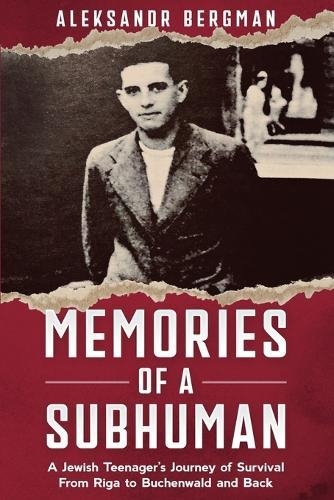
Aleksandr Bergman was born in Riga, Latvia in 1925. The son of a teacher, his youth was filled with the promise of a vibrant European future - until the world caught fire. At 15, Aleksandr watched as the Red Army shuttered his country's borders. But the Soviet occupation was only the beginning of the nightmare. In June 1941, the Nazis entered Riga, and the life he knew vanished forever. From the mass executions of the Riga Ghetto to the harrowing depths of the Kaiserwald, Stutthof, and Buchenwald concentration camps, Aleksandr bears witness to the darkest corners of the human experience. Yet, amidst unthinkable inhumanity, his story is defined by a different force: unyielding resilience. Liberated from Buchenwald, Aleksandr decided to return to Riga. To honor his parents' murdered dreams, he built a life from the ashes - graduating in law, raising a family, and ensuring his grandchildren became the living legacy the regime tried to extinguish. In his later years, Aleksandr became the voice for the 70,000 Latvian Jews who perished, founding the Latvian Ghetto and Concentration Camps Prisoners Association. This book is more than a Holocaust memoir; it is a flame of memory for the 90% of the Jewish population of Latvia lost to history, and a testament to the ""tree of life"" that continues to grow against all odds.
Full Product Details
Author: Aleksandr Bergman
Publisher: Amsterdam Publishers
Imprint: Amsterdam Publishers
Dimensions:
Width: 15.20cm
, Height: 1.70cm
, Length: 22.90cm
Weight: 0.399kg
ISBN: 9789493541016
ISBN 10: 9493541010
Pages: 298
Publication Date: 04 July 2026
Audience:
General/trade
,
General
Format: Paperback
Publisher's Status: Active
Availability: Not yet available

This item is yet to be released. You can pre-order this item and we will dispatch it to you upon its release.
Reviews
The life of Aleksandr Bergman has in an amazing way spanned several eras, building a ""live bridge"" between pre-WWII Latvian Jewish community, which was almost completely wiped out by the Nazis, and us - people of 21st century. He miraculously has survived the Holocaust, but managed to return to regular life and got a degree. He practiced as a lawyer, becoming one of the most respected professionals in Latvia, consciously distancing himself from the Soviet authorities. In 1990s, already in his retirement years, he actively committed himself to the revival of the Jewish community life, and his support was invaluable for me and other community leaders. Mr. Bergman was not only a moral authority, but a friend, a fellow-thinker, a teacher. I'll always remember our walks through the neighbourhoods of Riga, where in 1941 the Ghetto was created - he was sharing his memories, what he has seen and been through as a teenager at these very streets. In his book Aleksandr Bergman tells this story to the reader - vividly, clearly and honestly. - Arkady Suharenko, President of Jewish Community of Latvia The book by Aleksandr Bergman is not only a first-hand account of Holocaust in Latvia, a survivor's story. Bergman tries to convey the emotions he had decades ago as much as to tell the dry facts of his biography, which makes it also a valuable and fascinating insight into human psychology, into how we act, how we make decisions at critical points of history. - Ilya Lensky, Director of the Museum ""Jews in Latvia"" A deeply disturbing and haunting account of Aleksandr Bergman's experiences during the Holocaust in Latvia. His vivid descriptions of the horrors endured are profoundly shocking, standing as a testament to an unbreakable inner determination. His ultimate leadership in the revival of Latvia's Jewish community speaks to a rare human dignity and extraordinary strength. - Charles Springfield, MD. President, Jewish Survivors of Latvia USA The memories of Aleksandr Bergman are a stark monument to both his time and to the over 70,000 Latvian Jews who perished in the hastily dug up pits, ghettos and camps. We have promised to not forget or repeat the lessons of the Holocaust. But we begin to forget where the division of people by their origin leads us. I hope that Bergman's book of memories will not only be useful to historians but will also serve to make all of us more humane, honoring the promise to not forget. - Dr. hist. Kaspars Zellis, Leading researcher, University of Latvia, Institute of Philosophy and Sociology My ghetto and concentration camp comrade Aleksandr Bergman is one of the few of us who has been able to tell about the horrors we experienced without self-pity. Alexandr Bergman comes from a family of Jewish teachers - in the summer of 1941, the auxiliary police took away his grandfather, a few months later his mother was killed along with thousands of Riga ghetto prisoners in the Rumbula Massacre, and two years later the SS took his father to his death from the concentration camp in Riga. The two Bergman brothers went through the Riga ghetto, Riga-Kaiserwald, Stutthof in Poland and Buchenwald in Germany concentration camps, escaped at the end of the war and miraculously survived. Later, despite the Soviet government antisemitic suspicion of Holocaust survivors, Aleksandr found the strength to study, become a well-known lawyer in Riga, and after the restoration of Latvian sovereignty, also the chairman of the Association of Latvian Jews - former ghetto and concentration camp prisoners. - Dr.h.c. Margers Vestermanis, Holocaust survivor, historian, founder of the Museum ""Jews in Latvia""
Author Information
Aleksandr Bergman (1925-2016) was born in Riga, the capital of then independent Republic of Latvia. He was the second of three sons in the family of a public educator. Aleksander was 15 when World War II reached Latvia, first with the occupation by the Red Army from the east in 1940, then with the Nazi invasion from the west in 1941. From 1941 to 1945, he was a prisoner in the Riga Ghetto and three concentration camps - Kaiserwald (Latvia), Stutthof (Poland), and Buchenwald (Germany). After returning to Riga in 1945 he entered the law school of Latvian State University. In 1947 he married Josephina Itzykson (1927-1986). They had two children, son Jean and daughter Eleonora. In addition to a prominent legal career, Aleksandr Bergman has taken an active part in strengthening the Riga Jewish community. After the collapse of the USSR and the re-establishment of the sovereign Republic of Latvia in 1991, he became the chairman of the newly created Latvian Ghetto and Concentration Camps Prisoners Association, representing former prisoners of ghettos and concentration camps, and their descendants. The work of the organization, led by Aleksandr Bergman for over two decades, now continues both in Latvia and the United States, including the publication of this book.