Overview
To Write What one Could Not Tell Anyone You who live in all tranquility So warm and comfortable in your houses, You who come home at night to find The table laid and friendly faces around you, Consider if this is a man, He who toils in the mud, Who knows no rest, Who fights for a crust of bread, Who dies for the slightest reason. Consider if this is a woman, She who has lost her name and her hair, And even the strength to remember, Her gaze blank and her bosom chilled, Like a frog in winter. Do not forget that this happened, No, do not forget it: Engrave these words in your heart. Think of them in your home, in the street, When you sleep, when you rise; Repeat them to your children. Or else your house will crumble, You will be overcome by illness, And your children will turn away from you (Levi 1987:9, the translations is mine). At Auschwitz, Filip Müller was assigned to the Sonderkommando. Every day, with his fellow prisoners, he emptied the gas chambers of their piles of defiled corpses and loaded them into the crematorium furnaces of the extermination camp.
Full Product Details
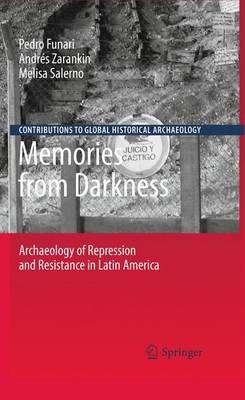
Author: Pedro Funari ,
Andres Zarankin ,
Melissa Salerno
Publisher: Springer-Verlag New York Inc.
Imprint: Springer-Verlag New York Inc.
Edition: 2010 ed.
Dimensions:
Width: 15.50cm
, Height: 1.10cm
, Length: 23.50cm
Weight: 0.454kg
ISBN: 9781461424604
ISBN 10: 1461424607
Pages: 191
Publication Date: 03 March 2012
Audience:
Primary & secondary/elementary & high school
,
Educational: Primary & Secondary
Format: Paperback
Publisher's Status: Active
Availability: Manufactured on demand

We will order this item for you from a manufactured on demand supplier.
Reviews
Memories from Darkness, edited by Pedro Funari, Andres Zarankin, and Melisa Salerno shows us the kind of archaeology that really matters, in a particularly important way. It contains a real mixture of papers, covering different aspects of repression and dictatorship in a number of South Amiercan countries...There are theoretical papers, scientific pieces, material culture studies and first hand accounts on Brazil, Venezuela, Mexico, Bolivia, and Argentina, all adequately illustrated and, we must be thankful given the range of exciting South American scholarship presented here, with individual bibliographies for each paper. This book is about freedom of speech. None of the papers end with something as restrictive as a 'Conclusion'; rather those that choose end with 'Final Remarks'--a reminder of the importance of individuality and subjectivity when archaeology chooses to discuss matters of life and death. Most of the book verges on shocking, but only in that minute scales to which the archaeologists here go in discussing the conditions and effects of repression are not commonly reported at the distance from which I write. Occasionally the contents of the book are downright hard...Memories from Darkness also has useful opinion pieces at its start (Laurent Oliver) and end (Martin Hall) that, rather than disrupting the distinctly South American collection of papers, serve to set them in useful wider contexts. Overall, this is an important publication. Its style feels quite 'raw', but this fits the subject matter and ethos of the book well. Required reading for contemporary and conflict archaeologists, it will also be of particular use to those among the wider world of post-medieval archaeology who are unsure as to the importance of studying the recent past and the present. James Dixon Post Medieval Archaeology 46/2, (2012)
Memories from Darkness, edited by Pedro Funari, Andres Zarankin, and Melisa Salerno shows us the kind of archaeology that really matters, in a particularly important way. It contains a real mixture of papers, covering different aspects of repression and dictatorship in a number of South Amiercan countries...There are theoretical papers, scientific pieces, material culture studies and first hand accounts on Brazil, Venezuela, Mexico, Bolivia, and Argentina, all adequately illustrated and, we must be thankful given the range of exciting South American scholarship presented here, with individual bibliographies for each paper. This book is about freedom of speech. None of the papers end with something as restrictive as a 'Conclusion'; rather those that choose end with 'Final Remarks'--a reminder of the importance of individuality and subjectivity when archaeology chooses to discuss matters of life and death. Most of the book verges on shocking, but only in that minute scales to which the archaeologists here go in discussing the conditions and effects of repression are not commonly reported at the distance from which I write. Occasionally the contents of the book are downright hard...Memories from Darkness also has useful opinion pieces at its start (Laurent Oliver) and end (Martin Hall) that, rather than disrupting the distinctly South American collection of papers, serve to set them in useful wider contexts. Overall, this is an important publication. Its style feels quite 'raw', but this fits the subject matter and ethos of the book well. Required reading for contemporary and conflict archaeologists, it will also be of particular use to those among the wider world of post-medieval archaeology who are unsure as to the importance of studying the recent past and the present. James Dixon Post Medieval Archaeology 46/2, (2012)
Memories from Darkness, edited by Pedro Funari, Andres Zarankin, and Melisa Salerno shows us the kind of archaeology that really matters, in a particularly important way. It contains a real mixture of papers, covering different aspects of repression and dictatorship in a number of South Amiercan countries...There are theoretical papers, scientific pieces, material culture studies and first hand accounts on Brazil, Venezuela, Mexico, Bolivia, and Argentina, all adequately illustrated and, we must be thankful given the range of exciting South American scholarship presented here, with individual bibliographies for each paper. This book is about freedom of speech. None of the papers end with something as restrictive as a 'Conclusion'; rather those that choose end with 'Final Remarks'--a reminder of the importance of individuality and subjectivity when archaeology chooses to discuss matters of life and death. Most of the book verges on shocking, but only in that minute scales to which the archaeologists here go in discussing the conditions and effects of repression are not commonly reported at the distance from which I write. Occasionally the contents of the book are downright hard...Memories from Darkness also has useful opinion pieces at its start (Laurent Oliver) and end (Martin Hall) that, rather than disrupting the distinctly South American collection of papers, serve to set them in useful wider contexts. Overall, this is an important publication. Its style feels quite 'raw', but this fits the subject matter and ethos of the book well. Required reading for contemporary and conflict archaeologists, it will also be of particular use to those among the wider world of post-medieval archaeology who are unsure as to the importance of studying the recent past and the present.James DixonPost Medieval Archaeology46/2, (2012)