Overview
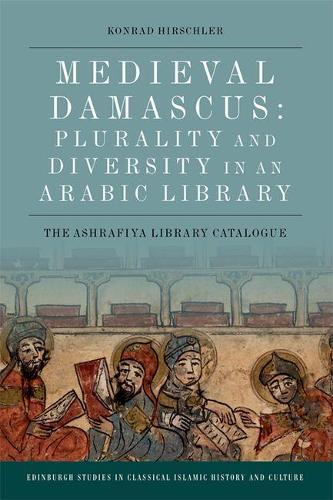
The written text was a pervasive feature of cultural practices in the medieval Middle East. At the heart of book circulation stood libraries that experienced a rapid expansion from the twelfth century onwards. While the existence of these libraries is well known our knowledge of their content and structure has been very limited as hardly any medieval Arabic catalogues have been preserved. This book discusses the largest and earliest medieval library of the Middle East for which we have documentation the Ashrafiya library in the very centre of Damascus and edits its catalogue. This catalogue shows that even book collections attached to Sunni religious institutions could hold rather unexpected titles, such as stories from the 1001 Nights, manuals for traders, medical handbooks, Shiite prayers, love poetry and texts extolling wine consumption. At the same time this library catalogue decisively expands our knowledge of how the books were spatially organised on the bookshelves of such a large medieval library. With over 2,000 entries this catalogue is essential reading for anybody interested in the cultural and intellectual history of Arabic societies. Setting the Ashrafiya catalogue into a comparative perspective with contemporaneous libraries on the British Isles this book opens new perspectives for the study of medieval libraries.
Full Product Details
Author: Konrad Hirschler (Professor of Middle Eastern History, Freie Universität Berlin)
Publisher: Edinburgh University Press
Imprint: Edinburgh University Press
Weight: 0.906kg
ISBN: 9781474426398
ISBN 10: 1474426395
Pages: 512
Publication Date: 01 August 2017
Audience:
College/higher education
,
Postgraduate, Research & Scholarly
Format: Paperback
Publisher's Status: Active
Availability: Temporarily unavailable

The supplier advises that this item is temporarily unavailable. It will be ordered for you and placed on backorder. Once it does come back in stock, we will ship it out to you.
Reviews
Hirschler's analysis of the catalogue is painstaking and impressively thorough. It offers significant new understandings of many facets of book culture and libraries as institutions in medieval Damascus. Yet, this is not all Hirschler offers. He also includes an edition of the catalogue text and a meticulously annotated translation. Hirschler's work is a significant and, we anticipate, a long-lasting contribution to the field. -- MEM Best Book Prize Committee The way historiographical considerations are framed as well as the monographic and editorial contribution, both in print and digital format, are an eloquent illustration of Konrad Hirschler's talent. -- Renaud Soler, Universite Paris-Sorbonne, Arabica So far no work with this profile and of this quality has been undertaken on libraries in the Islamic lands. This volume is a must for those interested in any aspect of book culture. -- Berat Acil, Istanbul Sehir University, Divan - Journal of Interdisciplinary Studies Konrad Hirschler's Medieval Damascus offers a unique insight... Scholars of Middle Eastern literacy and literature will be trawling Medieval Damascus for some time to come. And from a wider perspective, because Damascus's old libraries were thoroughly dispersed and destroyed, this book at last allows us to see what kind of people called medieval Damascus their home. -- Peter Webb, Times Literary Supplement This is a tour de force of ferocious codex dissection, relentless bibliographical probing, and imaginative reconstructive storytelling. The trajectory of an urban public library whose holdings shed light on the intellectual milieu of thirteenth-century Damascus comes to light through Hirschler's sensible and comparative lens. Our knowledge of medieval Arabic book culture, library culture and reading culture is significantly enriched. -- Li Guo, University of Notre Dame Konrad Hirschler's Medieval Damascus offers a unique insight...Scholars of Middle Eastern literacy and literature will be trawling Medieval Damascus for some time to come. And from a wider perspective, because Damascus's old libraries were thoroughly dispersed and destroyed, this book at last allows us to see what kind of people called medieval Damascus their home. -- Peter Webb, Times Literary Supplement Provides a unique insight into the pre-print world of books in the Middle East. -- Stephan Conermann, Sehepunkte 16/7-8
This is a tour de force of ferocious codex dissection, relentless bibliographical probing, and imaginative reconstructive storytelling. The trajectory of an urban public library whose holdings shed light on the intellectual milieu of thirteenth-century Damascus comes to light through Hirschler's sensible and comparative lens. Our knowledge of medieval Arabic book culture, library culture and reading culture is significantly enriched. -- Li Guo, University of Notre Dame Konrad Hirschler's Medieval Damascus offers a unique insight...Scholars of Middle Eastern literacy and literature will be trawling Medieval Damascus for some time to come. And from a wider perspective, because Damascus's old libraries were thoroughly dispersed and destroyed, this book at last allows us to see what kind of people called medieval Damascus their home. -- Peter Webb, Times Literary Supplement Provides a unique insight into the pre-print world of books in the Middle East. -- Stephan Conermann, Sehepunkte 16/7-8 Hirschler's analysis of the catalogue is painstaking and impressively thorough. It offers significant new understandings of many facets of book culture and libraries as institutions in medieval Damascus. Yet, this is not all Hirschler offers. He also includes an edition of the catalogue text and a meticulously annotated translation. Hirschler's work is a significant and, we anticipate, a long-lasting contribution to the field. -- MEM Best Book Prize Committee The way historiographical considerations are framed as well as the monographic and editorial contribution, both in print and digital format, are an eloquent illustration of Konrad Hirschler's talent. -- Renaud Soler, Universite Paris-Sorbonne, Arabica So far no work with this profile and of this quality has been undertaken on libraries in the Islamic lands. This volume is a must for those interested in any aspect of book culture. -- Berat Acil, Istanbul Sehir University, Divan - Journal of Interdisciplinary Studies Konrad Hirschler's Medieval Damascus offers a unique insight... Scholars of Middle Eastern literacy and literature will be trawling Medieval Damascus for some time to come. And from a wider perspective, because Damascus's old libraries were thoroughly dispersed and destroyed, this book at last allows us to see what kind of people called medieval Damascus their home. -- Peter Webb, Times Literary Supplement
This is a tour de force of ferocious codex dissection, relentless bibliographical probing, and imaginative reconstructive storytelling. The trajectory of an urban public library whose holdings shed light on the intellectual milieu of thirteenth-century Damascus comes to light through Hirschler's sensible and comparative lens. Our knowledge of medieval Arabic book culture, library culture and reading culture is significantly enriched. -- Li Guo, University of Notre Dame Konrad Hirschler's Medieval Damascus offers a unique insight...Scholars of Middle Eastern literacy and literature will be trawling Medieval Damascus for some time to come. And from a wider perspective, because Damascus's old libraries were thoroughly dispersed and destroyed, this book at last allows us to see what kind of people called medieval Damascus their home. -- Peter Webb, Times Literary Supplement Provides a unique insight into the pre-print world of books in the Middle East. -- Stephan Conermann, Sehepunkte 16/7-8
Author Information
Konrad Hirschler is Professor of Middle Eastern History at Universität Hamburg (Centre for the Study of Manuscript Cultures) and previously held professorships of Middle Eastern History at SOAS (University of London) and Freie Universität Berlin. He is amongst others author of award-winning books such as A Monument to Medieval Syrian Book Culture – The Library of Ibn ʿAbd al-Hādī (EUP, 2020), Medieval Damascus: Plurality and Diversity in an Arabic Library (EUP, 2016), The Written Word in the Medieval Arabic Lands: A Social and Cultural History of Reading Practices (EUP, 2012) and Medieval Arabic Historiography: Authors as Actors (Routledge, 2006).